



Melissa Andrews-Wurramarrba has become the first individual from her isolated Northern Territory community to obtain a university degree in more than three decades.
Her dream of becoming a teacher led her to Adelaide for university after completing Year 12, and it was with their assistance that she achieved her goal.
The challenges of adapting to a new environment proved difficult however, prompting her to return home after a year.
"A lot of people, they go to university with their friends from high school and their family sticks around in the town," Ms Andrews-Wurramarrba said, via ABC.
"But me, straight from bush to the city — it wasn't for me at that time."
In 2017, Ms Andrews-Wurramarrba received an unexpected visit from Dr. Daniels and Associate Professor Emilie Ens of Macquarie University, inviting her to join a program they had initiated.
This program eventually evolved into Australia's inaugural "bush uni". Consequently, Ms Andrews-Wurramarrba embarked on her teaching journey, participating in a trial run of the Wuyagiba Study hub located in a remote homeland.
This particular homeland was situated two hours away, accessible via a sandy track that meandered through the picturesque bushland surrounding Ngukurr.
"(Dr Daniels) knew (me) from the beginning when I started talking about becoming a teacher," Ms Andrews-Wurramarrba said.
"She spoke to me one time and said 'I already see you as a teacher.
"I was up there in the classroom teaching grammar to these students and I was thinking: this is me, this is what I am good at, and what I want to do in the future."
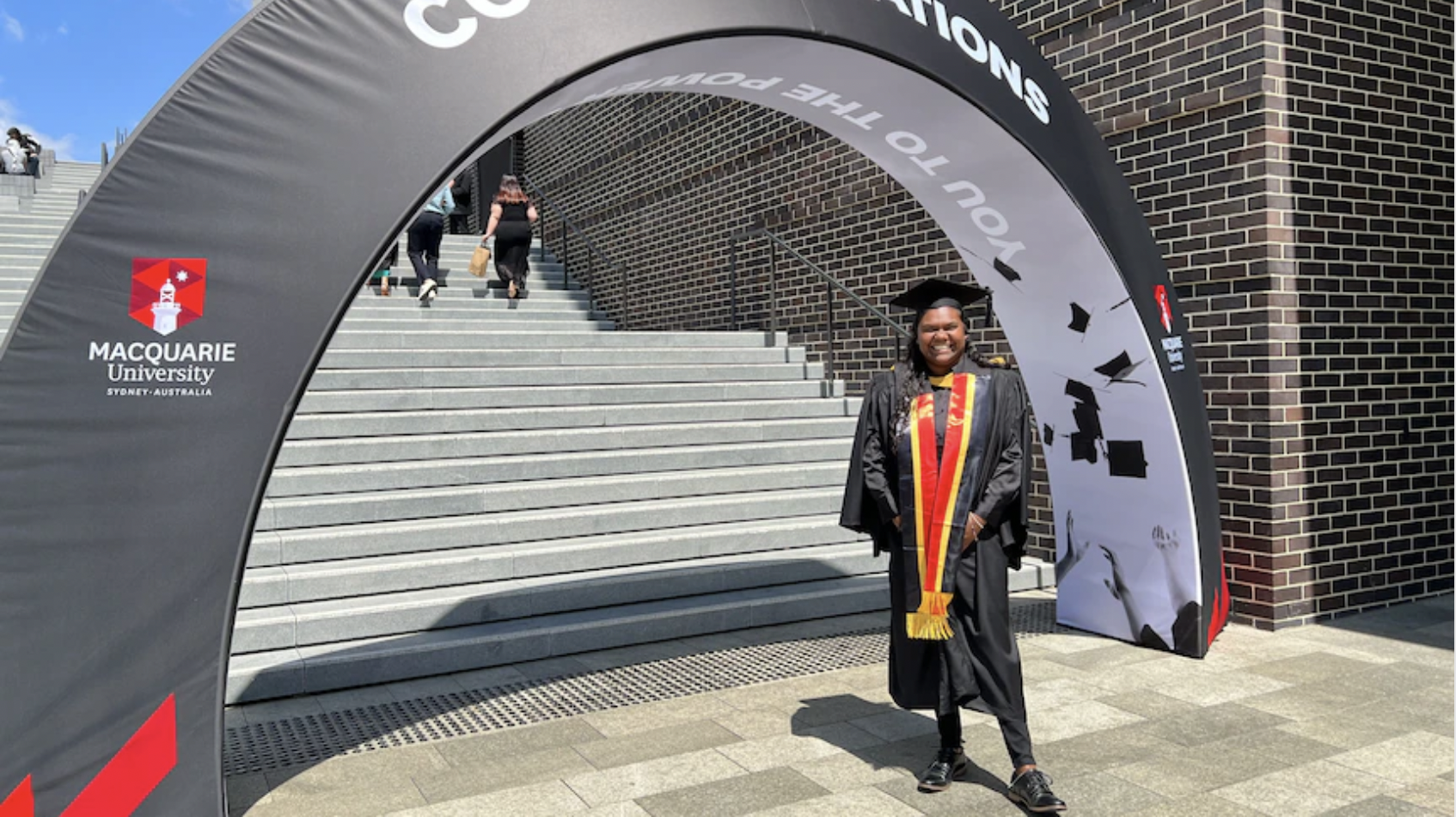
Ms Andrews-Wurramarrba attributes her decision to return to university and successfully graduate to the invaluable experience and support she received from Wuyagiba.
Completing her final unit from the hub enabled her to remain in close proximity to her home, which was a significant factor in her journey.
She acknowledges that pursuing higher education as an Aboriginal individual, particularly from a remote region, presents numerous challenges that may appear insurmountable.
This is further compounded by the fact that English is not the primary language spoken in many remote communities.
"There'll be a language barrier, especially the academic language," Ms Andrews-Wurramarrba said.
"And the environment — they're from the bush … catching a train … walking to the class, that's going to be a challenging part."
Ms Andrews-Wurramarrba's aspiration remains to teach in a classroom and pursue a master's degree in education.
In the meantime, she finds herself in Ngukurr, actively addressing the root causes of low school attendance through her involvement in a program administered by the Yugul Mangi Development Aboriginal Corporation.
"One day, Ngukurr school's going to have 95 percent attendance. That's my dream," Ms Andrews-Wurramarrba said.
"Education is the key. And now that I've graduated from university, as a graduate from Ngukurr and an Aboriginal person, I am a key for them."
Prior to Andrews-Wurramarrba, community members Kevin Rogers and the late Dr Daniels, whose first name remains undisclosed due to cultural sensitivities, were the trailblazers from the 1,000-person community of Ngukurr.



