


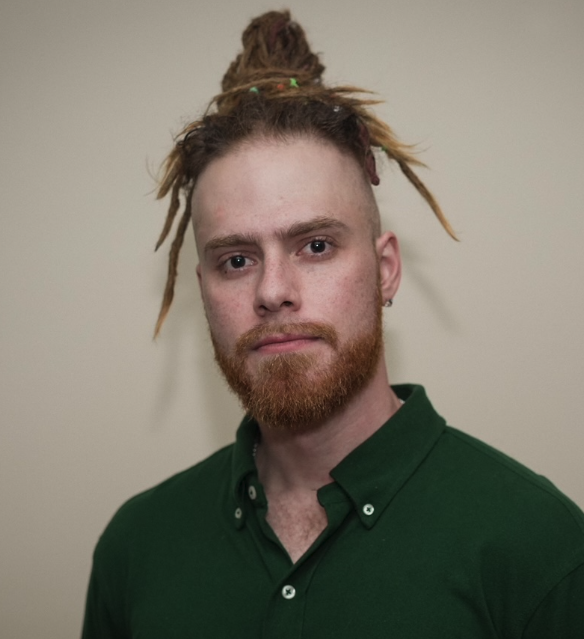

First Nations Diné and Acoma Pueblo speech pathologist and researcher, Joshuaa Allison-Burbank, is leading a study which aims to support children experiencing speech delays by working within their native languages.
Mr Allison-Burbank noticed high rates of preventable developmental delay while working as the only speech pathologist in the Indian Health Service area of Shiprock, New Mexico, across parts of New Mexico, Arizona and Utah.
The problem sits alongside the impacts of colonialism, boarding schools and broken treaty promises, he said, with Mr Allison-Burbank wanting to understand why many children were not meeting expected early language milestones.
He now works with the Johns Hopkins Center for Indigenous Health on a four-year study called 'Language is Medicine', funded by a $3.1 million grant from the National Institutes of Health.
The study aims to reach families in very rural parts of the Navajo Nation by using evidence-based early language strategies delivered through tribal home visiting programs.
Mr Allison-Burbank said the work focuses on the whole child across developmental areas, including communication, motor skills, problem-solving and social-emotional development, adding developmental delays can be identified early, and early intervention can reduce impacts that carry into schooling and adulthood.
He said 'Language is Medicine' trains tribal home visitors who already work in community, speak the language, and have relationships with families, to deliver early language support.
Mr Allison-Burbank said the work is built around a coaching model adapted for Navajo families.
"We use a coaching model called Teach-Model-Coach," he said, Native News Online reports.
"We teach them, we model it to them, and then we coach them through that learning experience.
"We further tailor it - since this is focused on Navajo families, we indigenized that whole concept by turning it from Teach-Model-Coach to Teach-Model-K'é."
His pilot study in the northern agency of the Navajo Nation found children's language development improved after home visitors delivered the program with coaching and cultural tailoring.
The new grant will support a larger trial in the eastern Navajo Nation, including communities with limited services.
Mr Allison-Burbank said his research started with a single question from his clinical work.
"Why are so many Native children not talking at these time points when we expect them to be talking?" he said.
Mr Allison-Burbank said he sees language as central to connection, identity and how children learn through relationships.
"Language allows for connection... it allows for attachment to your child... it allows for identity," he said.
"That's one of the first things we do as Native people - we introduce ourselves."
Mr Allison-Burbank said he wants the study to show the intervention can work at a larger scale, and be adapted for other Indigenous languages and communities.
"My hope is that the intervention is proven to work across a larger sample size," he said.
"That's the next goal: Can we take this to scale?
"Can we replicate this elsewhere in another Indigenous language?"
The four-year trial is now rolling out in very remote parts of the Navajo Nation, using tribal home visitors to deliver early language support in families' day-to-day settings.
The study will test whether the approach works at scale and can be adapted for other Native languages and communities.
Original reporting by Native News Online.



