




Artistry on the canvas has always been the path towards Paul Fleming's Olympic destiny.
Even among the 4,554 remarkable Australians - including 66 Indigenous athletes - to compete across the 54 Summer and Winter Olympic Games, the résumé of the talented Warrgamaygan, Birri Gubba and Djindubari man stands out.
It all started by chance though.
In 2000, as a 12-year-old, Fleming proudly carried the Olympic torch through his North Queensland hometown of Tully ahead of that year's Sydney Games.
Just eight years later, he was a featherweight in the boxing ring at the Beijing 2008 Olympics.
By the time Fleming turned 32, he was pulling no punches in the Olympic arena - swapping his gloves for a paint brush.
He discovered a new way of expressing passion for his culture, taking up traditional Indigenous art practices in 2018, encouraging the next generation of Aboriginal and Torres Strait Islander people to stay close to their roots and take pride in their identity.
Fleming's Walking Together design - the title of his Aboriginal art works on Australia's Olympic outfits, inspired by the Walking Together for Reconciliation march that took place on May 28, 2000, across the Sydney Harbour Bridge - has since wowed worldwide audiences.
The 2026 Milano-Cortina Winter Olympics is his fourth Olympic artistic campaign following the 2020 Tokyo Summer Games, 2022 Beijing Winter Games and 2024 Paris Summer Games.
The Australian Olympic Committee, the AOC, has continued to reuse and "redevelop" Fleming's prints.
The centrepiece represents a meeting place where the Olympics brings together competitors from all over the world, competing for the same goal and essentially becoming "one" people.
"I think it is still relevant, no matter what," Fleming told National Indigenous Times.
"The design of Walking Together is a story of coming from different backgrounds, different races and religions, different sexual orientations, whatever it is, and the journey to the biggest sporting event there is."
The artwork is fluid across each of the Olympic Games but has been "incorporated in a different way" every time.
There is one aspect that remains the same and, for Fleming, that is an important footnote.
"The main thing the AOC uses is the feet design with the little dots," he said.
"I did a series of them, and that's all part of the painting. That's my main feature where they are in the meeting circle.
"The use that trail of feet is important because they're walking in a journey. They like to run that along a lot of the designs."
Fleming is a student of his own place in Aboriginal history as much as he is of art and of boxing.
The 38-year-old, who currently resides in Penrith, is the first Aboriginal person to create his people's traditional art in the Olympic space.
David Bosun, a proud Torres Strait Islander is the second Indigenous artist, and has an ongoing artistic role in creating cultural designs.
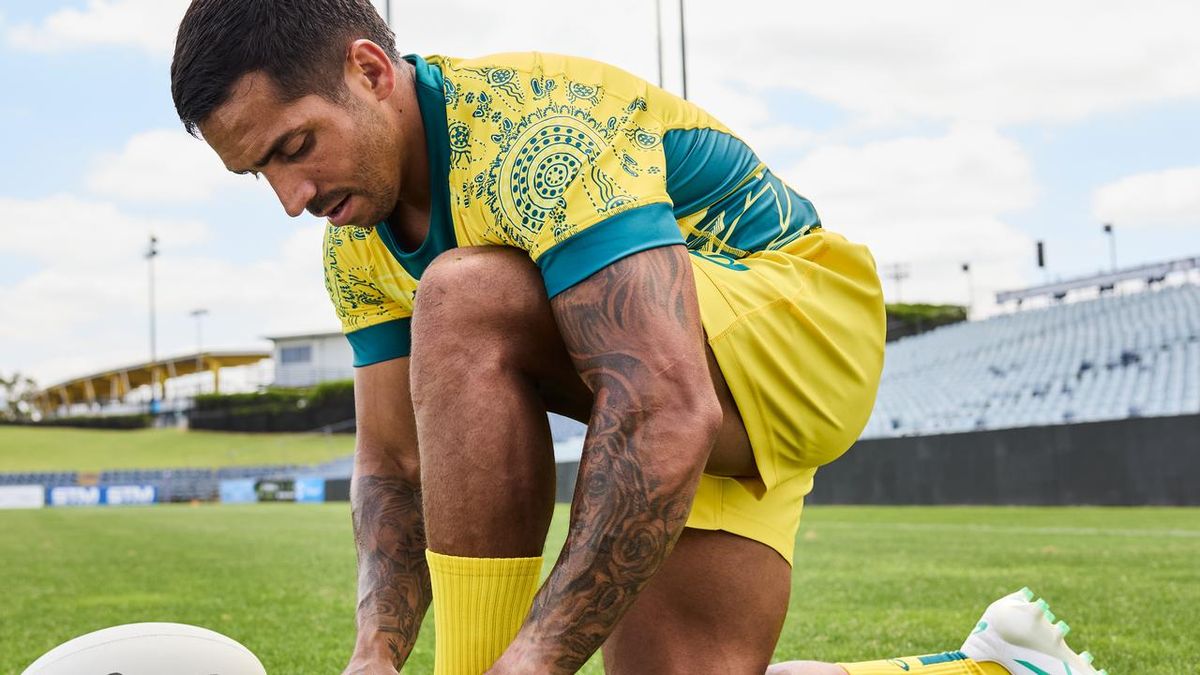
"You can only be the first one once, so that's pretty cool," Fleming said.
"It was the first time in history that it has been done. To think I am part of (Olympic) history in that way and that people will look back at that when I am dust, when I am dead and gone, brings my family and my kids a lot of pride.
"But just the unity of Indigenous culture, you can only find it here. Other countries have their own flavours and version of their culture, but we have the only oldest continuous culture on the planet.
"To represent that and have that represented on the biggest sporting stage of the planet is just so humbling. The way I look at it is that is bigger than me - it's bigger than how I feel about it, too."
While Fleming likes to look at the bigger picture of the artwork, there is also a personal side that brings him joy.
"For my mum to be able to see this is fantastic," he said.
"My dad is not Indigenous, my mum is. For her, she grew up pre-referendum (1967) - she grew up when she was 11 and it passed.
"She was born in '56 and she remembers growing up when things were a lot, lot different. For her to see this change, to see how far we've come - and we still have a long way to go - but to see her son be a part of that, it is where I get my biggest pride from it."
While Fleming did not capture a medal in Beijing, he did go on to have an illustrious professional boxing career.
He went undefeated in his first 26 fights, including the Continental Americas super featherweight title victory, until a draw prevented the southpaw fighter from winning the IBF International as well as the interim WBA Oceania super featherweight titles following a two-year layoff.
Fleming, who lost just once in 30 bouts by the time of retirement, appears to take being a custodian of his culture in his stride, carrying on the legacy of his ancestors.
"I think there is a lot of people that have carried the culture in their own way," he said.
"This is just one of my ways that I have been able to give back.
"It's not of anything of just my own - you must have some sort of divine intervention. The stars have to align, or some things have to come into play."



