




Newly appointed Minister for Indigenous Australians, Malarndirri McCarthy, has said she will take a bi-partisan political approach in the wake of the latest Productivity Commission report, which shows the number of First Nations people incarcerated, dying by suicide and children placed into out-of-home (OOHC) care all increasing.
Describing some of the data as "deeply troubling," Minister McCarthy said she was determined to work with Indigenous Australians, the Coalition of Peaks, and all governments across the country to "bring about positive change".
"I will be reaching out to my colleagues across the parliament to seek a bipartisan approach to Indigenous affairs," she said.
Only five of 19 targets monitored by the Commission in its annual report are deemed to be on track: healthy birthweight for Indigenous babies; children enrolled in preschool; Indigenous employment; and land mass and sea waters covered under Indigenous legal rights and interests.
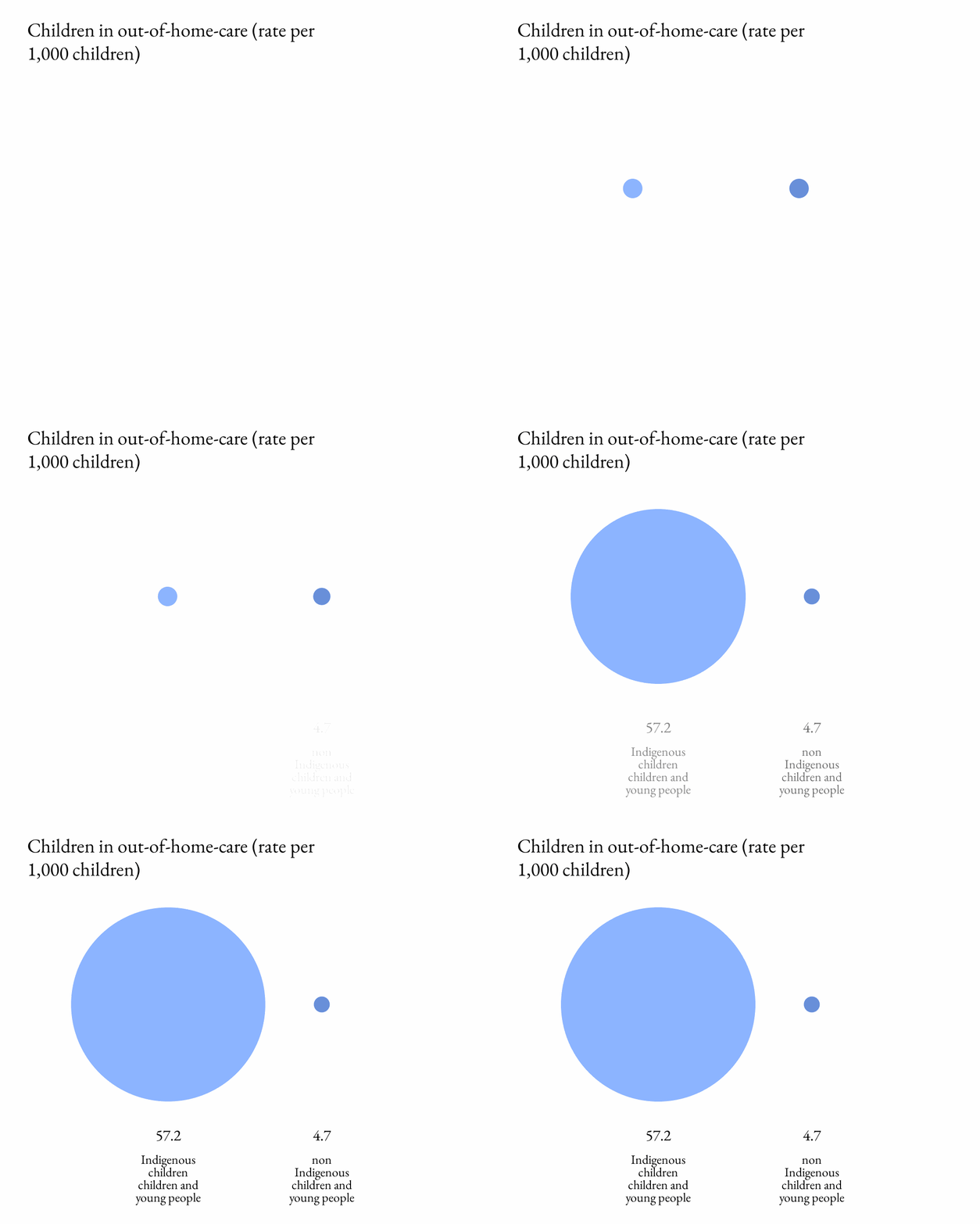
Early childhood development, Indigenous adults held in incarceration, Indigenous children in OOHC and Indigenous suicide rates were all revealed to not be on track.
Whilst there were improvements in life expectancy rates - with Indigenous women born between 2020-22 now expected to live for 75.6 years, and men expected to live for 71.9 years - it still leaves Aboriginal and Torres Strait Islander people significantly behind non-Indigenous life expectancies and unlikely to meet the 2031 target set by the government.
Speaking on ABC Radio, Minister McCarthy said she was conscious that the Closing the Gap numbers needed to be kept at the forefront of everyone's mind in politics.
"I'd hate to think that the Closing the Gap target was ever removed…because this is about keeping it in front of every politician here, not just the Minister for Indigenous Australians," she said.
"I mean that collectively, in terms of keeping it in front of politicians, because once you remove it from debate and from the public eye, it doesn't get as dealt with as it should."
Report co-author Natalie Siegel-Brown said the data in the report "should impel governments to act".
She said one of the consistent themes to improved outcomes was governments enacting Priority Reforms — a strengthened Aboriginal Community Controlled sector, shared decision making, shared data and the government changing its operation.
"The aspirations of the Agreement are not only achievable, but equity of outcomes for Aboriginal and Torres Strait Islander people is within reach if governments breathe life into the Priority Reforms," Commissioner Siegel-Brown said.
For the first time the data featured analysis of the historical and ongoing context for eight socioeconomic outcome areas, something Coalition of Peaks co-convenor Catherine Liddle argued had been a long-time coming.
"It's so important because it helps us move away from a deficit narrative focused on just data without any understanding of the context as to the why and the how behind these numbers. Without that context and understanding real change cannot happen," Ms Liddle said.
A scathing Productivity Commission report in February found, despite a new Closing the Gap agreement signed under former Prime Minister Scott Morrison, governments had been treating the targets as "business as usual".
Prime Minister Anthony Albanese said at the time: "Canberra must be willing to share power with communities; to offer responsibility and ownership and self-determination; to let local knowledge design programs; to trust locals to deliver them and to listen to locals when they tell us what's working and what isn't".
Indigenous organisations have long-argued that Indigenous-led responses - through ACCOs - are the best way to help Close the Gap.
Ms Liddle pointed to areas where the targets were being met and argued this showed that "when we control our services, we get better outcomes for our people".
"When systemic issues are dealt with, we have success and great outcomes for our people," she said.
"We know that when Aboriginal and Torres Strait Islander people are connected to their culture the Closing the Gap measures are better met."
The Arrernte/Luritja woman called for funding to be directed to Indigenous-led service providers, arguing there were "still far too many non-Indigenous operated service providers being funded" which didn't understand how communities "think and feel".
"The biggest investments into early education and care in Australia are not in the Aboriginal community-controlled sector, they're actually in the mainstream," she said.
"That is a failure by governments to invest in the right set of criteria into the right type of service delivery, and to move at the speed that it needs to move at."



