




Lower Southern Arrernte artist Jennifer Kemarre Martiniello OAM has used glass to hold family, culture and Country in her finalist work for the Wandjuk Marika Memorial 3D Award at the 2026 Telstra National Aboriginal and Torres Strait Islander Art Awards (NATSIAA).
Now in its 43rd year, Telstra NATSIAA brings together First Nations artists from across the country, with 64 works selected from 221 entries for this year's exhibition at the Museum and Art Gallery of the Northern Territory.
Ms Martiniello, who lives in Canberra, is an internationally recognised glass artist of Aboriginal, Chinese and Anglo-Celtic descent.
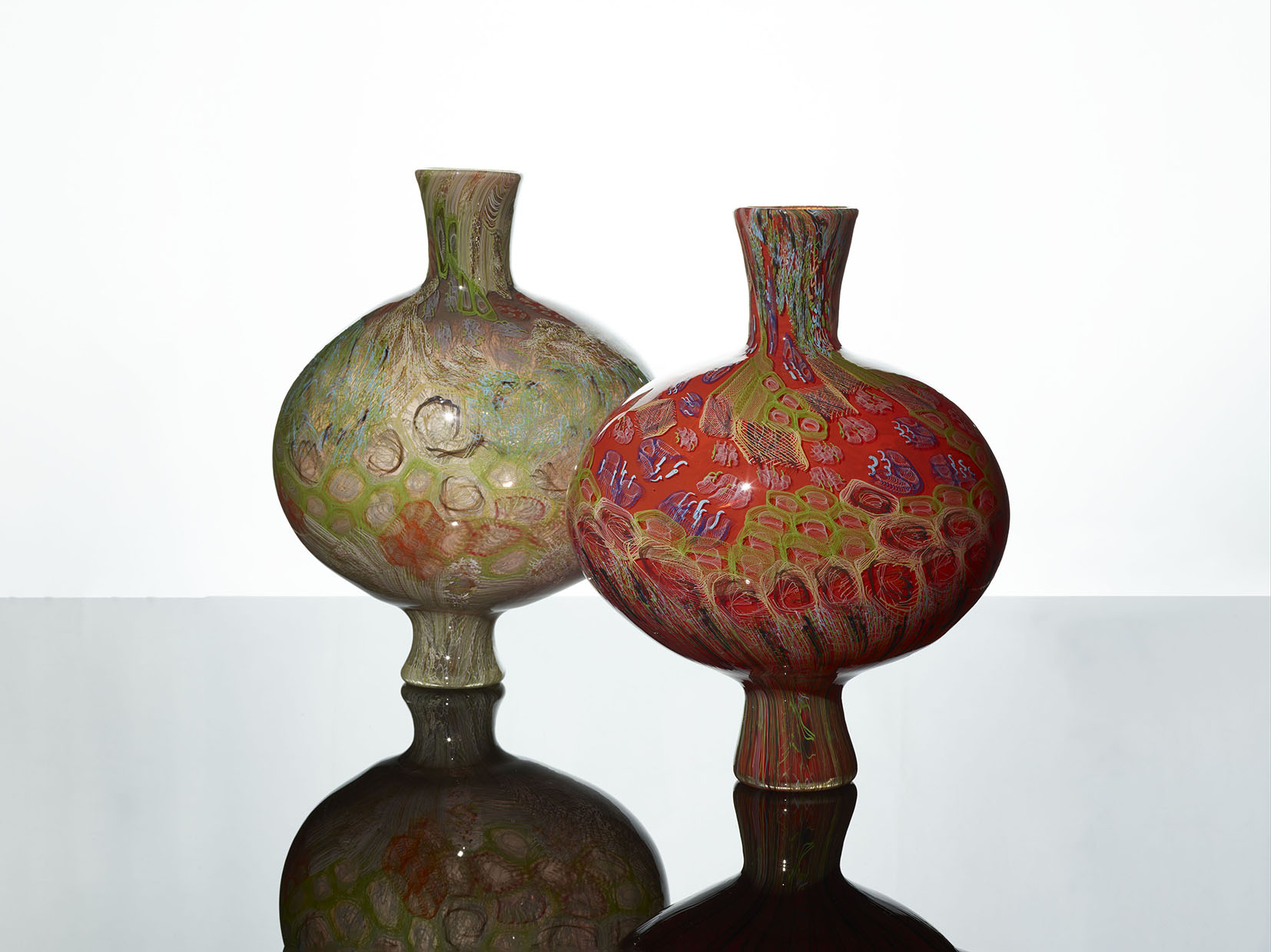
Her finalist work features two hot-blown glass vessels based on the form of a Chinese Han dynasty Hu vessel, which she said was linked to the shape of cocoons and the history of silk.
The work draws together her Lower Southern Arrernte and Chinese heritage, with the vessels connected to the Chinese gardens at Hookeys Waterhole, near Oodnadatta, where her father was born.
Ms Martiniello said being named a finalist among artists from across Australia was a privilege.
"I think it's an immense privilege to be a finalist in NATSIAA," she said.
"All the entrants from right across Australia are just extraordinary artists.
"To be in that company is extraordinary, so I'm really thrilled to be a finalist this year."
Ms Martiniello won the Telstra Award in 2013 and said she had stepped back from entering for some time after that win.
She said her work was grounded in the protection and continuation of culture.
"My first and foremost motivation is the preservation and the ongoing continuity of culture," Ms Martiniello said.
"From my Country, that's grandmother's law."
Ms Martiniello said her grandmother was a Lower Southern Arrernte woman who married a Chinese man and established market gardens at Hookeys Waterhole.
She said the place continued to hold deep meaning for her family and her work.
"It's Red Gibber Desert, but I can't really explain the feeling of being there," Ms Martiniello said.
"You feel like you've plugged into a battery to be re-energised when you go back up on Country there.
"I've always had that really strong connection."
The two vessels in this year's finalist work use the Hu form to connect silk strands, cocoons and DNA.
Ms Martiniello said the work became a way to explore inheritance, resilience and identity through glass.
"My concept when I saw these was to connect silk strands with DNA, which is also resilient," Ms Martiniello said.
"It's what shapes you and who you are and what you inherit.
"I saw them as being my heritage Hu, or my cocoons."
The vessels include colours and plant forms connected to Hookeys Waterhole, drawing on both the cultivated garden and the native flora of the area.
Ms Martiniello said the pair carried what she wanted to express about place.
"I'm quite thrilled with them because to me they say everything I wanted to say about that place in hot-blown glass," Ms Martiniello said.
She continued making work because culture, Country and family history remained a constant source.
Both of her grandmothers used to tell her that what was born in would come out.
"It's there, it needs to be expressed, and you just have to give into it," Ms Martiniello said.
"If you're following your passion, it will nourish you and feed you and energise you along the way to keep you going.
"There's always something more to say."
The 2026 Telstra NATSIAA exhibition opened at the Museum and Art Gallery of the Northern Territory on June 27.
The winners will be announced at the awards ceremony on August 7, with artists sharing in a total prize pool of $190,000, including the $100,000 Telstra Art Award.



