




Applications are now open for the 2025 First Nations Cancer Scholarships Program, a federal government-backed initiative supporting Aboriginal and Torres Strait Islander leadership and Indigenous-led strategies in cancer control.
Delivered through a partnership by Aurora Education Foundation and Cancer Australia, four scholarships will be awarded to eligible Aboriginal and Torres Strait Islander students, health professionals or early career researchers enrolled in full-time postgraduate study or research in a cancer-related field.
With the Commonwealth providing up to $120,000 per year for up to three years, in addition to tailored academic, wellbeing and community support, winners will gain a solid foundation for success.
Beyond individual support, the scholarship also helps build a strong network of First Nations researchers and practitioners who will drive systemic change in cancer control and close the gap in Indigenous health outcomes.
One previous scholarship recipient, Khwanruethai Ngampromwongs, a proud Wiradjuri, Wailwaan and Thai PhD candidate, commends the program for opening doors for First Nations people.
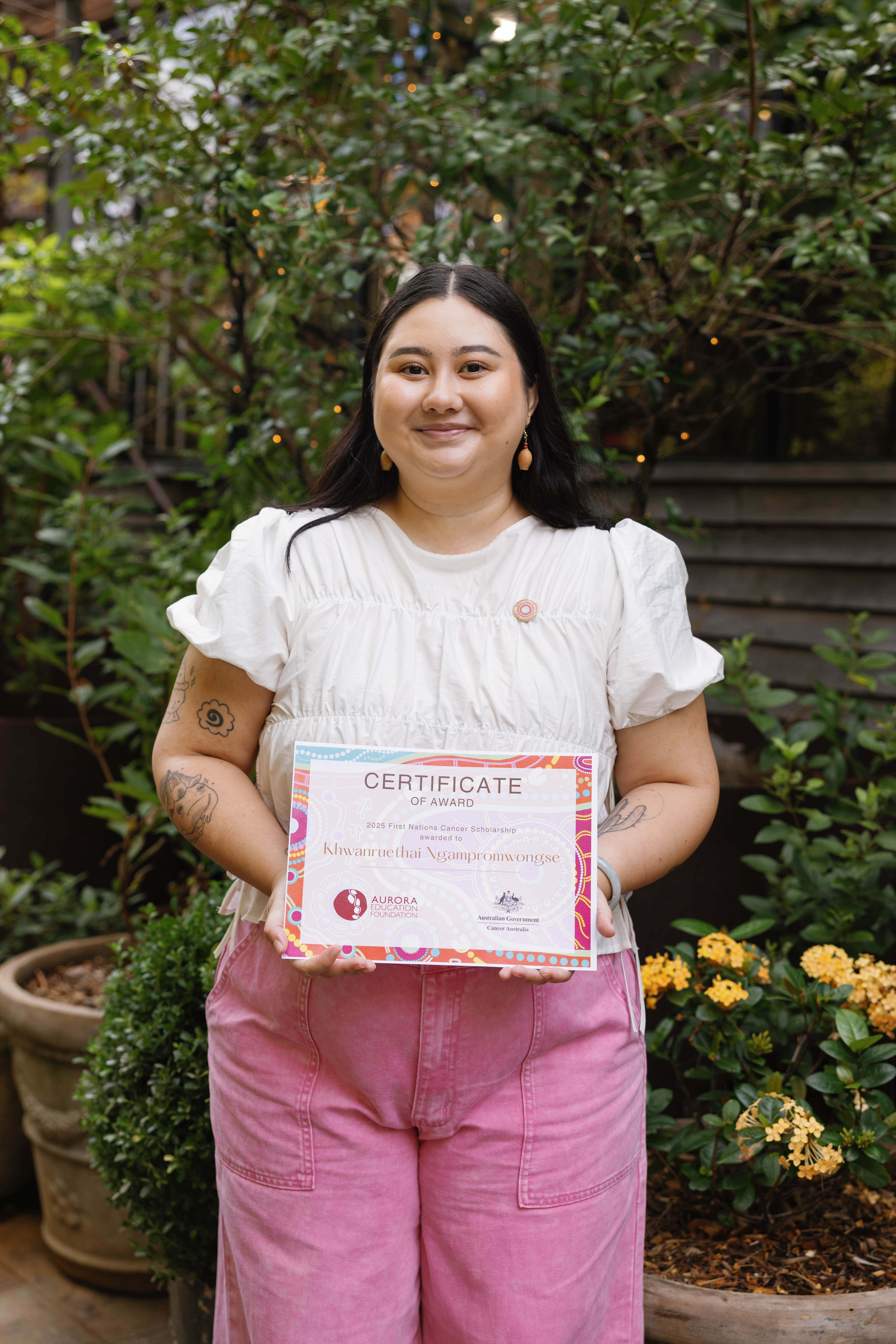
"This scholarship has honestly taken so much pressure off; it meant I can focus on my research without constantly worrying about juggling multiple jobs just to get by. It's also given me the freedom to really lean into opportunities that align with my values and community work, which has made all the difference," they said.
Now a PhD Student and Research Assistant at Yardhura Walani, the National Centre for Aboriginal and Torres Strait Islander Wellbeing Research, Khwanruethai reflected on their experience: "One of the biggest [moments] was the chance to travel to Canada recently, where I visited the Waakebiness Institute for Indigenous Health at the University of Toronto. It was such a privilege to be on Turtle Island and learn about Indigenous-led health systems, policy, and research over there.
"It gave me space to reflect on our own systems here, and how powerful it is when Indigenous people are the ones designing the care, not just receiving it."
That experience affirmed what Khwanruethai believes is at the heart of systemic change in healthcare: community-led leadership rooted in lived experience.
"Because we know what our communities need. We carry the stories, the grief, the strength, the cultural knowledge. When mob are leading this work, we're not just changing the data, we're changing the systems that have failed us for too long.
"It means moving away from a one-size-fits-all approach to care. When more of us are at the table, and especially when we're leading, it becomes about relationality, accountability, and listening properly. It creates space for healing that's culturally grounded, not just clinically informed."
For Khwanruethai, visibility and representation are just as important as research.
"Someone once recognised me from the National Cervical Screening 'Own It' campaign that I was involved in, promoting self-collection option for under-screened communities, and they told me how much it meant to see someone like them represented in that space."
"That really stuck with me. It reminded me that visibility matters, and that the work I am doing with my research can help people feel seen, safe, and valued," they said.
"Even if you feel like your path is a bit different or you haven't seen anyone like you doing this kind of work… that's exactly why your voice is needed. Our stories, our ways of knowing, our leadership are crucial in reshaping cancer care."
Khwanruethai's words reflect a core belief shared by Cancer Australia and Aurora Education Foundation: that Aboriginal and Torres Strait Islander organisations are best placed to deliver effective programs to address outcomes in their communities.
"As we work towards building a stronger, more inclusive cancer system through the implementation of the Australian Cancer Plan, initiatives like the First Nations Cancer Scholarship are crucial in empowering Indigenous voices and perspectives in cancer control efforts. Together, we can drive innovation, improve outcomes, and ultimately, save lives," said Cancer Australia CEO Professor Dorothy Keefe.
"By providing avenues for exceptional Aboriginal and Torres Strait Islander individuals to cultivate specialised skills and expertise, we aim to fortify the leadership and contributions of cancer-related professionals in advancing cancer control efforts nationwide," she continued.
As the program continues to nurture Aboriginal and Torres Strait Islander scholars in cancer control, Aurora Education Foundation CEO, Leila Smith, proudly remarked: "Our scholars are not only advancing their careers, they're shaping the future of cancer care in and for our communities. This program is helping to grow a new generation of Indigenous leaders in cancer control, and we're proud to support them."
Application for the program are available online.



