




Australia will fail to close the gap or achieve lasting justice for First Nations peoples unless governments move beyond decades of unfulfilled commitments and embed Indigenous rights into the nation's legal and political systems, a new national report warns.
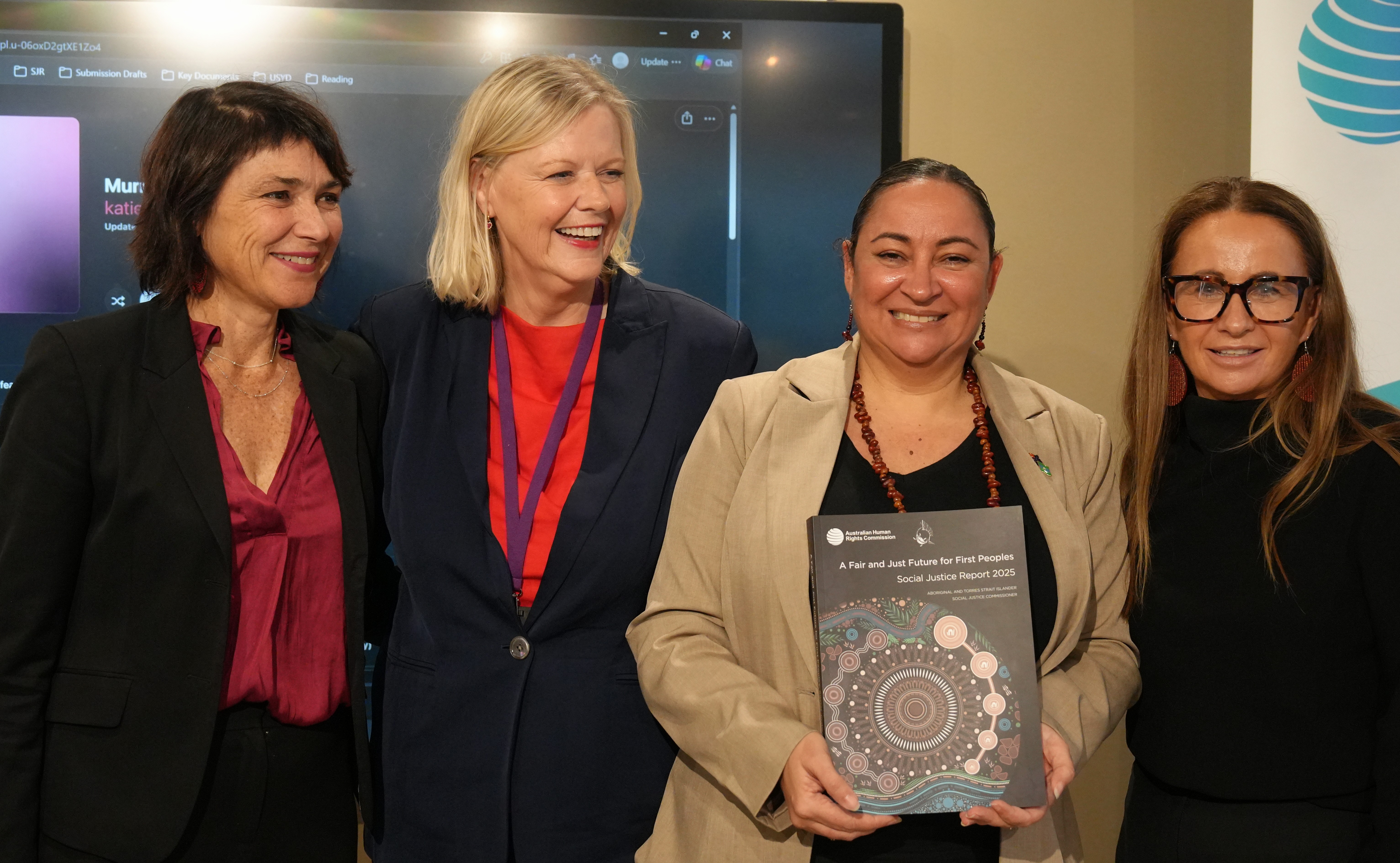
Released on Friday by Aboriginal and Torres Strait Islander Social Justice Commissioner Katie Kiss, A Fair and Just Future for First Peoples: Social Justice Report 2025 draws on the voices of more than 1,600 Aboriginal and Torres Strait Islander people from across Australia to deliver "a blueprint for structural reform".
The report found First Nations communities are already leading innovative, community-driven solutions, but notes that without comprehensive rights-affirming structures and protections, those efforts will continue to be undermined.
"Despite decades of recommendations and commitments, First Peoples continue to face systemic injustice. Our people are actively leading change, with strong cultural foundations, local knowledge, and community-led initiatives producing real, positive outcomes at the grassroots level," Commissioner Kiss said.
"If Australia is to leverage the true potential of these efforts, the counterweights of systemic racism, inadequate accountability, and long-standing government inaction on delivering human rights must be addressed.
"These are the drivers of persistent inequality across all areas of life and of the continuing disadvantage and harm experienced by Aboriginal and Torres Strait Islander people."
Why structural reform matters
Statistics outlined within the report paint a worrying picture of the structural barriers shaping outcomes for First Nations people across health, justice and social systems.
Aboriginal and Torres Strait Islander people account for around 35 per cent of Australia's prison population despite making up only three per cent of the national population. Furthermore, First Nations young people represent about 60 per cent of those in youth detention.
Aboriginal and Torres Strait Islander children remain 10 to 11 times more likely to be placed in out-of-home care than non-Indigenous children. At the same time, inequities in housing, healthcare, education and essential infrastructure continue to entrench disadvantage.
For Commissioner Kiss, these statistics are proof that First Nations rights continue to be hindered under Australia's current approach.
The report also highlights governments' repeated failure to act on previous inquiries and commitments. More than 600 Aboriginal and Torres Strait Islander people have died in custody since the 1991 Royal Commission into Aboriginal Deaths in Custody; only five of the 83 recommendations from the 'Bringing Them Home' report have been implemented, and just four to five of the 19 Closing the Gap targets are currently on track.
Commissioner Kiss said racism remains one of the greatest barriers to equality, contributing to poorer outcomes across health, justice and social systems.
"Racism causes real harm and even early deaths. Ending racism needs more than words; it requires stronger laws, honest education and culturally safe systems," she said.
"Active representation and participation in decision-making, genuine power sharing and healing, and truth telling are the only way forward."
A blueprint for change
At the centre of the report is a five-point blueprint anchored in five priorities:
-
Promoting the full enjoyment of rights
-
Strengthening government accountability
-
Increasing First Nations participation in decision-making
-
Ensuring access to justice and rebuilding strong, self-determining communities.
The report argues that while governments have spent decades responding to the symptoms of inequality, real change will only come through structural reform that empowers Aboriginal and Torres Strait Islander communities and embeds human rights into Australia's legal framework.
It also introduced 25 recommendations, including core approaches such as:
-
Introducing a national Human Rights Act
-
Implementing the United Nations Declaration on the Rights of Indigenous Peoples
-
Establishing a national representative mechanism and the Makarrata Commission
-
Raising the age of criminal responsibility to at least 14 years of age
-
Creating an independent oversight of deaths in custody
Expanding long-term funding for Aboriginal community-controlled organisations
Implementing the National Anti-Racism Framework
Reforming native title and cultural heritage laws.
While critical of governments' records, the report emphasises that First Nations-led solutions already exist and calls for sustained investment rather than short-term funding cycles.
"When communities design, govern and lead our own solutions, we thrive. Governments must move beyond rhetoric and work in genuine partnership with us," Commissioner Kiss said.
Speaking at the launch of the report, Commissioner Kiss said Australia could not continue to promote itself as a defender of human rights internationally while failing to fully protect those rights at home.
"Human rights do not dispossess people, human rights do not marginalise people, human rights do not cause poverty, and they do not cause life expectancy gaps. It is the denial of those rights that is the largest contributor to these things," she said.
"Over three-quarters of a century since the establishment of the United Nations, and over three decades on from the establishment of the Social Justice Commissioner role, our people are still denied justice in this country."
From recommendations to actions
Commissioner Kiss has formally requested that the Australian Government provide a public response to the report, outlining how it intends to implement the recommendations, including clear timelines and accountability measures.
"The 25 recommendations in A Fair and Just Future for First Peoples provide a pathway for governments to move beyond rights, ritualism, and rhetoric to act with integrity, and to ensure strength, courage, and determination of First Peoples are met with enabling rather than disabling structural reform and genuine accountability," she said on Friday.
"Governments must demonstrate meaningful action through collaborating with First Peoples, and to uphold the dignity, courage, and determination of First Peoples with structural reform, genuine accountability, and integrity," she said.
The full report is available online.



