




Three members of the First Peoples' Assembly of Victoria have penned an open letter, outlining their feelings on the Yoorrook justice commission and the work needed to build towards Treaty in Victoria.
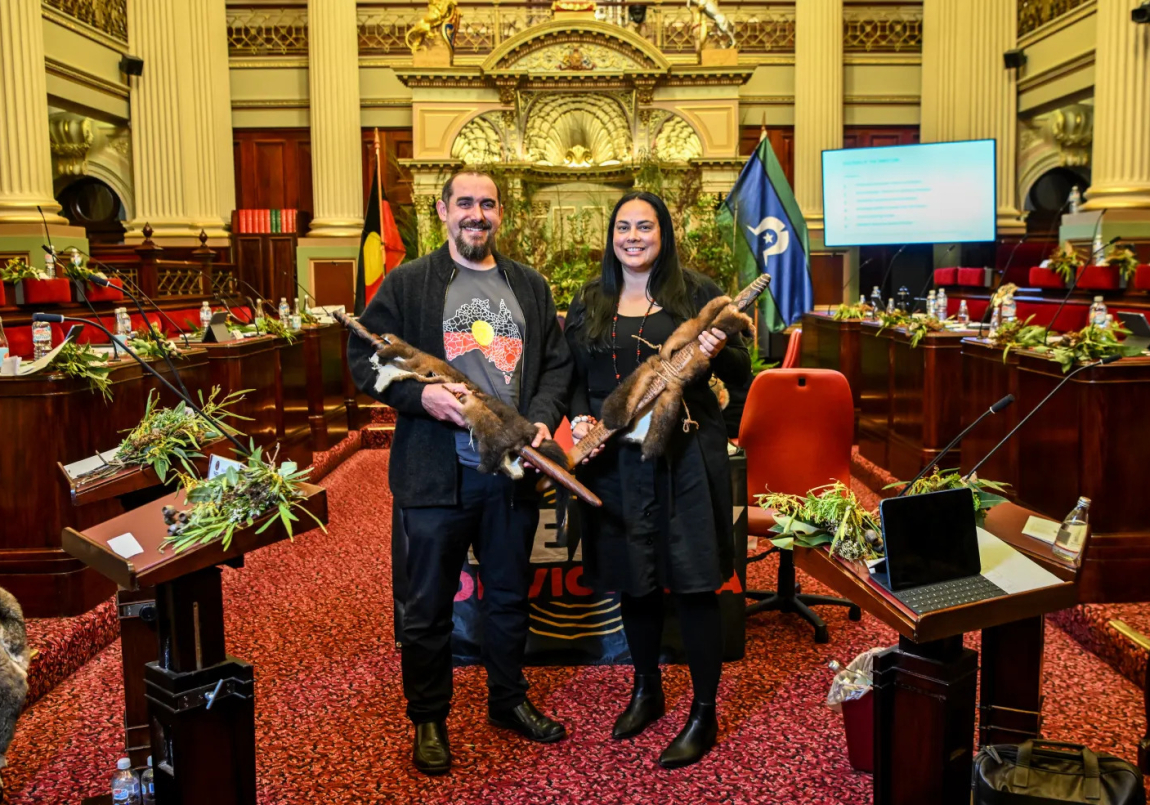
The two co-chairs of the Assembly: Wamba Wamba, Yorta Yorta, Dhudhuroa and Dja Dja Wurrung woman Ngarra Murray; and Gunditjmara man Reuben Berg; along with newly elected member and CEO of the Victorian Aboriginal Legal Service, Yorta Yorta and Narrandjeri woman Nerita Waight, wrote that the Assembly delivered on what was asked of them by communities.
"As part of our journey to Treaty in Victoria, our communities called for the establishment of a Truth-telling process which is now underway with the Yoorrook Justice Commission," they said in a letter published on the First Peoples' Assembly website.
The Yoorrook Justice Commission - the first formal truth-telling process into historical and ongoing injustices experienced by First Peoples in Victoria - was a key and practical legacy of the Assembly's first term.
It recently handed a landmark interim report to Victorian Parliament in which featured 46 recommendations, including an overhaul of the state's child protection and criminal justice systems.
The authors said that despite First Nations people being the victims of perpetual violence and injustice, they were once again called on "to do the hard work."
"Yoorrook is something we had long wanted…To share our stories. Our pain. Our grief. Our struggle but also our hopes, our aspirations, our ideas for building a better Victoria," they said.
"We rose to the challenge. Our people and our organisations have made dozens of submissions and spent many hours giving evidence to Yoorrook about the discrimination and oppression we face in the legal and child protection systems."
Over the course of the truth-telling hearings, witnesses recounted evidence of systemic racism, police malpractice and human rights violations against Indigenous Victorians.
Wergaia and Wamba Wamba Elder and Chair of the Yoorrook Justice Commission, Professor Eleanor Bourke AM, said: "Seven formal apologies were made by representatives of government for the past and ongoing harm caused to Aboriginal people at the hands of the state.These apologies were important. They are now on the public record. But the real test will be the actions, the actions required will lead to transformational change."
One of the key recommendations of the Yoorrook report was the long-term impact and consequences that a child protection system in Victoria had on First Nations people. It stated:
"In effect, this means an Aboriginal child in our community can be in a pipeline to the justice system before being born…It is hard to imagine a scenario that more profoundly demonstrates systemic failure."
Wurundjeri and Ngurai Illum Wurrung woman and Yoorrook Commissioner Sue-Anne Hunter said at the release of the report: "The present-day failures of Victoria's child protection and criminal justice systems for First Peoples are still deeply rooted in the colonial foundations of the State."
The report itself recommended the state transfer the decision-making power, as well as authority and control of resources, over to First Nations people, giving "full effect to self-determination in the Victorian child protection system."
"The overarching call is that decision-making power, authority, control and resources of the criminal legal and child protection system as it related to First Peoples, must be transferred to First Peoples," the three Assembly members said.
Ms Murray, Ms Waight and Mr Berg highlighted the stories of Indigenous people in Victoria who suffered whilst in the care of a system that denigrated and traumatised people at the behest of welfare.
"This lack of care or affection is startling, but it has been a hallmark of our communities' experience of the welfare system for generations," they said.
"Many of the truths told at Yoorrook speak of the relentless ways our people are pushed around and kicked down, silenced and disappeared. But our communities resist the silence and do the hard work to make their voices heard, and their rights to be recognised."
Outlined during the hearings was the story of Yorta Yorta man Uncle Ross, who was separated from his mother at age three and raised by family members, due to his mother being the victim of a "violent relationship with a racist man."
At age seven he lost the aunty and uncle who were caring for him on the same day.
"There was a lot of trauma from that separation, and underlying trauma like this pushes our mob down the wrong path," he said.
"It was just loss, after loss, after loss."
Uncle Ross recounted stories of racist teachers and violence at the hands of police.
"When I was in a police station in Shepparton in about my mid-twenties, I was beaten up by eight police officers who stood around me punching me from one side to another," he told the hearings.
"For me, the brutality wasn't as bad in prisons as it was in police stations. The worst violence came from being chucked in the back of a divvy van or police cell."
This trauma led Uncle Ross to use drugs and alcohol to cope. 25 years ago, he began working at the Aboriginal health service cleaning the floors, before becoming a drug and alcohol counsellor to help other Aboriginal people in the community.
The Assembly members note that the whilst Uncle Ross had a unique story, his resilience and spirit in the face of trauma and hardships were familiar to many First Nations people.
During the hearing, VALS said they'd spoken to a child who'd been through over a dozen care facilities, with noticeable indications of serious mental health and disability issues of which they were not receiving consistent healthcare for.
Instead of helping the child, the residential care would regularly invoke harm by calling the police for actions such as throwing things around.
"The 'care facility' did this knowing that police would choose harm too," the members said.
The authors stated that since colonisation, it has been First Nations people building their own pathways.
"For the last 235 years, our people have faced massacres, slavery and oppression. Yet we have done the hard work to survive and rebuild," they said.
"Our own hard work has brought us a long way."
The letter was published in the same week opposition spokesperson for Indigenous Australians, Jacinta Nampijinpa Price, told reporters that there were no negative consequences for First Nations people as a result of colonisation.
"I'll be honest with you, no, I don't think so. Positive impact? Absolutely," Senator Price said.
"Aboriginal Australians, many of us have the same opportunities as all other Australians in this country... There's no ongoing negative impacts of colonisation."
A submission by the Victorian state government to the Yoorrook commission stated:
The Government acknowledges the profound impact of colonisation and apologises for the role governments have played. The Government acknowledges the wide-spread theft of land, dispossession of culture, removal of children, enforced poverty, dehumanisation, criminalisation and institutionalisation that colonisation entailed. The Government acknowledges that colonisation was premised on erroneous beliefs of racial superiority - and First Peoples' inferiority - and that these racist beliefs, and the systems, laws and institutions that were built upon them, persist today."
The three Assembly members, in recounting the experiences told at Yoorrook, paint a picture of abuse, neglect and racism - all statements shared by the commissioners of the report.
"This lack of care or affection is startling, but it has been a hallmark of our communities' experience of the welfare system for generations," they said.
"Many of the truths told at Yoorrook speak of the relentless ways our people are pushed around and kicked down, silenced and disappeared. But our communities resist the silence and do the hard work to make their voices heard, and their rights to be recognised."
They urged the Victorian government - who so far have been hesitant to put a time frame on adopting the recommendation - to act immediately, especially as many of the reforms directly impact First Nations people. They say it's achievable if the government and the people of Victoria "choose bravery over cowardice, truth over distortion and progress over stagnation."
These proposed changes - all recommended in the Yoorrook report – are considered vital, with many Indigenous and human rights groups previously having called for them.
They include: Police oversight; including an independent investigator to stop what Police Commissioner Shane Patton labelled "systemic racism, racist attitudes and discriminatory actions of police [that] have gone undetected, unchecked, unpunished or without appropriate sanctions and have caused significant harm across generations of Aboriginal families," raising the age of criminal responsibility to 14 immediately; whilst also prohibiting anyone under 16 being held in detention, and new legislation dedicated to the safety, well-being and protection of Aboriginal children.
"What we need now is for the Government and Victorians to work with us to make change," they said.
"First Peoples will do the hard work negotiating Treaty so that we honour our people's truth. We simply ask you to walk hand in hand with us."



