




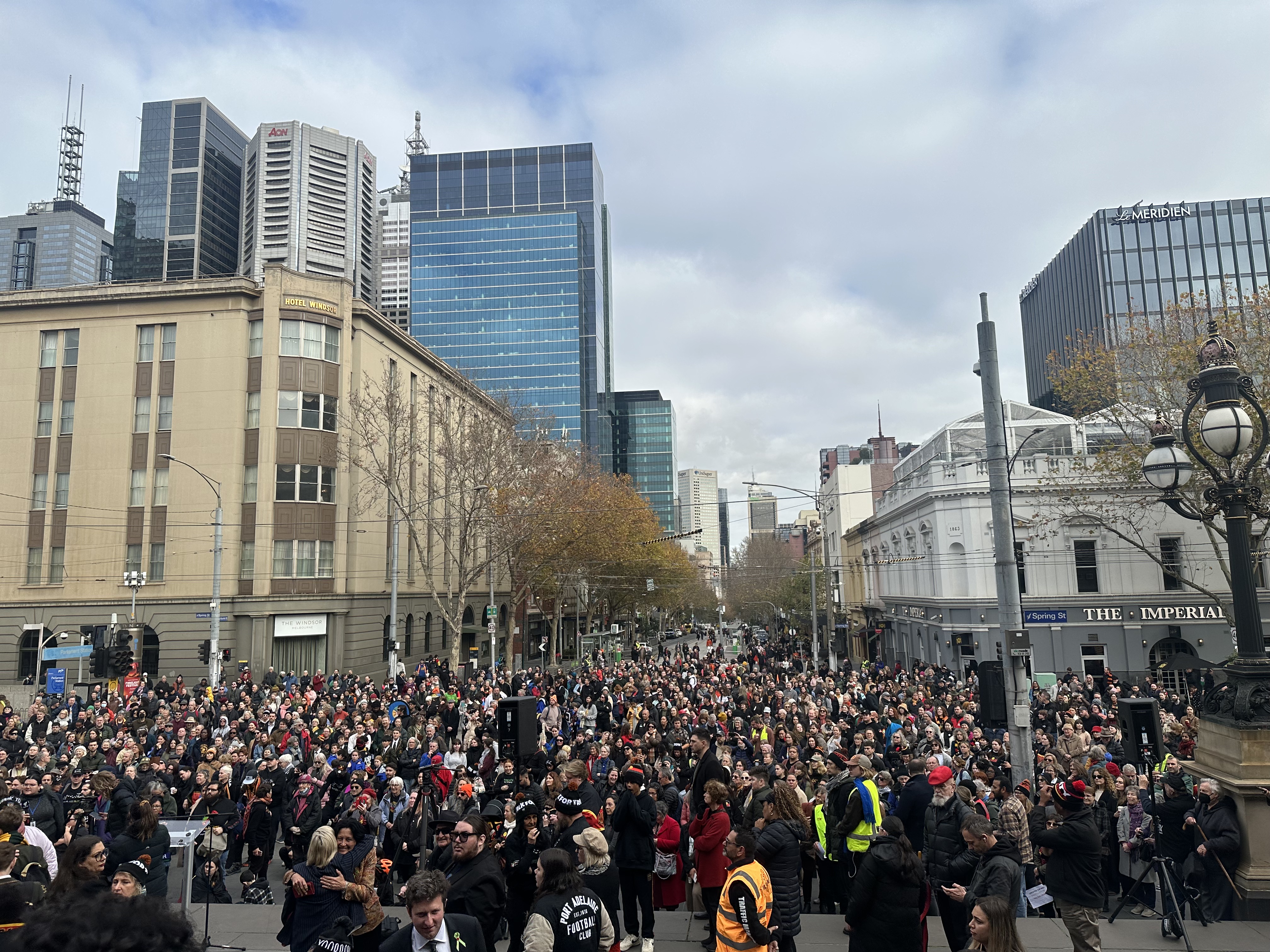
As Travis Lovett approached Spring Street — the seat of Victoria's Parliament and a symbol of over 150 years of laws that have discriminated against First Nations people — a crowd of thousands erupted in applause.
The towering figure of the Kerrupmara Gunditjmara man offered a tired but proud smile as he stood before Parliament, having completed a 500-kilometre journey marking the end of the Yoorrook Justice Commission, the nation's first formal truth-telling process.
"The first step was taken with the weight of history pressing through the soles of my shoes and the voices of my people whispering, urging, steadying me forward," he said.
Over 25 days, Mr Lovett — one of five Yoorrook Commissioners — walked nearly half the state, starting from Portland on Gunditjmara Country, the place where colonisation in Victoria "took its first breath".
"We began at the place where the first wounds were struck into the earth; where footsteps came ashore — not as visitors, but as claimants," he told the crowd on Wednesday.
"Where the smoke of fires long burning was ignored, and where our presence was declared — absence.
"We began where truths were buried and where they are now being unearthed through the stories and hard work of so many over such a long time."
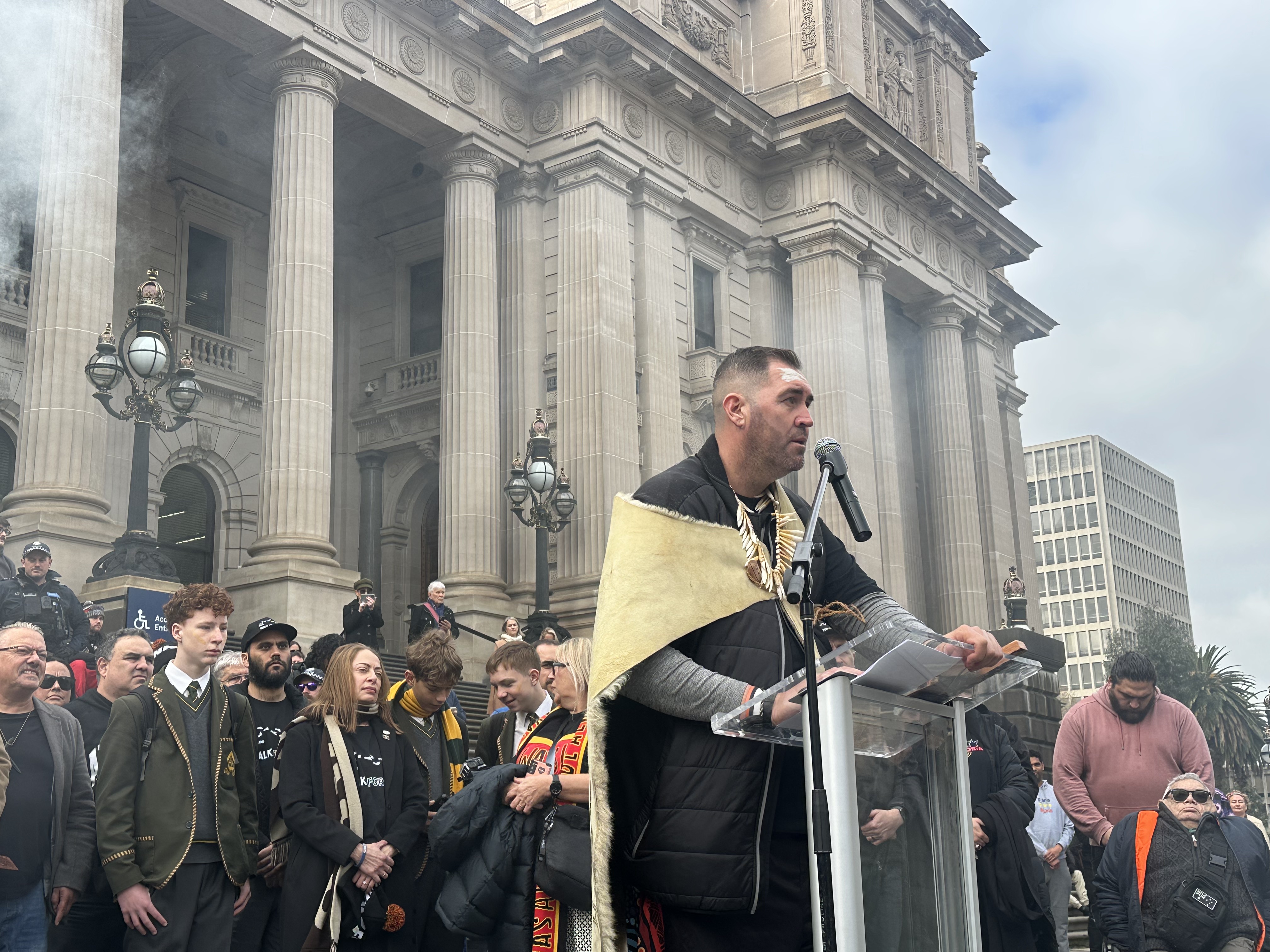
Schoolchildren, families, and supporters have joined more than 10,000 people in signing up for parts of the walk. On a brisk Wednesday morning, more than 5,000 walked alongside Mr Lovett on the final stretch to Parliament, where he delivered a message of truth to Premier Jacinta Allan.
On the steps of a place he described as where "the lie of emptiness took root — a lie that was signed into law, written into school books, and carved into the stone," Mr Lovett said he was standing "on the steps of power".
"These stones have carried silence," he said. "They have heard promises and watched them break. But today, they hear song; they hear story; and they hear presence."
Federal and state politicians, members of the First Peoples' Assembly, and thousands of First Peoples gathered around Mr Lovett — many visibly emotional as he recounted the journey — a path filled with sorrow, survival and strength.
"We moved from massacre sites hidden beneath the paddocks and plaques, to suburban bus stops where our children waited in school uniforms stitched with the legacy of exclusion," he said.
"We crossed bridges over rivers that once ran red and followed footpaths through towns where our people were once forbidden to linger after sunset."
The Walk for Truth was held to mark the completion of Yoorrook's final report — which includes an Official Public Record — and to urge Victorians to confront the state's history and commit to a just future.
"Victoria's history is not a neat story," Mr Lovett said. "It's a jagged, tangled one of invasion and survival; of denial and resurgence.
"It lives in policies and plaques, in stolen children and stolen wages, in sacred trees cut down for car parks. But, it also lives in community halls, in sacred possum cloaks, in the organisations we have built for ourselves."
The four-year inquiry, which formally ends this month, will become Victoria's longest-running royal commission. Since 2021, it has collected testimony from thousands of people — Indigenous and non-Indigenous — including Stolen Generations survivors, descendants of colonisers, and Premier Jacinta Allan.
It has prompted 16 ministerial apologies and exposed billions of dollars earned by governments from land and water not shared with First Peoples.
The final report is expected to contain more than 100 recommendations addressing every aspect of government involvement in Aboriginal lives since colonisation.
"We have sat with testimonies that carry the weight of generations," Mr Lovett said.
"Testimonies that do not ask for sympathy — but for justice, for dignity, for truth to be spoken aloud without interruption, without rephrasing, without being folded into the usual frameworks."
He said Elders shared how their laws, passed down through memory, kinship and practice, were never recognised by the state — but endured.
"They told us how those laws were disrupted but never erased, how they kept them alive through ceremony, through language, through love, even in exile," Mr Lovett said.
Emphasising the importance of truth-telling for First Peoples, whose lived experiences of colonisation have rarely been formally recorded, he said the process is "not a ritual".
"It's not symbolic. It's a reckoning. It's a commitment to change — structural, legal, cultural," he said.
In finishing an at times emotional speech, and to a powerful final cheer from the crowd, a weary Mr Lovett declared: "We are here to say the silence ends here. The time of not knowing — of choosing not to know — is over."



