




The New South Wales Court of Appeal has struck down anti-protest laws introduced in the wake of the Bondi Beach terror attack.
The challenge was brought by three activist groups — the Blak Caucus, Jews Against the Occupation '48 and the Palestine Action Group — which argued the laws, known as the public assembly restriction declaration (PARD), were unconstitutional.
The legislation was originally passed during an emergency sitting of parliament on Christmas Eve. They allowed restrictions on public assemblies for up to 90 days following a terrorism incident, preventing organisers from using the Form 1 process to notify police of planned protests.
In effect, it meant people could not protest without fear of arrest.
The court found the scheme impermissibly burdened the implied constitutional freedom of communication, marking the second time in six months that anti-protest laws introduced by the Minns government have been struck down.
The full bench of the NSW Court of Appeal — Chief Justice Andrew Bell, Justice Julie Ward and Justice Stephen Free — unanimously ruled the laws invalid, writing: "The lack of proportionality between the notionally legitimate objective and the means chosen to pursue that objective is a problem that is inherent in the power itself."
"The PARD scheme is a blunt tool which does not require, or even allow for, consideration of the characteristics or conduct of any particular public assemblies or the nature or severity of any threat to the community that could be said to arise," the judges wrote.
"It is not enough that the legislature perceived the need for strong action to preserve the cohesion and safety of the community in the wake of an exceptionally traumatic public event."
Police had used the laws to block Blak Caucus organiser Paul Silva from holding a march in January marking 10 years since the death of David Dungay Jr, which was planned for Hyde Park in Sydney.
At the time, the Dunghutti activist said the laws were being used to silence criticism of the government and corrective services.
"It's quite disgusting that they would implement it, but then, I will say that it does expose it for what it really is," he said at the time.
"It exposes the New South Wales Police and the New South Wales government for their systematic failures, and scrutinises police for their brutalisation and their responsibility for them in custody."
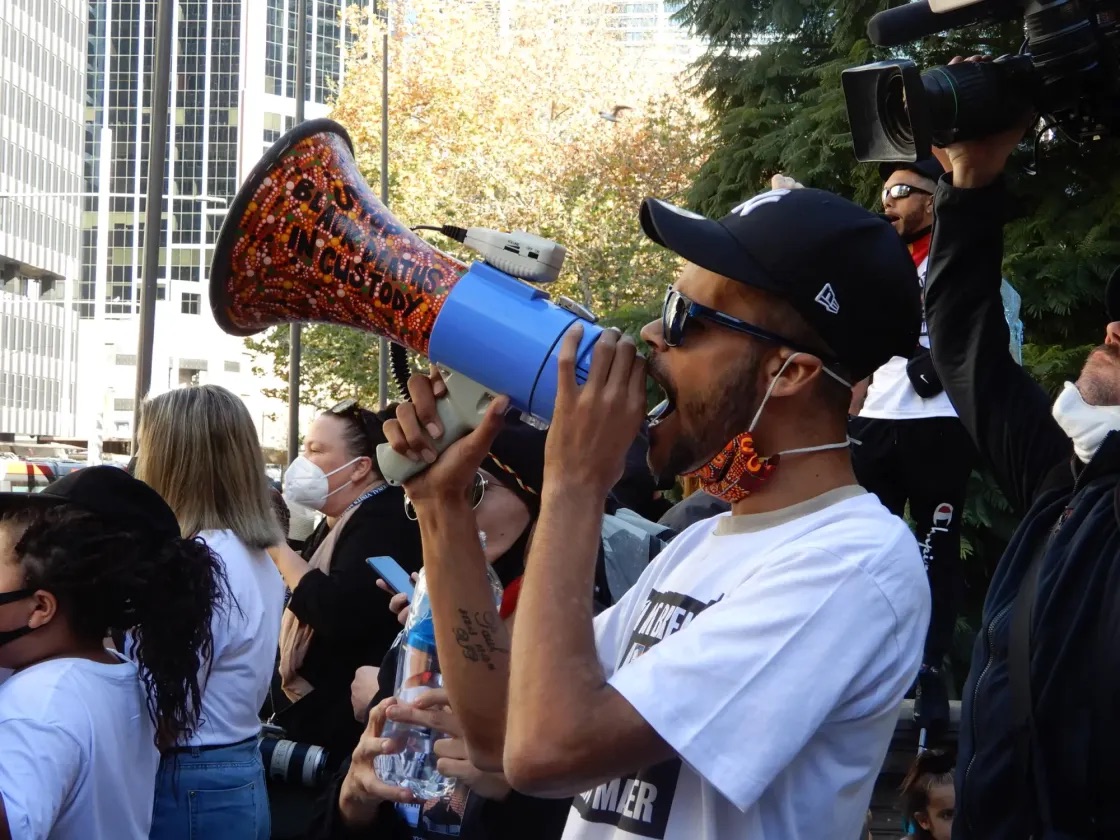
The Aboriginal Legal Service was also highly critical of the laws, arguing the right to protest is fundamental in a democracy.
"The right to protest is a cornerstone of a functioning democracy. Aboriginal deaths in custody and the incarceration of Aboriginal people are at record highs, both in NSW and nationally," ALS Principal Legal Officer Nadine Miles said at the time.
"This is a time of crisis for the communities we serve. It is a time to come together and unite for change, not to risk silencing the voices of Aboriginal people."
The three judges said the scope of PARD was also concerning.
"For the duration of a PARD made in those circumstances, the restriction would apply not just to mass assemblies by the group in question but to any other public assembly, even one concerned with completely unrelated subject matter," they wrote.
"The restriction would apply equally to an environmental group seeking to protest against planning laws by gathering outside a council office or a collection of individuals seeking to protest against deaths in custody outside a police station."
They added: "Perhaps most paradoxically of all, it would apply to a proposed public assembly in support of social cohesion."
The restrictions were extended multiple times, including during the visit of Israel's president in February, which saw violence and mass protests across Sydney and Melbourne.
NSW Greens justice spokesperson and solicitor Sue Higginson said the "unconstitutional laws" were the reason "Police felt empowered to commit violence against innocent people" during the visit.
"Given this outcome, civil liability in the tens of millions is inevitable. People were harmed, their right to march to Parliament was unlawfully obstructed, and no doubt police were harmed too. Premier Chris Minns needs to take responsibility for this," she said.
"Instead of progressing evidence-based reform to combat hate and antisemitism in the aftermath of the Bondi Massacre, the Premier chose to foist unrelated and absurdly anti-democratic anti-protest laws on the parliament knowing they would be declared invalid."



