

Stone artefacts found beneath the sea at Murujuga in north-western Australia have revealed how First Nations peoples lived and moved resources across a landscape submerged at least 9,000 years ago.
The discoveries form part of Australia's oldest known underwater archaeological record and show that Aboriginal cultural heritage survives across a broader submerged landscape in the World Heritage-listed region.
Murujuga Aboriginal Corporation rangers worked alongside researchers to locate and document the sites, including artefacts associated with an ancient freshwater spring.
MAC director Vincent Adams highlighted the findings' connection to the Ngarda-Ngarli people's continuing care for Country.
"The Ngarda-Ngarli people have cared for Murujuga for at least 50,000 years," Mr Adams said.
"What this research shows is that our cultural landscape extends far beyond the shoreline and into Sea Country, where important parts of our story remain preserved beneath the sea."
While the sites were submerged at least 9,000 years ago, the artefacts could be considerably older.
The findings also support efforts to identify and protect submerged heritage following Murujuga's World Heritage recognition.
Mr Adams outlined the role of research in protecting the whole cultural landscape.
"World Heritage recognition brings new responsibilities as well as global recognition," he said.
"Research like this strengthens our ability to identify, understand and protect the whole Murujuga cultural landscape, including Country that was submerged when sea levels rose thousands of years ago."
More than two million square kilometres of Australia's continental shelf was submerged as sea levels rose after the last Ice Age.
Before that transformation, generations of First Nations peoples lived across landscapes that now lie beneath the ocean.
The newly documented sites reveal how people used two different parts of that landscape.
One centres on a freshwater spring that would have provided a resource and a place for people to gather.
The other is associated with a rocky hill overlooking an ancient river channel, dating from when the archipelago was connected by dry land.
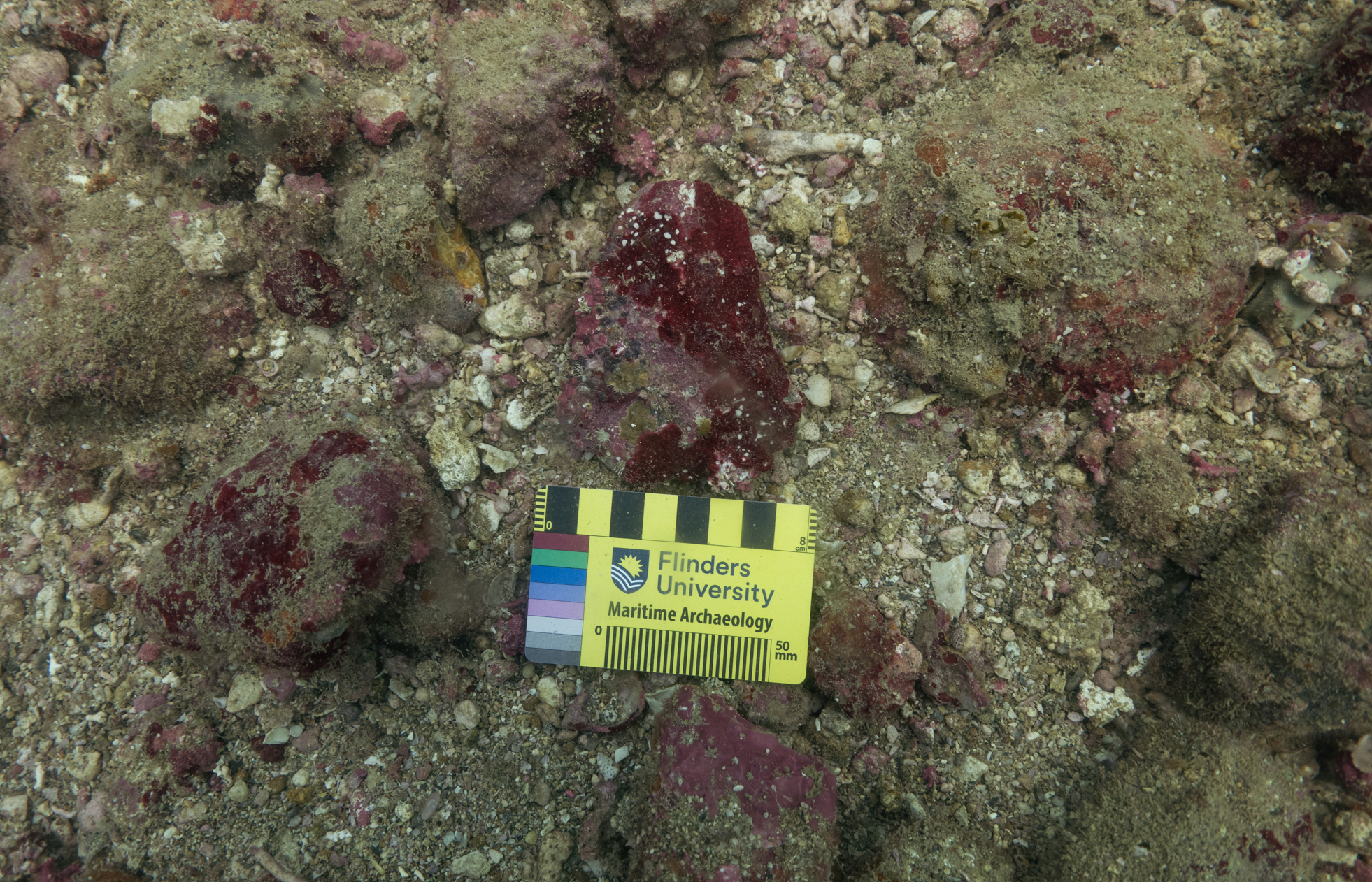
Analysis indicates some artefacts were made from stone sourced around Rosemary Island, about 23 kilometres from where they were found, suggesting people transported resources across the landscape.
The research brought together Murujuga Aboriginal Corporation and researchers from Flinders University, the University of Western Australia, James Cook University and the University of York in the United Kingdom.
Corporation Land and Sea Unit Rangers Malik Churnside and Richard Variakojis trained as scientific divers, undertook surveys and made some of the underwater discoveries.
Both are co-authors of the paper.
Lead researcher and Flinders University marine archaeologist Professor Jonathan Benjamin highlighted the Rangers' contribution.
"The collaboration demonstrates the value of working beside trained Indigenous Rangers who actively contributed to this challenging scientific research," Mr Benjamin said.
The study builds on discoveries reported in 2020 and 2023 by the Deep History of Sea Country project team.
Murujuga project team members are also affiliated with the ARC Centre of Excellence for Indigenous and Environmental Histories and Futures.