


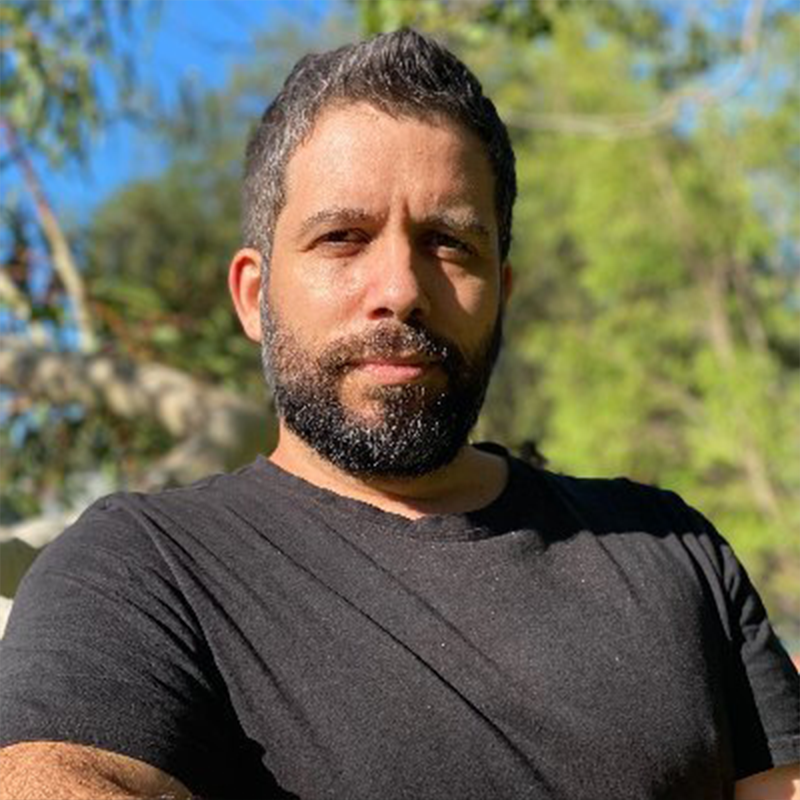

Without power-sharing, compensation and the return of land, both native title and the Uluru Statement from the Heart fail Aboriginal people, veteran artist and activist Richard Bell says.
Bell spoke about his work and his life at the Ever Present exhibition in Singapore over the weekend and didn't mince words.
The Kamilaroi, Koomi, Jimon and Goreng Goreng artist's Embassy showpiece is on display at the National Gallery Singapore as part of the Ever Present: First Peoples Art exhibition.
Bell created Embassy, a replica and tribute to the 1972 Tent Embassy in Canberra, in 2013.
It has been exhibited around the world, often outside seats of power, just as the original Tent Embassy faces old Parliament House in Canberra.
Bell said Embassy had resonated in different ways in different countries.
"In New York, Sylvia McAdam, the co-founder of Idle No More, came, and she was fantastic," he said.
https://www.nit.com.au/in-singapores-national-gallery-international-tourists-are-confronting-australias-indigenous-history-as-told-through-art/
"The young women who started the Black Lives Matter movement attended, Henry Douglas from the Black Panther Party and members of the New York chapter of the Black Panthers came to the Embassy."
For Ever Present, Embassy is inside Singapore's former City Hall chamber, built by the British colonial regime, where Bell and National Gallery Singapore director Eugene Tan recently held a Q&A.
Bell commented on the irony of Embassy being inside an old seat of colonial power, noting that he prefers it to be outside and in opposition to such monuments, as it is in Kassel, Germany, opposite the Fredericianum.
He said the original tent embassy was "on the news every day" when he was a teenager in 1972.
"It was my last year of high school. I was poor, I couldn't make it down to Canberra for the protest but there was plenty of coverage of it," he said.
"I spent the first two years of my life living in a tent until the white people in town threw out enough corrugated iron for us to build a shack... Later I moved to Darwin after my mother got a job there."
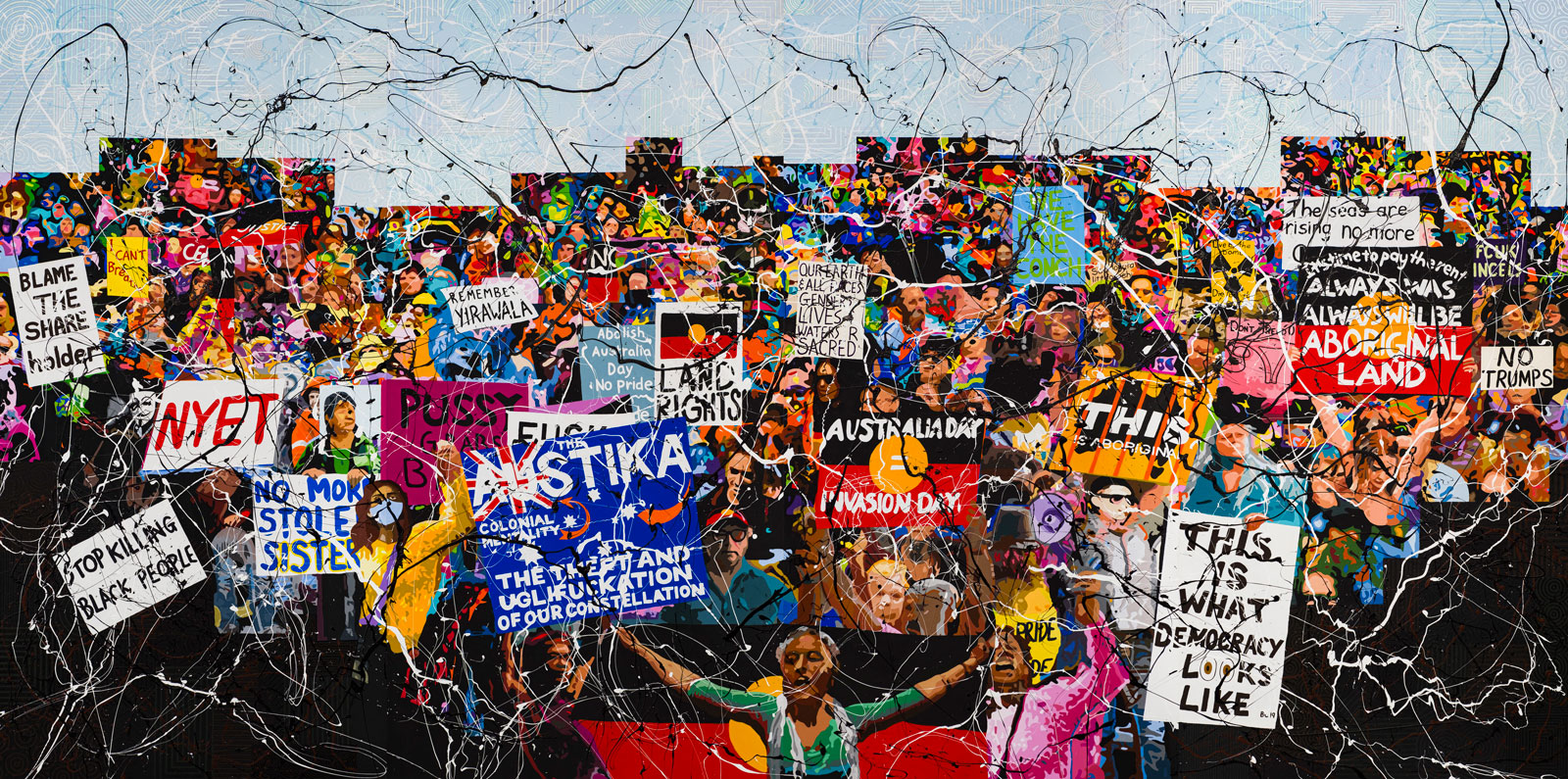 From Little Things Big Things Grow - Richard Bell.
Bell said becoming a full time artist happened "by accident" in the 1980s while trying to make a living selling art and boomerangs to tourists.
"A white guy said to me one day 'why don't you get into fine art?'." he said.
"I said why the f*** would I do that?
"He said you are an activist and there are things you can do in art that would get you arrested if you did them outside of an art gallery."
Bell, who described himself as an "activist masquerading as an artist" said funding gravitated toward "inoffensive, polite works"; underlining the need for works powerful enough to in big galleries and museums without playing to the market.
Native Title a 'farce'
Not long after the establishment of the original Embassy in 1972, the long road to fighting for land rights and sovereignty was bogged down in the court system.
While working for the New South Wales Aboriginal Legal Service in the early 1980s, Bell watched on as two high profile cases were struck down by the High Court of Australia.
He was then involved in planning a meeting of representatives from Aboriginal Legal Services around the country, an important early stage in what became the Mabo cases.
While native title entered the Australian political lexicon as a result of the Mabo decision in 1992, true land rights remained elusive.
Bell said native title had done little more than create a layer of bureaucracy which had removed the right of self-determination.
"Land rights gives us inalienable title to our land, that is much stronger form of land title than native title, which is the weakest land title in Australia," Bell said.
"We have this farcical situation now where the people who tell us we are Aboriginal are anthropologists.
"I can not declare myself Aboriginal in Native Title without the backing of anthropologists."
Bell said native title had set back the land rights cause and fueled division between once harmonious communities.
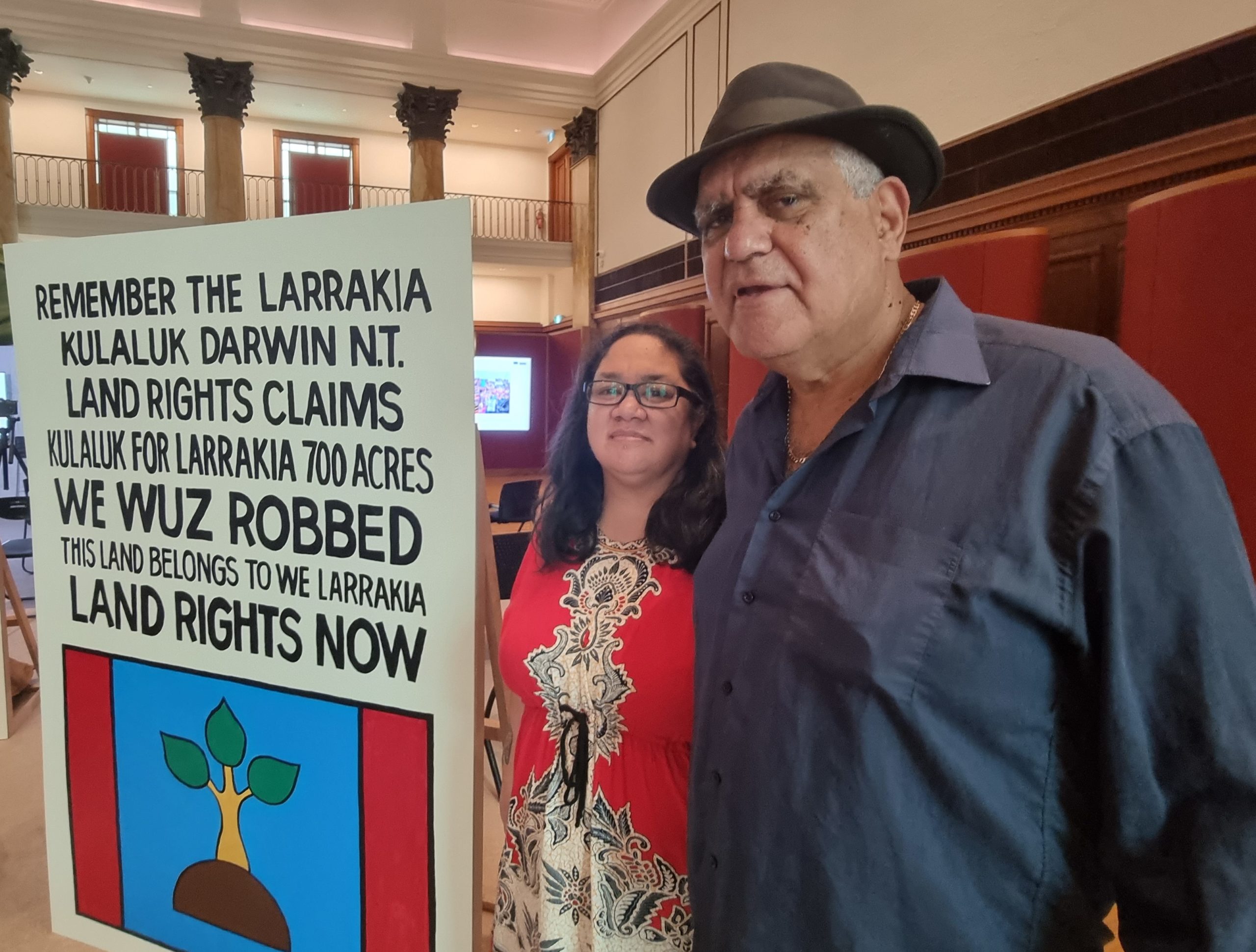 National Gallery of Australia Aboriginal and Torres Strait Islander Art curator Tina Baum with Richard Bell in Singapore. Photo by G. Torre.
He wants to see native title disavowed, and Indigenous people start once more the fight for real land rights.
"Now the land we are part of is being exploited, the resources have been taken without permission and without ceding anything to us," Bell said.
"We have to go to an institution established by the people who stole what we had and we have to operate within the rules of those people who stole our land.
"This juvenile concept of colonisation and conquest and owning other people's land is nonsense."
Uluru Statement a 'dead-end' risk
The long-time artist and activist expressed concern that the campaign for the Uluru Statement from the Heart could also prove to be a dead-end.
He raised concerns an enshrined Voice could simply be ignored, which made it easy for governments to endorse it.
"There was reconciliation, and Recognise, and now there is the Statement from the Heart," Bell said.
"There is... no compensation, no land, no money, no power sharing."
Bell claimed these projects were designed to make white people feel like they are doing something.
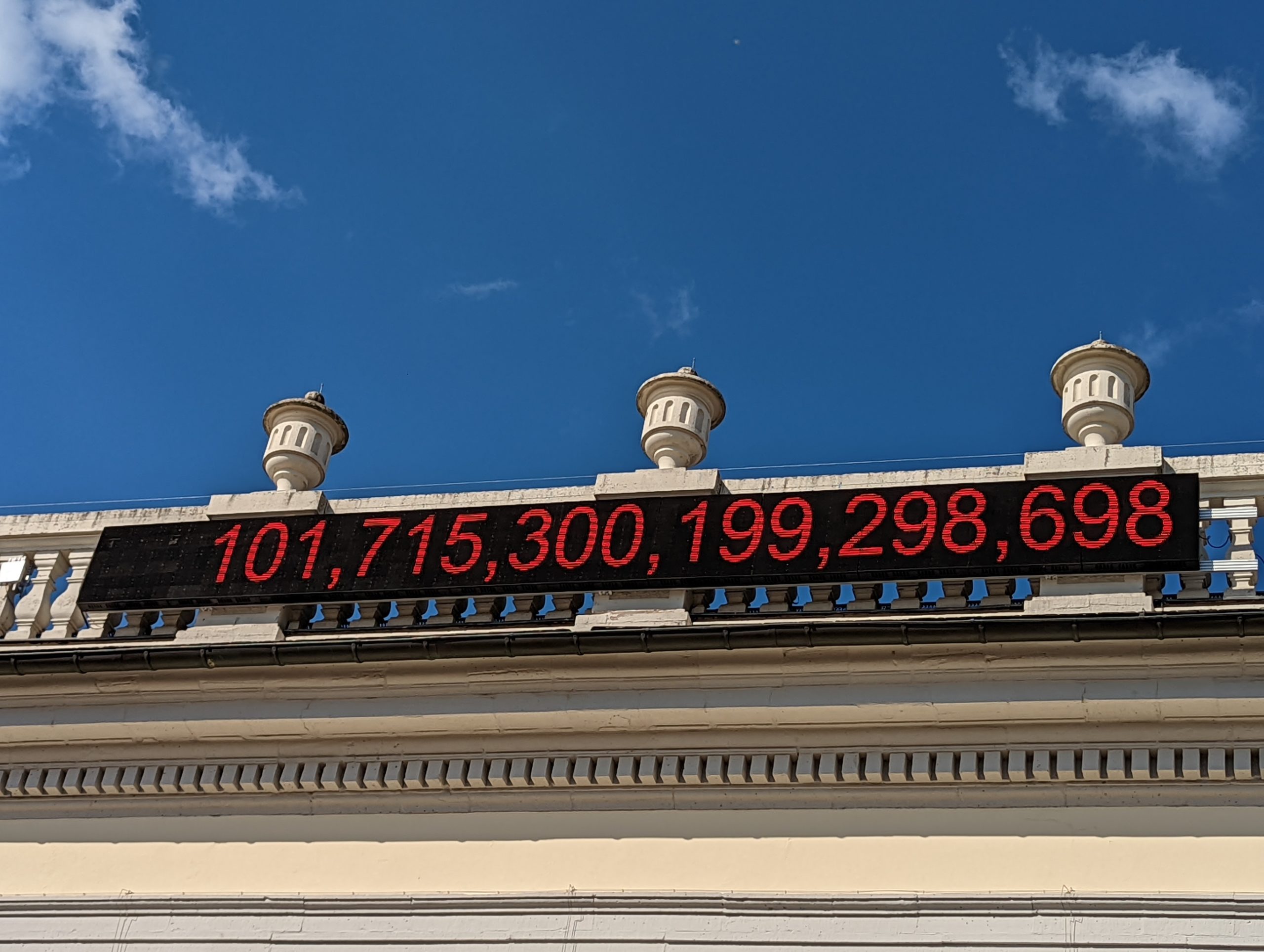 Pay The Rent (2022) - Richard Bell - displayed in Kassel, Germany.
His work, Pay The Rent (2022), features a massive electronic sign displaying a price tag owed by the Australian Government to Aboriginal people for the use and exploitation of the land.
It is a reflection of his thoughts about what he describes as the Statement's "emptiness" and challenges its audience to ask whether land and money is enough.
"We need designated seats in each parliament, federal and state, not a voice to parliament," Bell said.
"There is no way we should accept anything less."
The fight beyond a lifetime
For his decades of tireless campaign, Bell does not expect to see the changes he calls for in his lifetime.
"I have partied hard all my life and I am definitely not going to live that long," he said.
He said while there are many wrongs in the world, there was hope those problems could be fixed.
"I look at solutions. These things take a long time. As Vincent Lingiari said, we are Aboriginal we know how to wait. We have to reach and look for solutions," Bell said.
"My next project I am going to write a draft Constitution for a new entity, whether it's a nation state or whatever, and take the draft around Australia and hold town halls, old fashioned town hall meetings, and build a team of people who can do that long after I am gone because realistically something like this would take 40, 50 years.
"In saying that I am being optimistic that climate change is not going to kill us before then."
It is this sentiment on his next work which reveals a home truth about Bell; he retains great faith in the power of art to communicate and inspire.
"Art has a really important role to play, not only in calling out power but also in presenting possibilities, presenting idea that can make things better," he said.
"We need to love more and cut back on hate. Amplify the love; for each other and for ourselves. For our friends, even for our enemies. Back the fuck up from this hate business."
- Giovanni Torre travelled to Singapore as a guest of Wesfarmers.



