


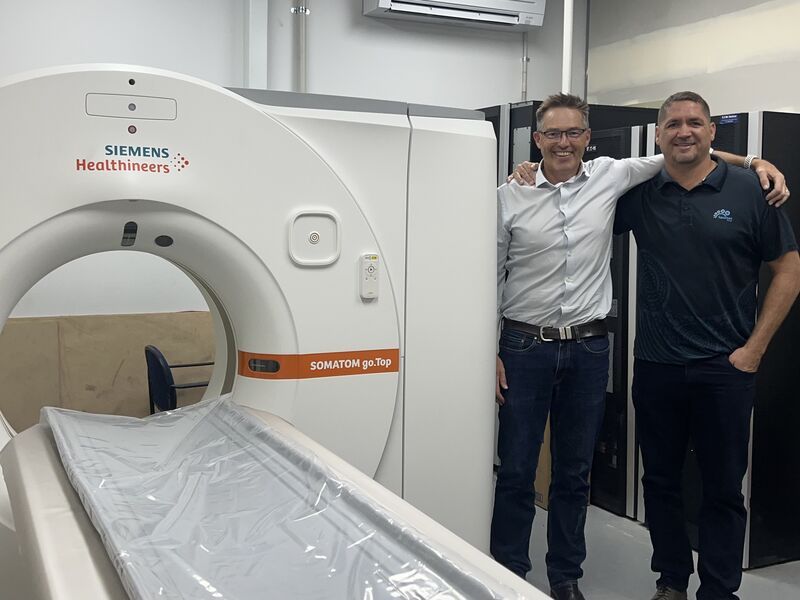
The installation of a cutting-edge CT scanner in Western Australia's Goldfields promises to make a crucial difference and fill a gap needed in the remote community.
Australia's first Indigenous medical imaging service (radiology and nuclear medicine) Spartan First Imaging hope it's the latest step in a long journey ahead for the area, and health across the state.
SFI, established by Aboriginal-owner occupational health service Spartan First and TeleMed Health Services, who's facility houses the scanner, installed the Siemens SOMATOM go.Top on-site in Kalgoorlie on Wednesday.
TeleMed director and nuclear medicine practitioner, Peter Tually, said the new scanner offers services not available through public health streams locally, providing more extensive imaging to the region which had previously required travelling to the city.
"There's still a lot of patients that if they need that advanced imaging, they have to go to Perth," Mr Tually told National Indigenous Times.
"And increasingly, patients, if they're confronted with that, and it's particularly so with Indigenous populations, is that they just choose not to have a scan because of either financial reasons or it's just too dislocated for their family, or work."
It also exposes patients to lower radiation doses, and less time in the scanner, he explained.
The need for services in remote regions is clear and lacking, Mr Tually said, with heart disease one area of concern.
Mr Tually has witnessed a stark decline in the age of first heart attack survivors from around 50 to people in their 30s in his less than three decades in Kalgoorlie.
The scanner also offers integration with AI reading tool, offering quick assessments of a patient's conditions and risk with sub-specialists to be connected in for ongoing care.
"We hope to make as many of the scans as free as possible where we can," Mr Tually said, saying there's also a need for higher Medicare rebates in the regions.
"Because costs in the bush are far more expensive than just in the city," he said.
Spartan First director and chief executive Des Headland said "our community missed out on a lot in terms of having quality healthcare in all aspects of life" - radiology and imaging in particular.
While the newest initiative is an exciting step forward, Mr Headland said, "there's a lot of hard work ahead of us to be able to deliver a great service for the communities".
The service operates eight medical centres across Western Australia, in the city and regions - recently opening its first dental clinic in Subiaco.
Delivery spans across the sector, from the mainstream network to government, defence and mining industries with the opportunity to harness that and "give back to our community".
"I see this opportunity here to make a huge difference within our Aboriginal communities, starting off in the Kalgoorlie-Goldfields region, and then as we grow that imaging business, we'll be looking to go elsewhere, to the regions all across WA," Mr Headland said.
Following their latest step Mr Tuolly stated, "we want to exceed the standard".
"That's our ambition, to give people extraordinary quality using the best technology, which we are using...to help improve outcomes. That's what this is all about," he said.
Participation in specialist lung screening services catering for the local mining industry is also planned, while heart disease and cancers are in current focus at the Kalgoorlie facility.
The scanner itself is projected to eventually run entirely off solar-charge batteries, with connection to the grid as a back up.



