




Families and communities must support children to attend school, the Aboriginal Medical Services Alliance Northern Territory (AMSANT) says, stressing that education is fundamental to health, opportunity and wellbeing.
AMSANT says schooling supports confidence and connection to community, alongside physical health and mental wellbeing.
"School is about much more than classrooms," AMSANT Chair Rob McPhee said.
"It's where children build confidence, relationships, routines and skills that support their health for life. Every day at school helps set kids up for stronger futures."
Children who remain engaged in education are more likely to experience better physical and mental health, improved employment prospects and longer life expectancy, the organisation says, with additional benefits including a significantly reduced likelihood of contact with the justice system.
"Education is one of the strongest predictors of lifelong health," Mr McPhee said. "That's why encouragement, support and understanding are so important — especially in the early weeks of the school year. When kids feel supported to go to school, everyone benefits."
Attendance rates low across the Territory
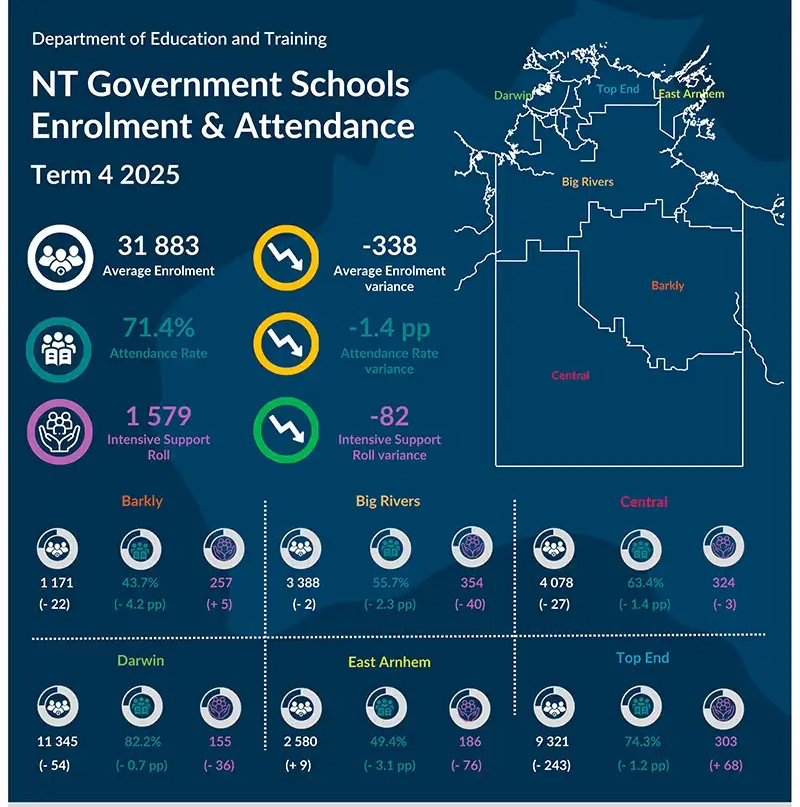
Northern Territory Department of Education enrolment and attendance data for Term 4, 2025, shows an overall attendance rate of 71.4 per cent. For Aboriginal children and young people, attendance was substantially lower at 53.3 per cent.
While attendance was highest in the Darwin region at 82.2 per cent, it fell to below 50 per cent in East Arnhem (49.4 per cent) and the Barkly region (43.7 per cent).
Last year, the Country Liberal Party introduced a policy allowing the NT Department of Education to refer parents of chronically absent students to the Commonwealth for income management. The NT Government also established truancy officers to enforce school attendance, including the power to fine parents $370 when children are absent without a valid reason.
Federal Shadow Minister for Indigenous Australians Kerrynne Liddle has been outspoken about the need to increase school attendance in remote and regional communities.
"One of the most protective factors is kids in schools, healthy kids, and healthy parenting. That's what I want people to focus on," she told the ABC last week.
"Let's focus on keeping kids out of custody, not focus on what we do with kids who are in custody. And if they're in custody, let's focus on making sure they don't end up back in custody.
"That's why I keep going back to those organisations that are charged with taxpayers' funding to deliver services to Aboriginal and Torres Strait Islander people to do it as effectively as possible."
.png)
Early childhood learning
AMSANT also emphasised the importance of early childhood education and adult learning programs, noting that education should not be limited to traditional age groups.
"Education doesn't stop at the school gate," Mr McPhee said.
"Early childhood programs, literacy support, bilingual and cultural education and lifelong learning all play a role in keeping our communities strong. When we encourage and support kids to learn, we're investing in healthier families and a stronger Territory."



