




Whilst the overall money going to First Nations organisations has increased dramatically, more than $300 million from the federal department responsible for Indigenous Australians was still directed to non-Indigenous organisations in the last financial year.
During the Canberra sitting of the Senate inquiry into racism and hate towards First Peoples, Senator Lidia Thorpe asked National Indigenous Australians Agency (NIAA) CEO Julie-Ann Guivarra about grant money given to "white organisations to provide programs to lift our people".
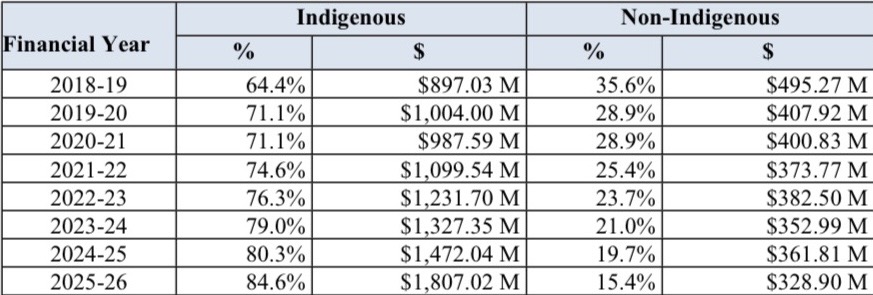
Responding to a question on notice, the NIAA confirmed that for the 2025-26 financial year, $328.9 million — or 15.4 per cent of the total Indigenous Advancement Strategy (IAS) funding — went to non-Indigenous organisations.
Both the amount of money and percentage of IAS funding going to non-Indigenous organisations have decreased over the last eight years, whilst funding for First Nations organisations has continued to increase markedly.
In 2018-19, only 64.4 per cent of IAS funding — $897.03 million — went to Aboriginal and Torres Strait Islander organisations. By 2025/26, this had increased to $1.807 billion — 84.6 per cent of IAS funding.
The improvement is even greater when looking at the previous iteration of the Department; IAS funding on Indigenous organisations was at only 35 per cent in 2014
At the time, Ms Guivarra said the NIAA is "moving towards more community-controlled organisations".
"Not all of our funding goes to community-controlled organisations either. It goes to other Aboriginal and Torres Strait Islander organisations as well, but we continue to actively monitor that as part of our work," she told the hearings in June.
The NIAA told National Indigenous Times funding for the IAS "is for the benefit of First Nations people".
"The NIAA gives preference to First Nations organisations for grants funding, where all other factors are equal," they said.
Some figures have been outspoken in their criticism of funds from the NIAA being directed to non-Indigenous-led organisations.
Earlier this year, National Indigenous Times reported more than $100 million in funding had been given to sporting codes since 2019. At the time, an NIAA spokesperson said funding delivered by organisations associated with the AFL and the NRL supports over "2,000 First Nations young people".
"They work with young people to strengthen school attendance and Year 12 attainment, provide boarding student accommodation and support students to transition into further education or employment post-Year 12," the spokesperson said.
"Progress is monitored through regular reporting, with payments linked to satisfactory performance or submission of evidence demonstrating that agreed outcomes have been achieved."
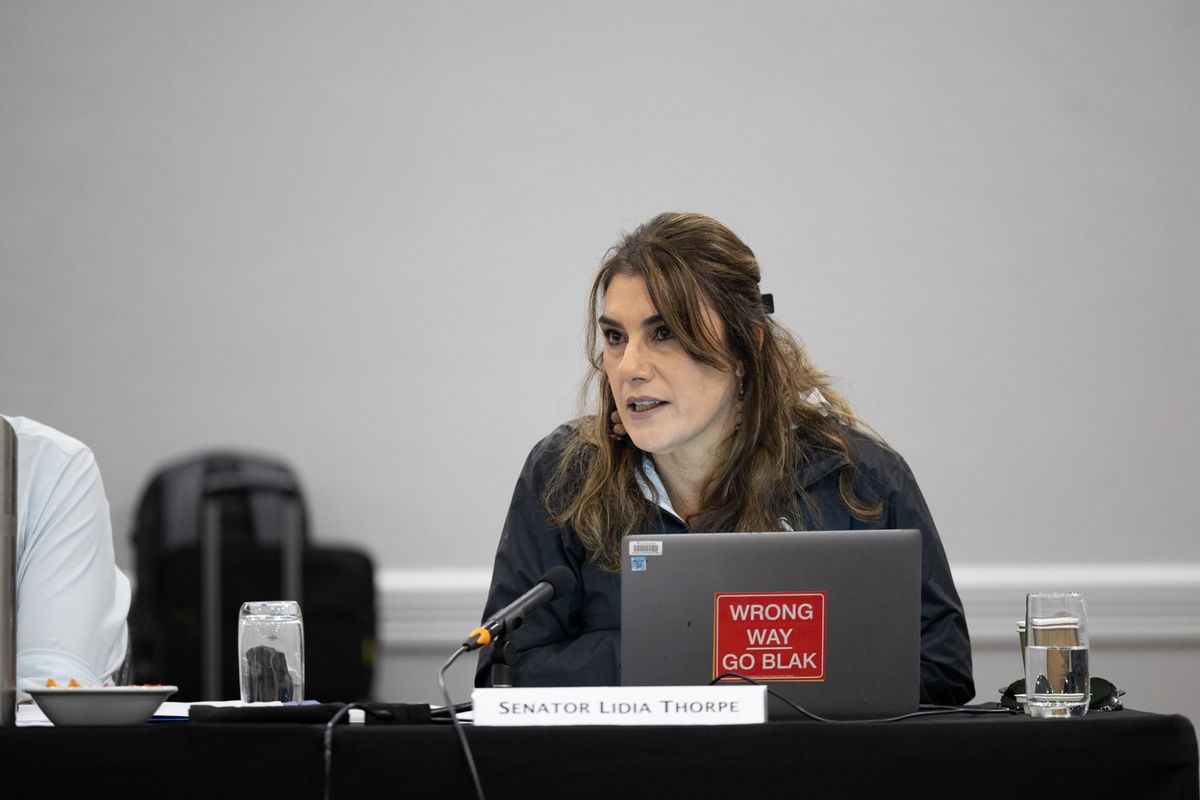
During the Canberra hearings, Ms Guivarra was asked by Senator Thorpe how the NIAA knows if the non-Indigenous organisations receiving money "are safe for our people?"
"How do you know they are not racist? Are there criteria attached to antiracism to receive funding? Or is a RAP enough?" she asked.
In response, Ms Guivarra — the first Indigenous woman to serve as an Australian ambassador — said that while there is no "specific criteria in our grants systems", funded programs would need "some sort of evidence that the provider is actually working with community".
"For example, in our Remote Jobs and Economic Development Program, basically the provider needs to have demonstrated that they've worked with community to have that program in place," she said.
"So that's one way we can test. It's not a perfect system, but that's one way we can test whether they're delivering in a culturally safe way."



