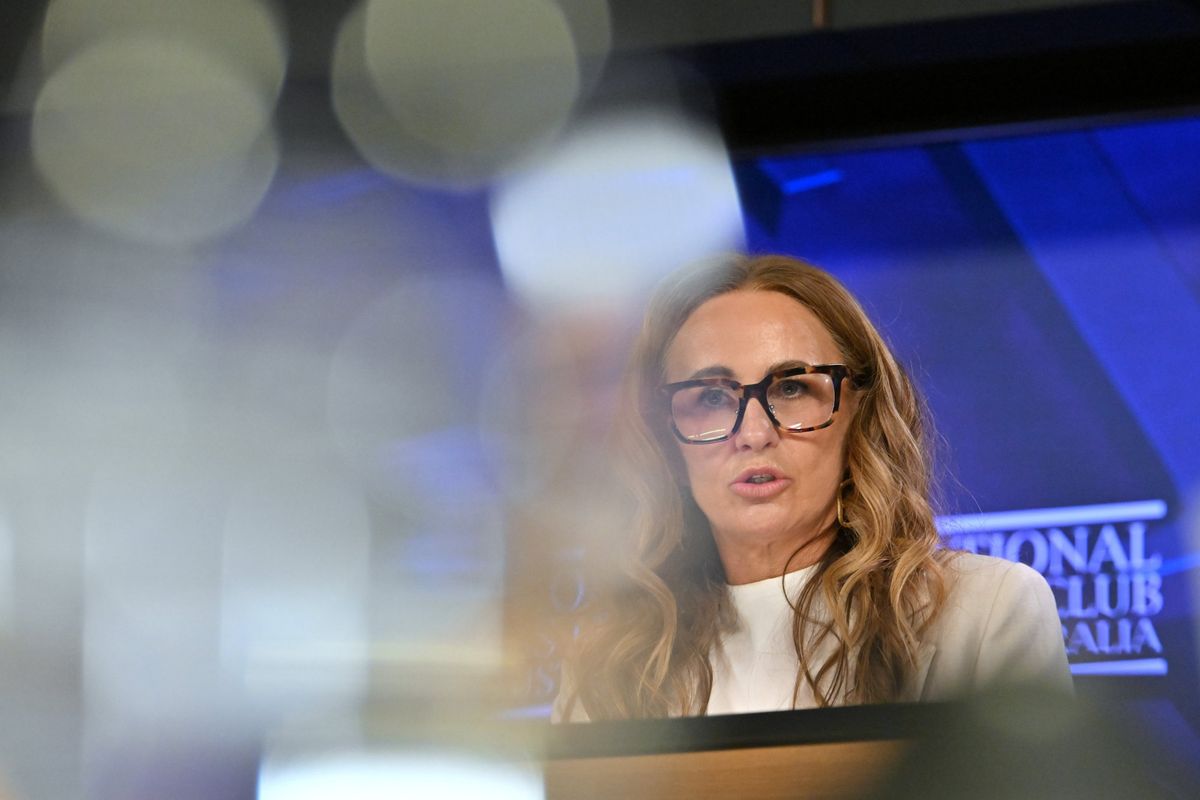
Australia has an accountability problem, not a knowledge problem, the Indigenous child commissioner has argued.
Appearing at the National Press Club on Wednesday, Sue-Anne Hunter took aim at successive governments across the country and called on them to take greater responsibility for the treatment of First Nations children.
"I have come here today with one call above all others — accountability," the Wurundjeri and Ngurai Illum Wurrung woman said.
"Governments don't need more advice...What has been missing is someone checking and saying out loud whether they are doing it."
View this post on Instagram
Her speech came less than a fortnight after the UN Special Rapporteur on the Rights of Indigenous Peoples visited the country and called on the federal government to enact minimum enforceable standards to uphold its international human rights obligations — including raising the minimum age of criminal responsibility.
Asked by this masthead if she would pressure the Commonwealth to enact minimum standards, Ms Hunter said: "I will take that up and push that, particularly for our children."
"Because if I don't do it as a national commissioner on behalf of our children, particularly Aboriginal and Torres Strait Islander children, then who's going to do it?"
The Commissioner said her office — which has significant legislative powers — would issue a report card on every government across the country on six issues: raising the age of criminal responsibility to at least 14; removing all children from adult police watch houses; funding Aboriginal community-controlled organisations to support families early; measuring child poverty; enacting all aspects of the Indigenous child placement principle; and sharing all the data on children who die in care.
"I will do it every year," she said. "I will publicise who has acted, who has not, and what they told me when I asked why.
"And if nothing moves, I will go further, using every power this Parliament has given me."
During his visit, the special rapporteur — who was denied entry into youth prisons in Queensland and the Northern Territory — described the human rights protections for First Peoples in Australia as "embarrassing".
Asked for her response, the Commissioner said she agreed with Dr Barume's statement.
"[I] couldn't agree more," she said.
"You only have to get on social media and have a look at the comments right at the moment — particularly in Victoria. The racism that's allowed to happen in this country is just beyond words."
View this post on Instagram
Australian governments have been criticised for shelving or ignoring inquiries — from the Royal Commission into Indigenous Deaths in Custody to the Bringing them Home Report — with advocates and experts long calling for greater accountability and arguing that the solutions have long been known.
There have been more than 1600 recommendations made across countless reports, Ms Hunter said.
"And over those same years, the number of children removed has gone up."
In each of the four times the UN Committee on the Rights of the Child has reviewed Australia since 1997, it raised concerns about children in OOHC "every single time," the Commissioner said.
She cited disproportionate rates of out-of-home care and incarceration for Indigenous children and young people across the country, with First Nations children 9.6 times more likely to be placed in OOHC nationally.
More than half of young people in detention are Aboriginal or Torres Strait Islander, the Commissioner said, noting they are around 27 times more likely to be detained than other young people.
"There are more Aboriginal and Torres Strait Islander children in care today than at any time since records began," she said.
"Then it was missions, reserves and dormitories, for their own good. Now it is foster care and residential units, in their best interests."
National Indigenous Times has previously reported on legal groups' evidence that mothers have had their children removed after reporting domestic violence, and Ms Hunter said they are often disbelieved.
"So women stop reaching out," she said. "And who could blame them? We have taught them that asking for help is dangerous."
The Commissioner argued that poverty, inadequate housing, food insecurity and unreliable access to electricity and water are contributing to child protection investigations and removals.
"We can tell you how many children were removed last quarter, by age and by state," she said. "What we cannot tell you is how many are going to bed hungry."
While acknowledging that neglect across the country is real, Ms Hunter added: "In 2026, in one of the richest countries on earth, Aboriginal and Torres Strait Islander children are growing up without food, clean running water or electricity they can rely on. And then, too often, it is their parents who get investigated."