

First Nations people are sick of constantly being used as a political football.
Victorian Greens' First Nations organiser, Talia Gulpilil, doesn't mind her words.
She is tired. First Nations people across the country are tired. Two-tiered media coverage, exaggerated blame, racist rhetoric — the list is endless.
Speaking to National Indigenous Times on the eve of an election expected to usher in a change of government — and potentially seismic changes for Victoria's Indigenous community — the quietly spoken Yolŋu, Wamba Wamba, Dja Dja Wurrung and Yorta Yorta woman speaks with a degree of weariness.
"Absolutely," she says when asked if racist rhetoric is becoming more prevalent.
"It's just so tiring. You know, every time you open Facebook, there's just something else."
A post shared by Talia Gulpilil for Eildon (@talia_gulpilil_for_eildon)
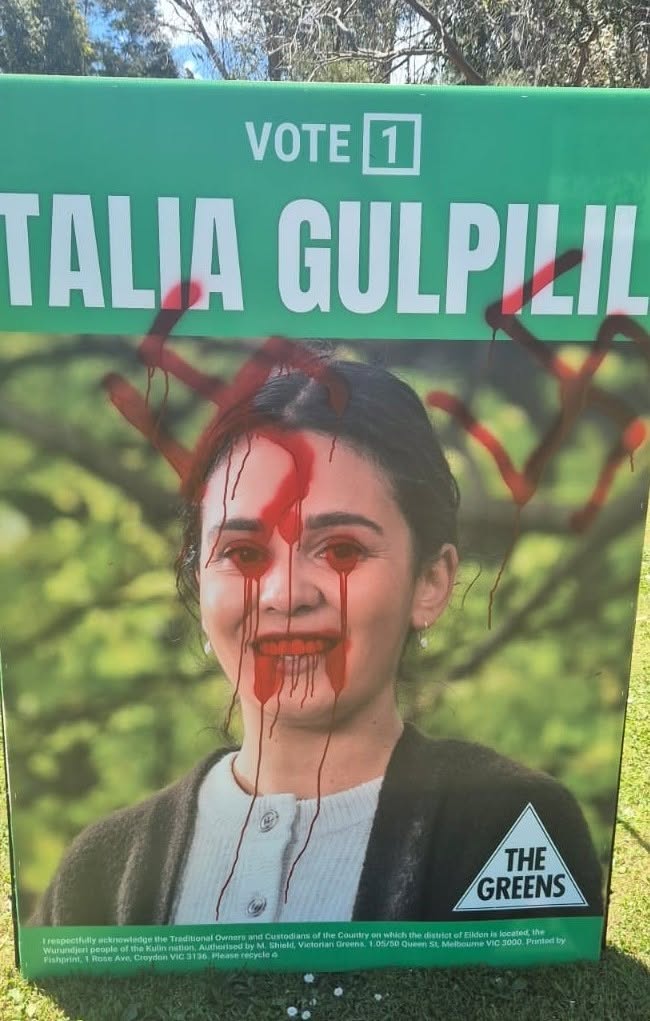
In October, a poster of Ms Gulpilil, who is the Greens candidate for Eildon — a regional seat north-east of Melbourne — was graffitied with two swastikas and red ink. Other posters were also defaced with the same graffiti, with the vandalism reported to police as an alleged hate crime.
This behaviour does not occur in a vacuum, she says.
Racism towards First Peoples has become an increasingly visible part of everyday life, with those in the public eye often finding themselves at the centre of it.
The media, Ms Gulpilil argues, "plays a huge part" in shaping that rhetoric.
"When there is negative issues within First Nations communities or a First Nations person, it's highly broadcast," she says.
"There's a huge media bias to what happens — how they choose to run a story when it's a First Nations person. So they're pushing out all this information to the wider community, to also make a decision on how they see First Nations people."
Whilst not comparable, she argues the Greens also face media bias in the way their policies are reported and understood.
"The Greens really just need a fair go," says Ms Gulpilil, whose grandfather is the acclaimed Australian actor and respected Yolŋu Elder, David Gulpilil.
"Our policies are here to benefit people, and I think once people actually look at the policies, they see that we are for the people...it's really disappointing at the moment that there's just so much money in politics because our policies seem to be lost in that."
While the national rise of antisemitism has been well documented, including through the establishment of a Royal Commission following the Bondi terror attack, Indigenous Australians have previously told this masthead they are dissatisfied with the lack of comparable attention given to increasing racism towards First Peoples.
A series of high-profile incidents in the last 18 months, including the alleged terror attack in Boorloo on January 26, attacks on Camp Sovereignty by neo-Nazis last year and the booing of Elders delivering a Welcome to Country on Anzac Day — all of which garnered little to no media coverage — prompted the federal government to launch a Senate inquiry into racism towards Indigenous Australians.
The aggressive and often outwardly racist debate centring on First Nations people has also become a feature of the election campaign.
Only this month in Victoria, the state Liberal Party was forced to dump its Williamstown candidate, Paul Lindemann, after "offensive" and "unacceptable" social media activity emerged, including posts referring to Indigenous people as "half-breed" and "full blood".
Despite the backlash, many unmoderated social media comments seen by this masthead applauded his rhetoric.
The Liberals — having withdrawn their support in 2024 — have also vowed to abolish the historic Treaty signed last year between the Victorian Government and the First Peoples' Assembly, while One Nation has gone further, promising to eliminate all Indigenous government bodies, as well as the ABC and SBS.
Many of the comments have focused on Treaty being an expensive waste of money, with online comments regularly citing familiar tropes.
For Ms Gulpilil, the continual reality that is First Nations rights being an election talking point is deeply frustrating.
"I think it's really frustrating that people are using us as political football," she says. "It's embarrassing that it took us this long to get a treaty in this country, and I think the treaty needs to stay.
"It's really disappointing that they're using it to gain votes; it's also the other side of that coin... people are voting to get rid of treaties. So it's really unfortunate in community when you don't know if people are voting against your rights or for them."
The consequences of that debate extend beyond the election campaign, with uncertainty over the future of Treaty and Indigenous representation weighing on First Nations communities.
Another First Nations Greens candidate recently left a community forum after being heckled and booed during an acknowledgement of Country, with Ms Gulpilil claiming event organisers failed to intervene.
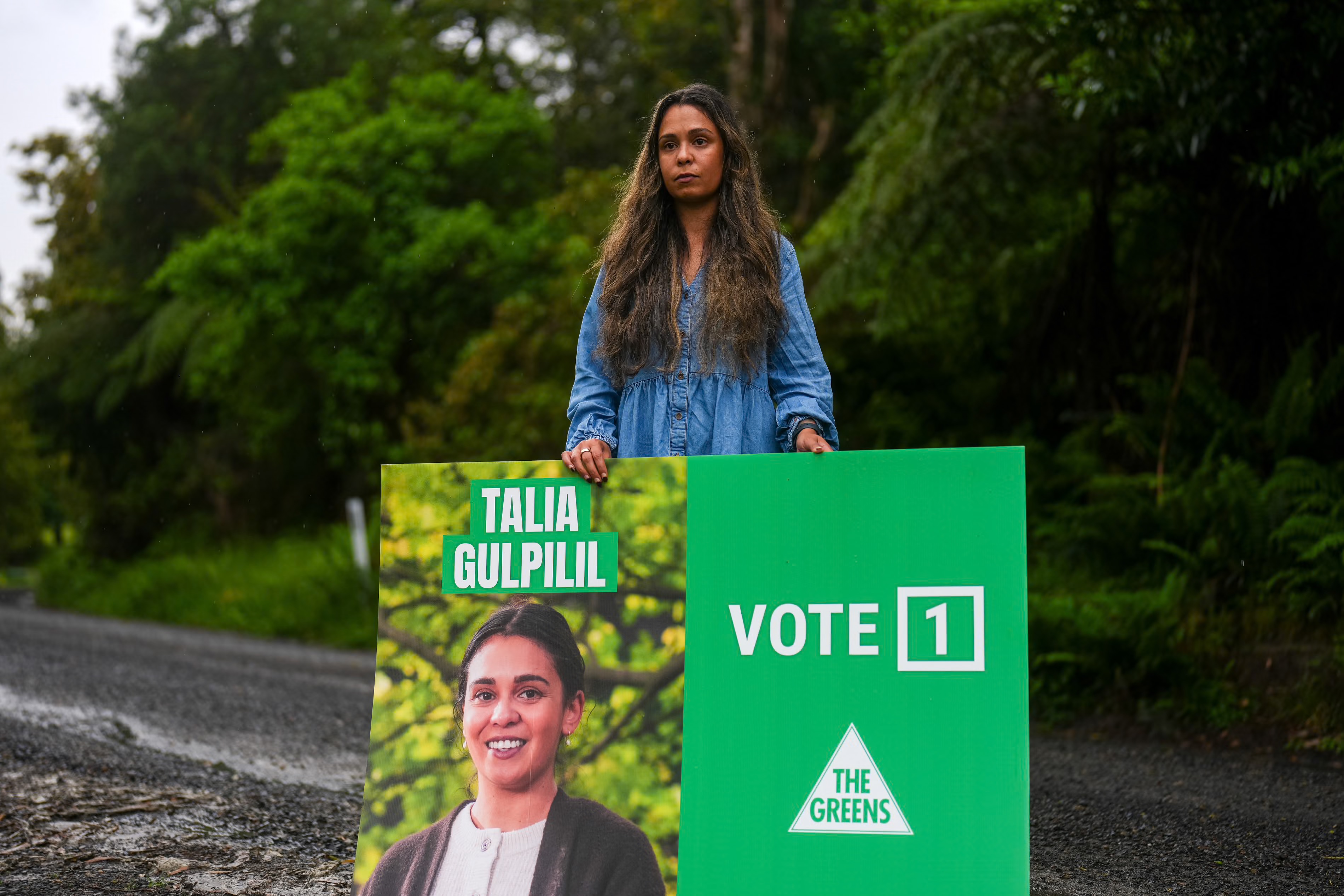
The incidents have reinforced the need for the party to have clear processes in place to protect their candidates As the Greens' First Nations organiser, she says it is about ensuring Indigenous candidates — both now and in the future — are properly supported.
On both the vandalism of her posters and the booing, Ms Gulpilil says she has spent time "actually implementing all these policies within the Victorian Greens to ensure that First Nations candidates moving forward are not met at crisis and they're met instantly".
"So we know exactly what to do when something like this happens."
Ms Gulpill says she has also encountered people accusing her of playing the victim, and tries not to read social media comments. She rejects the suggestion that speaking out about racism is about seeking sympathy.
"I never wanted to go into this and be like, 'I'm a victim,'" she says. "My biggest thing was being like, 'How do we make First Nations candidates safer in the future?'
"I don't care that I've been subjected to this — it's whatever; you have to have pretty thick skin to be in this industry. But I want to ensure: 'What steps can we have in place when it happens again?'"