


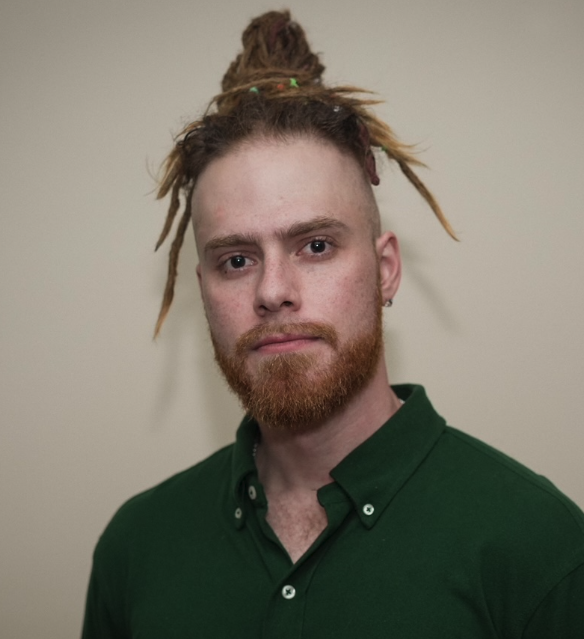

Indigenous educator Michael Evans has built his career around changing how Aboriginal and Torres Strait Islander histories, cultures and perspectives are taught in Australian classrooms.
A primary-qualified teacher with a Master of Indigenous Education, Mr Evans grew up on Awabakal Country and now works as an Aboriginal and Torres Strait Islander Peoples Content Writer and Editor with education platform Twinkl.
His path into education was shaped by his family's fractured relationship with culture and his experiences as an Aboriginal student.
Mr Evans' mother discovered her Aboriginal background as a teenager in the 1970s and was told it was not to be discussed, while the family's known history stops with his great-great-grandmother.
She later volunteered with the NSW Aboriginal Education Consultative Group, giving Mr Evans early exposure to Aboriginal education.
Mr Evans described how the experience shaped him.
"From a young age, I always wanted to learn more about my Aboriginal culture, and so did my mum and sisters," he said.
"It helped me understand that so much more could be done when it came to celebrating Aboriginal culture, sharing Aboriginal and Indigenous perspectives and truth-telling about Australian history."
Mr Evans' schooling in the early 2000s reinforced that view, with Aboriginal culture often treated as a separate activity rather than part of everyday learning.
Aboriginal students could be grouped together for cultural projects a few times each year, while non-Aboriginal students had little involvement.
"I came away from my primary and secondary education feeling as though my culture should have been celebrated more by all students,' he said.
"I also felt that history lessons did not do justice to the stories of Aboriginal peoples and, as a result, contributed to a divide between Indigenous and non-Indigenous cultures."
Mr Evans entered teaching determined to give younger students a different experience and make Aboriginal education a more consistent part of the classroom.
"I entered teaching with Aboriginal education at the forefront of my mind, wanting to ensure that the experiences of younger generations were different from my own," he said.
"I knew that Aboriginal education would be one aspect of a much larger career, but I was determined to embed it as much as possible throughout every aspect of my role to help create this difference.
"Since taking on the role of Aboriginal Content Writer/Editor at Twinkl, I have enjoyed being able to share my knowledge and support fellow educators on a much larger scale."
His work now includes developing and reviewing resources through Twinkl, with a focus on accurate and culturally respectful representation.
Mr Evans believes education can shape how current and future generations understand First Nations peoples and histories.
He outlined what accurate representation can contribute.
"With accurate representation comes the opportunity to shape a society that celebrates Aboriginal and Torres Strait Islander cultures, acknowledges and empathises with the mistreatment of Aboriginal and Torres Strait Islander Peoples, and works towards reconciliation with the past," Mr Evans said.
Mr Evans also believes Indigenous perspectives should be part of everyday learning rather than confined to History, Geography, NAIDOC Week or National Reconciliation Week.
Examples include Aboriginal knowledge of weather, seasonal patterns, animal behaviour and astronomy in Science, as well as Indigenous games in Physical Education.
Mr Evans warned against treating Indigenous culture as an occasional addition.
"When Indigenous culture is taught sporadically, it can create a perception that it is separate from Australian culture and Australia's identity," Mr Evans said.
"In reality, Indigenous culture is an integral part of Australia's identity and is something that all Australians can take pride in as a collective of Indigenous Peoples, Australians and those who choose to call Australia home."
He also encouraged teachers to use Indigenous pedagogies, including learning through stories, nature, hands-on activities and non-linear approaches.
Working with local Aboriginal and Torres Strait Islander communities was another important part of improving classroom teaching.
Mr Evans urged teachers to build those relationships over time.
"Showing communities that, as an educator, you are willing to commit to the journey of building a relationship and developing your understanding over a longer period of time, rather than expecting all the answers to your questions in one meeting, will not only strengthen your connection with the community but also your ability to teach Indigenous perspectives within the classroom," he said.
"It also doesn't have to be solely about teaching Indigenous content; It can also strengthen your own confidence in teaching these perspectives accurately and with cultural sensitivity, particularly when you have Aboriginal or Torres Strait Islander Elders and community members to guide you."
Twinkl provides educational resources for teachers, including materials designed to help embed Indigenous perspectives across the curriculum.



