




The percentage of First Nations Australians enrolled to vote across the country has edged closer to previous records in the past 12 months, but remains lower than the all-time high recorded before the 2023 Voice referendum.
The Australian Electoral Commission announced its latest figures on Tuesday, an once annual statistic made available to the public.
Per the latest estimation, 93.8 per cent of all eligible Indigenous Australians are enrolled to vote, a 0.8 per cent increase since this time last year.
The figure translates to an estimated 20,000 more people enrolled.
Unlike broader national enrolment rates which are published quarterly, Indigenous enrolment is estimated once every 12 months at June 30.
The figures rely on self-identification of being Aboriginal or Torres Strait Islander, from enrolment information available including Services Australia and the Australian Bureau of Statistics.
The overall national enrolment rate currently sits at 97.8 per cent.
A record 94.1 per cent of eligible Indigenous Australians were enrolled ahead of the Voice referendum in October 2023, marking the first time the figure had eclipsed 90 per cent.
The 2023 level dropped marginally to 92.9 per cent in 2024, and to 93 per cent in 2025.
The AEC estimates 2025 marked the first time Indigenous enrolment exceeded 600,000 people.
"There is a small gap to the overall national enrolment rate, which sits at 97.8 per cent, but the maintenance of high Indigenous enrolment in the past few years is incredibly pleasing," Electoral Commissioner Jeff Pope said.
New South Wales has the highest Indigenous enrolment rate at 97 per cent. All remaining states and Territories have an enrolment rate of at least 87 per cent, with the Northern Territory the lowest.
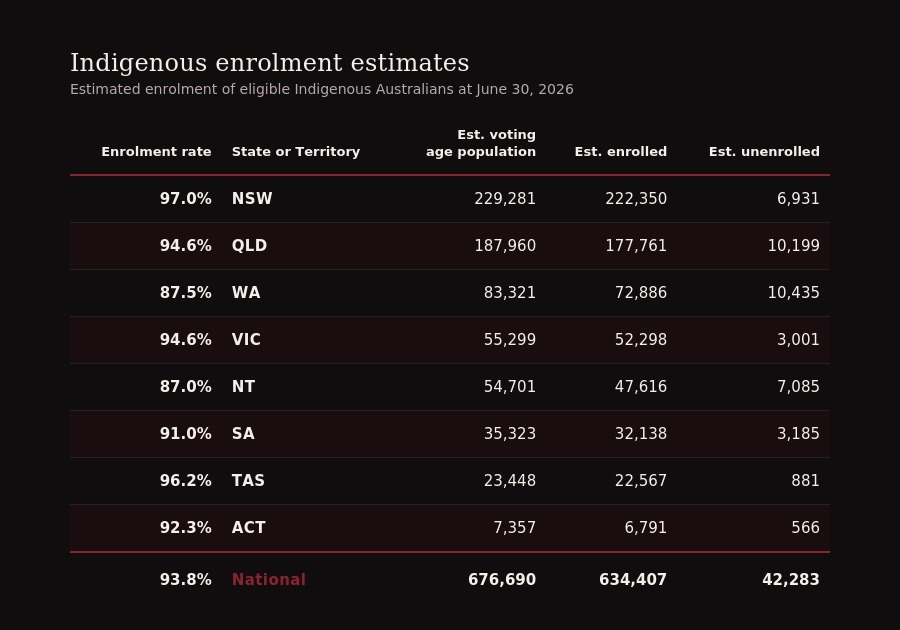
"Each state and territory is marginally different with some estimated enrolment rates increasing slightly, some stable and others with a slight dip - but all maintaining high levels," Mr Pope said.
"Indigenous enrolment rates in New South Wales and Tasmania are almost equal to overall enrolment rates in those jurisdictions, while Western Australia and the Northern Territory continue to have the highest proportion of unenrolled Indigenous Australians.
"We have seen a slight decline in the South Australian rate, largely driven by the pausing of direct enrolment activity that normally happens in the lead up to state elections."



