




The Northern Territory's Child Protection Minister has repeatedly failed to confirm whether she believes the Aboriginal and Torres Strait Islander Child Placement Principle (ATSICPP) supports the safety of First Nations children, despite the government arguing its new laws strengthen the Principle.
On Tuesday evening, the Country Liberal Party (CLP) Government passed its controversial child protection reforms, describing them as "the most significant overhaul of the Territory's child protection system in a generation".
The new laws remove the legal enforceability of the ATSICPP — designed to ensure children removed from their families maintain connections to family, community and culture — so that it applies only "as far as practicable".
.jpg)
As Aboriginal groups protested outside Parliament on Tuesday, government MPs defended the bill, arguing it did not diminish the Principle.
Blain MLA Matthew Kerle said the legislation "strengthens the Aboriginal child protection principle to a universal child placement principle while retaining important Aboriginal considerations", whilst Multicultural Affairs Minister Jinson Charls argued it "retains principles specific to Aboriginal children".
Chief Minister Lia Finocchiaro added: "We are also preserving the Aboriginal child placement principle which I know there has been a lot of concern about. This is still in the legislation."
Despite those assurances, Child Protection Minister Robyn Cahill has repeatedly declined to answer questions about whether she supports the ATSICPP.
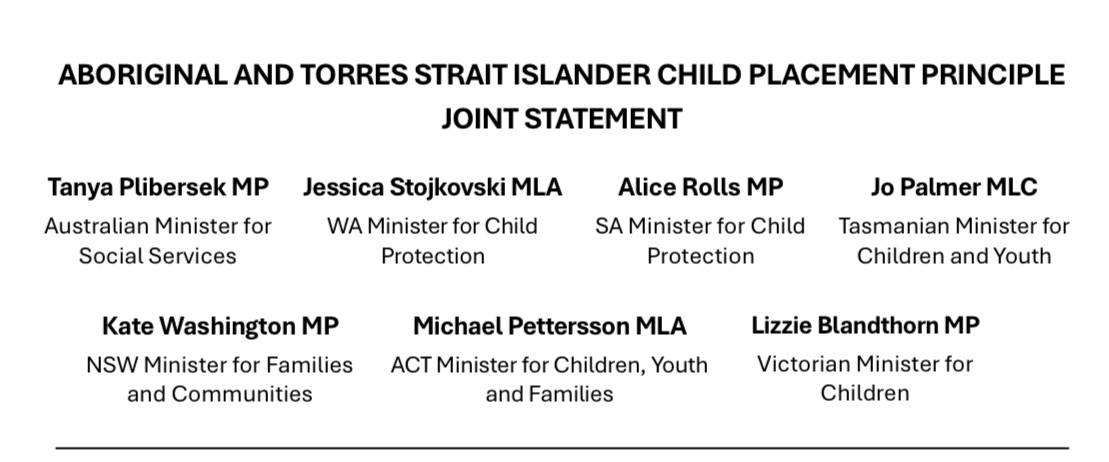
On Monday, National Indigenous Times reported Ms Cahill, along with Queensland Child Protection Minister Amanda Camm, did not sign a statement — endorsed by every other child protection minister in Australia — affirming that implementation of the ATSICPP is "entirely consistent with child safety".
The seven ministers said the ATSICPP "affirms the rights of Aboriginal and Torres Strait Islander children, families and communities by ensuring culture, family, community and Country are central to child protection decision making".
"A majority of the states and territories...recognise and abide by its critical objective to promote the best interests of Aboriginal and Torres Strait Islander children and young people, through recognition of the imperative of their continued connection to family, community and culture."
National Indigenous Times contacted the minister's office multiple times asking why she did not sign the statement, which followed a meeting of Community Services Ministers (CSM), alongside the Aboriginal and Torres Strait Islander Leadership Group, in Sydney last Friday — which Ms Cahill did not attend — and whether she backed its position that the ATSICPP is supportive of the safety, welfare and wellbeing of Aboriginal children and young people, as well as supporting the Principle in general.
The minister's office did not respond.
View this post on Instagram
On Tuesday, Ms Cahill criticised the ministers who signed the statement, arguing none of them "reached out to me to have a discussion about why we would take the approach we are, not one of them asked why we felt that it was so important to put safety first".
"And to be honest with you, that they don't think that that's important is something that I truly find incomprehensible," she told reporters.
"Here in the Territory, we have one goal, and that is to keep our children safe."
Asked on Wednesday night on ABC's 7.30 program if the bill made it more likely Aboriginal children will be removed from their families, the Minister stated: "Absolutely not."
"There has been zero lowering of the threshold," she said. "In actual fact, what it will do is make a Department more accountable to the work they have to do to keep those families connected and together."
%20(1).jpg)
However, experts disagree.
National Commissioner for Aboriginal and Torres Strait Islander Children and Young People Sue-Anne Hunter said the new laws will have "negative impacts on the care, safety and protection of First Nations children in the NT".
"Any politician, voice or commentator that says otherwise is incorrect," she said.
"The Northern Territory Government has undoubtedly misled the public, at the expense of Aboriginal and Torres Strait Islander children and young people."
The CLP Government's argument that opponents of the bill are effectively against child safety has angered many Aboriginal leaders, who say their submissions, public statements and work in the sector have always been focused on improving child safety, something the new laws will not achieve.
Shadow Minister for Children and Families and Child Protection Chansey Paech told Parliament the government was attempting to "divide Territorians into those who supposedly care and those who do not", labelling the approach "insulting" and a "dishonest characterisation of this debate".
"The question before us is not whether children matter," he said. "Of course they matter. Every child matters under existing legislation. The safety and best interests of a child are already paramount considerations in decisions made under the Care and Protection Act."
View this post on Instagram
A post shared by Senator Malarndirri McCarthy (@malarndirri)
While the CLP has promoted itself as improving accountability in the NT after the previous Labor government was mired in numerous controversies, Aboriginal organisations and community leaders have consistently argued they have failed to be consulted over key laws which will disproportionately impact First Nations people in the Territory.
"This is a government that thinks it knows what is best for Aboriginal people," Mulka MLA Yiŋiya Guyula said. "They are not experts. They are not Aboriginal people. They have not consulted experts or Aboriginal communities, but they think they know what is best."
The Yolŋu man said he was "angry and devastated" that the CLP had made "decisions about the removal of our children without the decency to talk with us, work with us, listen to our solutions and fix the problems".
"This is not something I will take lightly. It will cause harm and hurt many people," he added.
Earlier this month, the CLP-led parliamentary committee ignored evidence and expert advice and recommended the legislation be passed with only a minor amendment, despite 120 of the 150 submissions calling for the bill to be withdrawn or substantially amended.
Despite the widespread opposition, by pressing ahead with the reforms, the government "is choosing politics over evidence," argued SNAICC - National Voice for our Children chief executive Catherine Liddle.
"What we have seen is a politically driven agenda that has cut out Aboriginal and Torres Strait Islander voices, evidence-based reform and the people who work in this sector day in and day out," she said.



