




A statement supporting the Aboriginal and Torres Strait Islander Child Placement Principle (ATSICPP) has been signed by ministers from every state and territory except Queensland and the Northern Territory.
The ATSICPP — a reform introduced in the wake of the Bringing Them Home report — is designed to ensure children removed from their families maintain connections to family, community and culture.
However, experts say it is being challenged by both the Country Liberal Party (CLP) government in the Northern Territory, who have introduced highly criticised legislation that would alter the effectiveness of the ATSICPP, and in Queensland, where the Liberal National Party (LNP) government is considering the recommendations of a report into child safety, which argued that in some circumstances, the department has favoured the principles of the ATSICPP over child safety.
On Friday, Community Services Ministers (CSM) from the Commonwealth, states and territories met alongside the Aboriginal and Torres Strait Islander Leadership Group in Sydney. A communiqué after the meeting noted that the role of the ATSICPP in helping to reduce child removals, in line with Target 12 of the Closing the Gap Agreement.
"The Child Placement Principle consists of five key system elements, including prevention, partnership, placement, participation, and connection," the communiqué said. "The Committee recognises that evidence shows First Nations children achieve better outcomes when they are connected to family, culture and community."
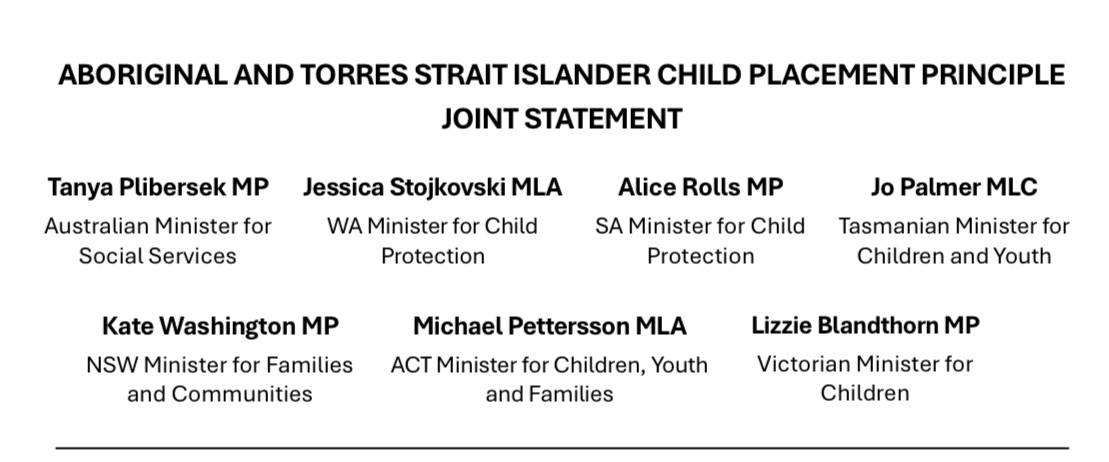
However, in a separate statement, the Federal Minister for Social Services, Tanya Plibersek, along with ministers responsible for child protection from Western Australia, South Australia, Tasmania, New South Wales, the Australian Capital Territory and Victoria, noted that only "a majority" of the states and territories, along with the Commonwealth, "maintain their continued commitment to the ATSICPP".
Neither the Northern Territory nor Queensland ministers responsible for child protection, Robyn Cahill and Amanda Camm, are signatories to the statement. Both have been contacted for comment.
Arguing the objectives of the ATSICPP are "entirely consistent with child safety", the seven ministers who signed the statement say it "affirms the rights of Aboriginal and Torres Strait Islander children, families and communities by ensuring culture, family, community and Country are central to child protection decision making".
"A majority of the states and territories...recognise and abide by its critical objective to promote the best interests of Aboriginal and Torres Strait Islander children and young people, through recognition of the imperative of their continued connection to family, community and culture."
The absence of support for the principle from both Ms Cahill and Ms Camm comes as both the Territory and Queensland governments have been criticised by human rights and legal groups for their treatment of First Nations children
Earlier this month, the CLP-led parliamentary committee in the Northern Territory ignored evidence and expert advice and recommended controversial child protection laws be passed, despite 120 of the 150 submissions calling for the legislation to be scrapped or substantially amended.
The proposed legislation removes the legal enforceability of the ATSICPP so that it applies only "as far as practicable", while also capping protection orders at two years in favour of permanency placements.
The committee's recommendation prompted the Northern Territory Children's Commissioner Shahleena Musk — a Larrakia woman and former crown prosecutor — to resign, citing concerns about the Territory Government's approach to governance, transparency and child protection reform.
In response to the legislation, the ministers' joint statement noted the "uniform view" of the Aboriginal Leadership Group that the bill "represents a diminution of the ATSCIPP" and will be detrimental to First Nations children in the Territory.
"A majority of the states and territories and the Commonwealth express concern that the NT's Bill has been progressed against the strong recommendation of Aboriginal stakeholders, as a regrettable divergence from the Safe and Supported Partnership Agreement made by all Australian governments and the Aboriginal Leadership Group to implement the ATSICPP to the standard of active efforts," the statement read.
"These jurisdictions unequivocally affirm that the ATSICPP, and its requirement for connection to community and culture, is supportive of, rather [than] at odds with, the safety, welfare and wellbeing of Aboriginal children and young people."
Despite the ATSICPP, the latest data shows only 17 per cent of First Nations children aged 0-17 in out-of-home care in the Northern Territory were placed with an Aboriginal and Torres Strait Islander relative or kin — the lowest rate in the country.
Catherine Liddle, CEO of SNAICC - National Voice for our Children, said the ministers' statement was virtually unprecedented. She argued the NT is "becoming a pariah state when it comes to the care and safety of Aboriginal children".
"A statement from every other Child and Family minister from across the country reinforcing the very principle you're trying to destroy should be setting off alarm bells throughout the NT Ministry that they have got things horribly wrong," she said.
The Arrernte and Luritja woman said she felt "deeply ashamed" as a "proud Territorian" about how the government is "treating some of the most vulnerable children and families across the state".
"If the NT Government truly cared about the safety of children," Ms Liddle said, "they would be doing what the evidence and the sector has been calling for — investing in family supports and early interventions, before families are in crisis and children are removed.
"We all agree that children do best when they grow up with family, loved and safe, knowing who they are and where they belong."
Writing in NT News on Monday, Minister Cahill — who criticised Ms Musk's comments after her resignation — said: "The Bill does not remove recognition of the unique importance of Aboriginal culture, language, Country or kinship."
"Those considerations remain central to decisions involving Aboriginal children as culture is not an optional extra, it is central to identity, belonging and healing," she said.
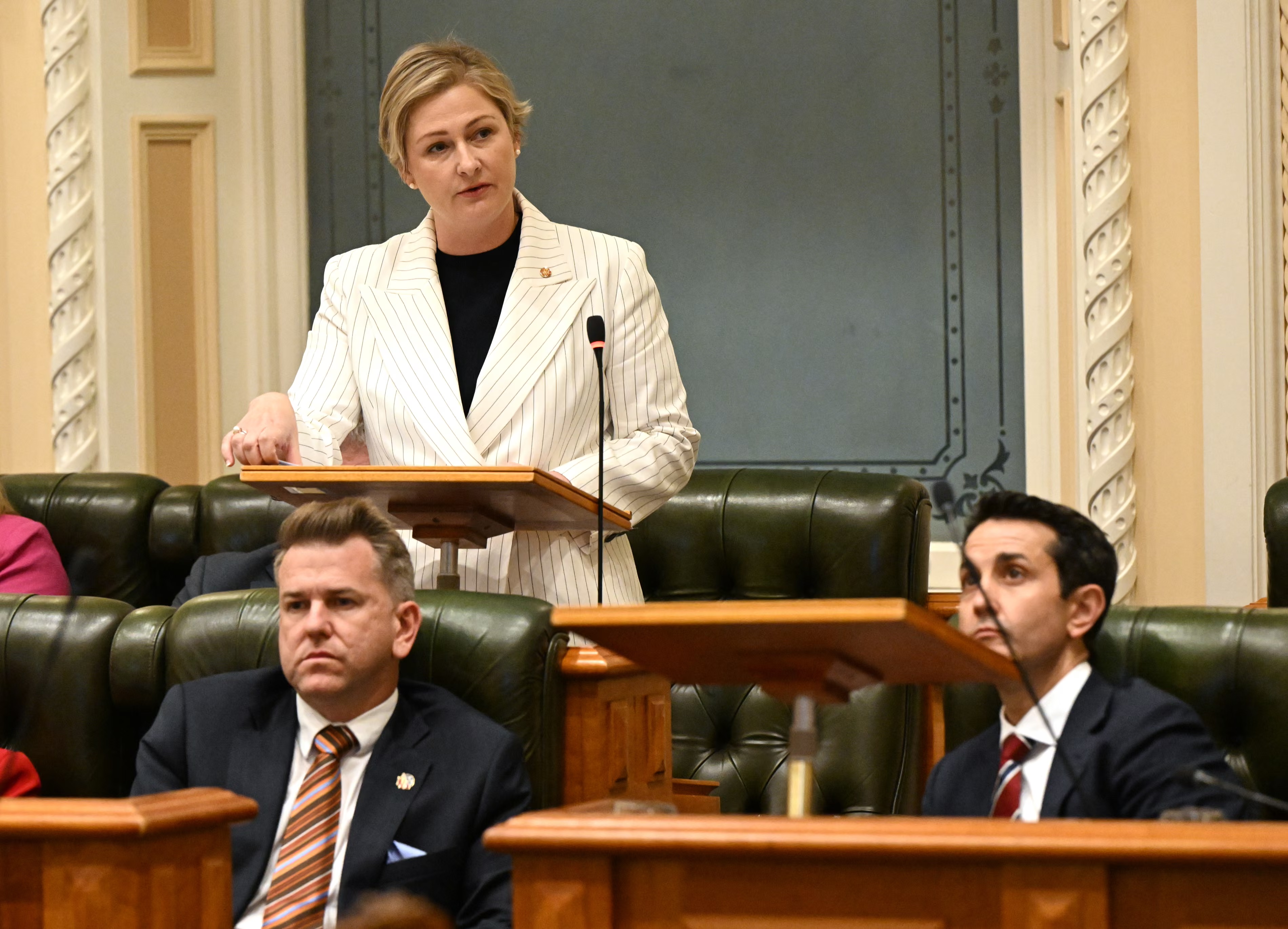
In Queensland, a report into child safety handed down last month recommended ensuring adoption is not restricted by a child's cultural background or ethnicity, and amending the Child Protection Act to establish adoption as a third permanency pathway for all children.
Aboriginal and Torres Strait Islander children in Queensland are placed in out-of-home care at 9.3 times the rate of non-Indigenous children. While First Nations children make up around 8 per cent of Queensland's youth population, they account for almost half of all children in state care.
The report also argued the department had shown a "tendency to give tacit priority to achieving the objectives of the ATSICPP in priority to an evaluation of the child's best interests".
"The commission considers pre-determined assumptions about the best interests of Aboriginal and Torres Strait Islander children represents both a risk to the safety of Aboriginal and Torres Strait Islander children as well as an intangible impediment to reforming the child safety system," the report said.
It is understood a government response to this inquiry will be handed down in the coming weeks, and will canvass issues around the ATSICPP.
When the report was handed down, it prompted National Commissioner for Aboriginal and Torres Strait Islander Children and Young People Sue-Anne Hunter to state: "We want to be incredibly clear... The ATSICPP does not interfere with the safety of a child; it enhances the protections."
"When it comes to the safety of our children, the ATSICPP is always considered alongside the paramount principle — it's not one or the other," she said. "Where the Queensland Government has misapplied the principle, the answer is to apply it properly, to the standard of Active Efforts, not to write it down to second place in the law."



