



Nearly all cases of cervical cancer are linked to human papillomavirus (HPV), but HPV vaccination rates in Australia are declining, and falling further backwards among Aboriginal and Torres Strait Islander young people.
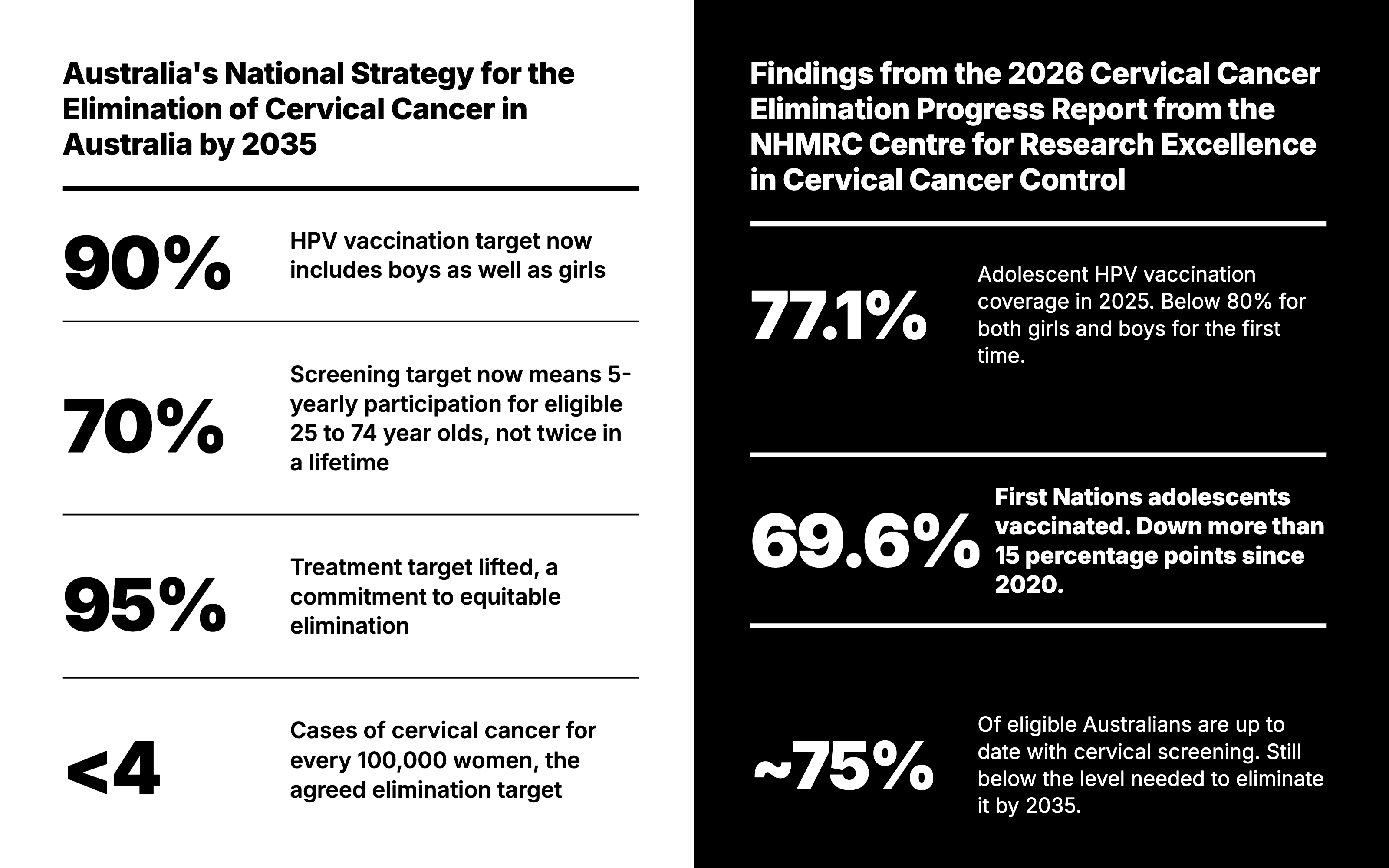
Between 2020 and 2025, HPV vaccination rates for First Nations adolescents, both male and female, fell by over 15 percentage points to 69.6 per cent.
It's a concerning figure for a one of the few cancers close to entirely preventable, with elimination as a public health problem seen as achievable.
This is according to the Cervical Cancer Elimination Progress Report from the NHMRC Centre for Research Excellence in Cervical Cancer Control (C4), with renewed action required.
November 17 is World Cervical Cancer Elimination Day.
While linked to more than 90 per cent of cervical cancer cases, HPV is a common virus which can affect all people and can cause a range of conditions, often asymptomatic, and generally considered a sexually transmitted infection (STI), transmissible by skin contact.
Vaccinations are usually administered to younger people in 12-13 year olds via schools.
When it comes to cervical cancer, HPV screening is recommended for anyone with a cervix from the age of 25, Professor Lisa Whop explains.
Screening participation, which can identify precancerous risk, is also falling below expectations for the NHMRC, at around three quarters of the eligible population up to date.
Australia has a National Strategy for the Elimination of Cervical Cancer, targeting a 90 per cent HPV vaccination rate, greater frequency of screenings and less than four cases per 100,000 women.
The strategy aims for the elimination of cervical cancer by 2035.
Professor Whop is a Gumulgal and Wagadagam Torres Strait Islander epidemiologist and associate director of the Australian National University's Yardhura Walani (National Centre for Aboriginal and Torres Strait Islander Wellbeing Research).
Cervical cancer is a "disease of inequity", she told National Indigenous Times.
"I would say we've made an incredible amount of progress, and cervical cancer still remains one of the cancers that we can almost completely prevent," she said.
Professor Whop doesn't see declining prevention methods necessarily as a lack of intention from the public, but from her perspective "a system that is not meeting the needs of those who need to be vaccinated and screened".
"We've made remarkable progress, huge gains in Australia ... and are going to largely be one of the countries that could reach elimination first", she said "but that won't include certain parts of the population, including Aboriginal and Torres Strait people, which is extremely concerning and not good enough."
On vaccination rates, the trail of COVID 19 is likely having an impact, Professor Whop expects.
Distrust has probably crept in, she added, possibly complacency and school attendance rates have not returned to the same level they were pre-pandemic.
There's also many questions being asked to land on an informed choice, particularly with First Nations adolescents, and their caregivers, Professor Whop has worked with in Queensland, she said.
At present, the 2035 goal is at some risk.
Prevention a 'gift' for future generations if work is put it
"We've made extraordinary progress towards eliminating cervical cancer, but that progress cannot be taken for granted," said Professor Julia Brotherton.
Professor Brotherton works within Cancer Prevention Policy at the University of Melbourne, and was lead author of NHMRC's report.
"Anyone aged 25 or under who has missed their HPV vaccination can catch up with a free single dose. I encourage young people and parents to speak with their GP, nurse or pharmacist."
There's positives to focus on, however.
"I think having the community, the whole community engaged in this conversation around this is a gift we can give to future generations...an amazing conversation to have, and almost everyone will want to sign up to."
Cervical screening self-collections available present as a "game-changer" she said, particularly for those without a regular GP, and providing an alternative to what can be an invasive experience.
A trusted provider isn't available to everyone, so self-collection can make screenings more possible, she added.
"Getting the message out there around self-collect and maintaining and investing better in the HPV vaccination is really important for all of our communities, but particularly for Aboriginal and Torres Strait Islander communities," Professor Whop said.
In remote communities, progress made here has been remarkable, Professor Whop added.
"What we're saying is, when we're trying to prevent when you get the vaccine, we're trying to prevent the virus that causes cervical cancer. And the earlier you get it, the better."
In the broader population, HPV vaccination rates have fallen to 77.1 per cent for both male and female adolescents.
Looking long term, rates below 80 per cent isn't enough to achieve elimination of targeted HPV types," NHMRC outlines.
"So cervical cancer, the way that I see it, and the way that it impacts the world is definitely a disease of inequity, and we see how that inequity plays out here in Australia," Professor Whop said.
"And the work left here to do in Australia now is to make sure that every person who needs a vaccine and every person who needs a screen has one. And I think we've got all the tools at our disposal."



