




Arizona Haddon, a recent Masters graduate in Urban Planning from the University of Auckland, has a deep-seated passion for placemaking, ignited during her upbringing in Tāmaki Makaurau.
Spending her childhood immersed in various neighbourhoods across the city, Ms Haddon developed a keen interest in understanding the dynamics of different communities.
Her formative years were enriched by the experiences of visiting her maternal grandparents in Browns Bay and her paternal grandparents in Mt Eden.
With familial roots connecting her to Ngāti Hauā in the Waikato through her mother and the villages of Musumusu and Lu'ua in Samoa through her father, her upbringing fostered her curiosity about the relationships between people and the places they inhabit.
"The rest of my family were mostly spread across Tāmaki Makaurau and I have memories of visiting relatives in different parts of the city," Ms Haddon said.
"I think my interest in placemaking stems from being a child and seeing all these different neighbourhoods, and the kinds of communities that lived there."
Ms Haddon's academic journey led her to delve deeply into the complexities of urban planning.
Graduating with first-class honours from the University of Auckland's Masters of Urban Planning (Professional) program, her studies provided her with the tools to explore the intricacies of why certain groups of people are drawn to specific communities and housing inequity.
"I think the biggest highlight has been having the opportunity and the tools to interrogate something that doesn't sit right with you," she said.
"For me, that has been housing inequity and later the intersection between Te Tiriti o Waitangi, local government, and planning issues."
Before pursuing her Urban Planning postgraduate studies at the University of Auckland, Ms Haddon completed her undergraduate degree in Sociology at Te Kunenga ki Pūrehuroa, Massey University.
Despite the constant challenge of managing multiple commitments, she also grappled with a sense of 'climate depression' at the outset of her Masters program.
"I took a resource management law paper and an environmental planning paper in the same semester," she said.
"Together, they drove home the extent of irreparable damage that has been done to our whenua and taonga by poor development practices, and the politicised nature of decision making that sits behind it all.
"I remember feeling very hopeless about the state of our planet and a lot of grief for the whānau that are bearing the brunt of this crisis."
The rollercoaster journey proved life-changing for Ms Haddon, leading to valuable new connections and ultimately securing her a position as a District Planner with the Thames-Coromandel District Council.
"It is exciting and varied work that I am well supported in. I'm really enjoying learning about the Waikato region where my whānau are originally from," she said.
"This place is rich in whakapapa, you can just tell from its extraordinary landscapes."
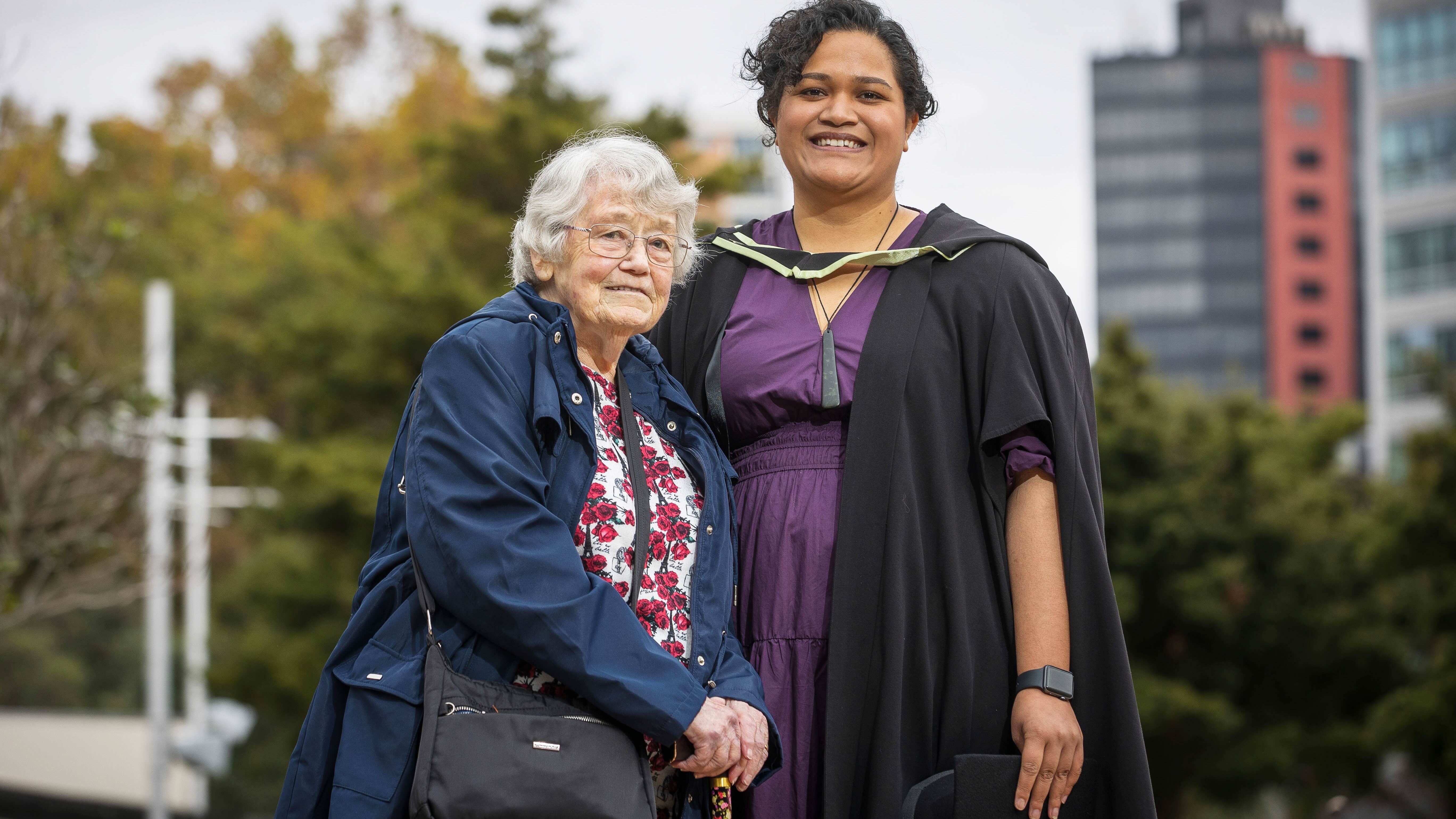
She acknowledges her grandmothers, Judith Haddon and Siulagi To'oala, as significant sources of motivation, emphasising their unwavering belief in the value of education, especially for women, despite neither having the opportunity to pursue studies beyond high school.
"Both of my grandmothers have been integral to me actually completing my degrees, they've been my sounding boards, carers, and uplifters," she said.
She recalls approaching the finish line of her undergraduate degree, and becoming more self-conscious about a lack of understanding of the system she was criticising.
"I think that's my Samoan upbringing – we're generally taught not to open our mouths until we've listened to all the different points of view," she said.
Ms Haddon persevered, opting to 'follow her nose' and applied for the Master's degree in Urban Planning.
She was awarded the 2022 Kupe Leadership Scholarship relieved her of financial burdens, solidifying her determination to continue her studies.
"I thought maybe if I understood the system better, I might one day be in a position to make a positive difference to it," she said.



