




Bábbarra Women's Centre and Tharangini Studio will join forces for their new woodblock textile collaboration and exhibition at the Bangalore Convention Centre – showing from the 4th to 20th of October, 2024.
In September 2024, three emerging Bábbarra artists will travel to India to participate in a collaborative woodblock workshop at Tharangini Studio.
The workshop, also including four local Indian designers, will study and co-create textiles using woodblock and organic dyes. These textiles together with other designs by Bábbarra Women's Centre will be included in the Bangalore Convention Centre exhibition.
The collection of textile artworks will then travel to Darwin to be exhibited in 2025 – with the exhibition venue yet to be announced.
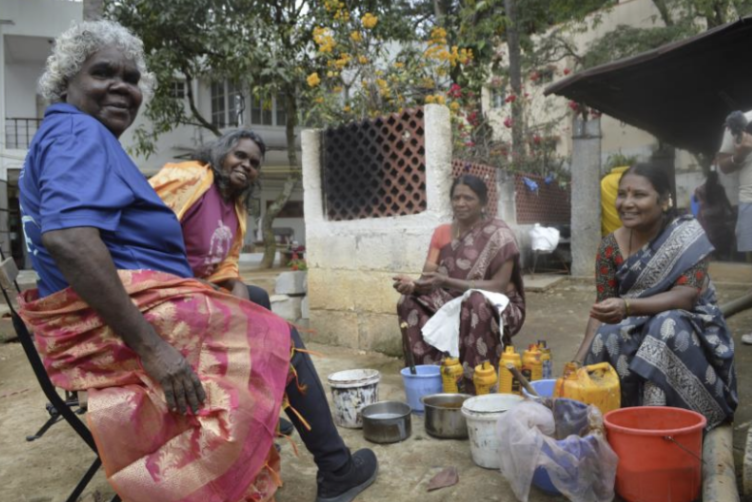
Janet Marawarr and D. Wurrkidj with colourists from Tharangini Studio, Bangalore. (Image: Jessica Stalenberg)
Situated on the Arafura coast of West Arnhem Land, Bábbarra Women's Centre, has been awarded a grant from the Centre for Australia - India Relations' Maitri Cultural Partnerships program. This funding strives to support Bábbarra to further their exploration of woodblock printing and convert some of their ancestral lino designs into teak.
Bábbarra Women's Centre manager Jessica Stalenberg travelled with senior Kuninjku artists, Janet Marawarr and Deborah Wurrkidj, to Kolkata last year to open their travelling exhibition 'Jarracharra; Dry Season Wind' at the Indian Museum.
While in India the group visited Tharangini Studio in Sadashivanagar, Bangalore where they discovered a synergy between their respective printing methods.
On her journey to India in 2023, Wurrkidj shared her experience, recounting the learning and observing she engaged in during the trip.
"We arrived in this country [India], we caught the plane to visit this new place. It's totally different to where we come from. And then since we arrived here, we have been very busy looking around taking everything in – learning and observing how people are doing things here, in India. They're really using a lot of different artistic methods printing with hand-carved woodblocks applied with ink to cover the woodblock surface with ink ready for the fabric," she said.
Tharangini Studio owner Padmini Govind explained that her vision is to "keep traditional woodblock printing relevant among the current generation" via ongoing collaborations and workshops.
To produce dye for woodblock printing, Tharangini uses organic ingredients like turmeric for yellow and Indian madder for red. The artisans stone ground them as metal grinders react with the dye and change the colour. The yellow turmeric colour speaks to the traditional bush dyes used by pandanus weavers in the West Arnhem region. Man-kurdudjumuk yellow colour comes from the root of the man-kurdudjumuk plant (coelospermum reticulatum) which is harvested from the sandy country near the flood plains.
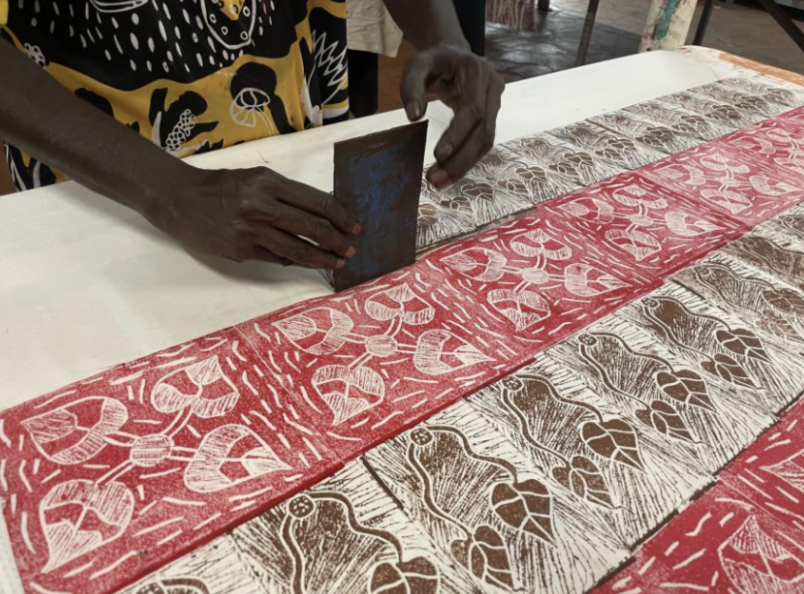
Aside from traditional woodblock printing, Tharangini Studio also work with discharge printing, where the pattern is formed by removing the dye from a dark fabric.
"Nowadays industries use chemicals to discharge the dye, but we retain the traditional organic means by using a natural resin such as gum Arabic," said Padmini.
When it comes to printing and techniques Bábbarra Women's Centre predominantly uses the technique of linocut on fabric, screen print and silk bush dye. The lino printing, which utilises linoleum sheets to hand press motifs on fabric commenced in the early 2000's when Jayne Nankivell was engaged to teach lino printing techniques as a means of economic empowerment with the early designs made into skirts and dresses. Today the favoured lino printing method continues and is passed down from generation to generation of women artists.
"The ability to preserve the lino tiles designed by generations of women leaders in Maningrida by carving the designs into teak is exciting. We have uncovered a cracked kunngol (clouds) design by Helen Lanyinwanga (dec) that will be made into wood," said Stalenberg.
"Lanyinwanga was the mother of Deborah Wurrkidj and the grandmother of Abigail Gurawiliwili. Deborah travelled to India in 2023 and Abigail will travel later this year for her first experience abroad. Padmini's team have been working carefully to ensure each woodblock retains the artists unique handwriting whilst adjusting the blocks to interlock organically. The lino tiles selected by the artists include stories that represent all of the language groups working at the centre including Ndjebbana, Kuninjku, Burarra, Kune and Gur-goni."
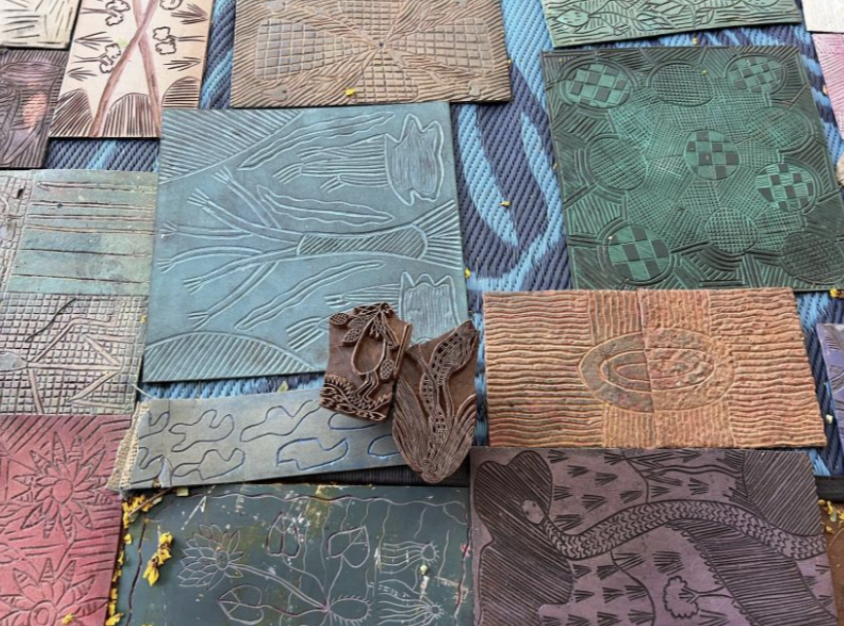
Founded by Ndjébbana leader Helen Williams in 1987, Bábbarra Women's Centre has transformed from from a humble women's refuge and creche to a thriving textile hub.
Bábbarra Women's Centre is operated by the 40-year-old Aboriginal owned Bawinanga Aboriginal Corporation, which generates economic opportunities for the regions' clan groups to live on their Homelands.
The centre is not just a custodian of Indigenous heritage, but also a creative studio where ancestral designs are printed on fabric to generate income for both the designer and printer. Designs created at the centre are further applied in contemporary fashion, homewares as well as exhibited internationally.
This month, Bábbarra Women's Centre has also launched a major collaboration with sustainable accessories brand Helen Kaminski.
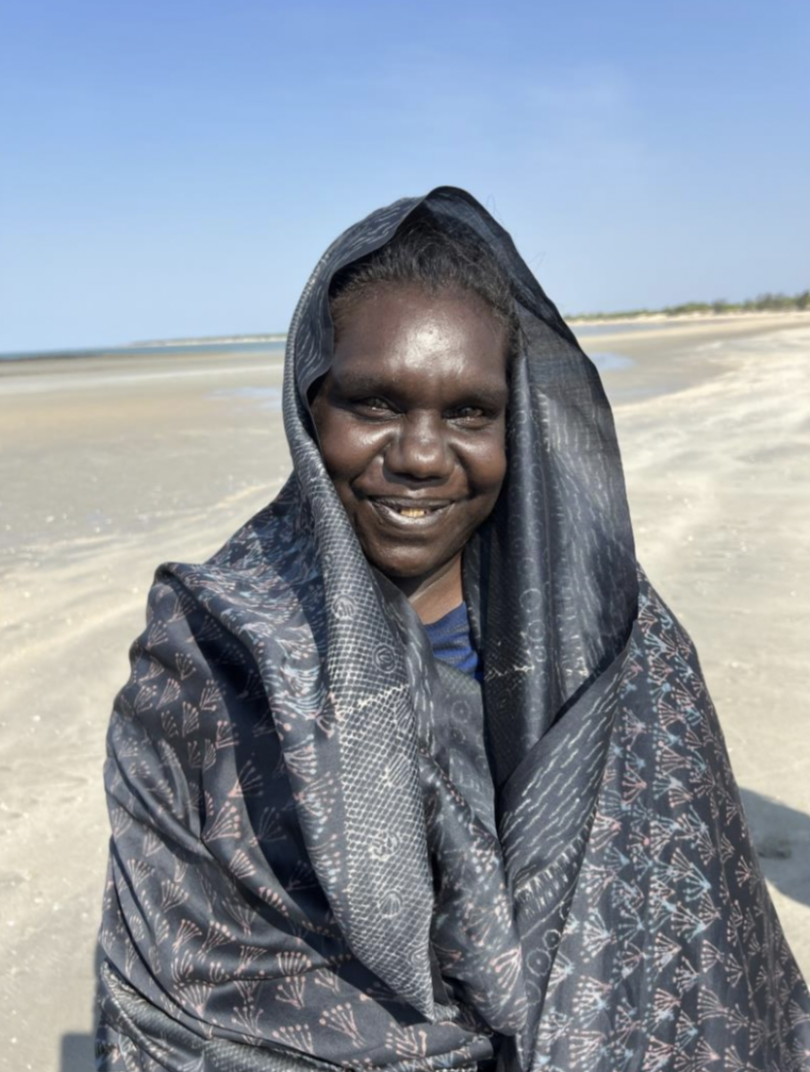
Rosanna Bonson adorned in Tharangini - Babbarra Indigo Sari by Deborah Wurrkidj and Janet
Marawarr. (Image: supplied)
Striving to make waves in global and community-centred artistry, Bábbarra Women's Centre and Tharangini Studio hope to promote connection and practical cooperation between Australia and India via the timeless craft that is Woodblock textile design.
The woodblock textile collaboration and exhibition will be held at the Bangalore Convention Centre from the 4th to the 20th of October, 2024.
For more fashion, beauty and lifestyle news subscribe for free to the Style Up newsletter.



