




The number of children aged 13 or under being housed in Queensland watch houses has increased 50 per cent in the past 12 months.
The statistics form part of a report tabled by the Office of the Public Guardian in Queensland parliament on Tuesday, and paint a picture predicted by human rights, Indigenous and legal groups in the face of the Human Rights Act being suspended in 2023 by the then-Labor government to allow children to be held in the adult facilities.
These concerns have only been exacerbated after the new LNP government enacted their "adult crime, adult time" laws, which will see children as young as ten face lifetime prison sentences for some crimes.
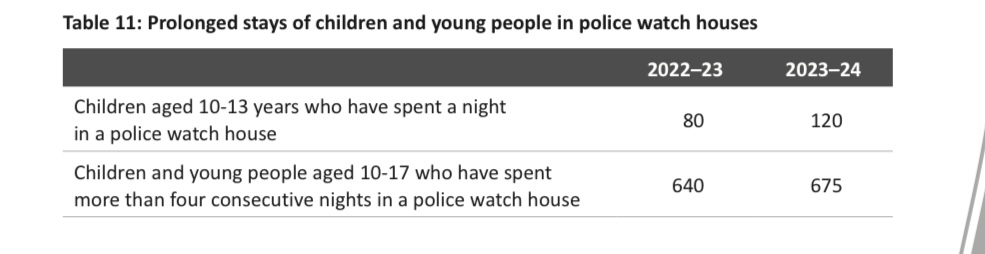
In 2023-24, 120 children aged 10-13 spent at least one night in an adult watch house—a 50 per cent increase from the year previous.
Children and young people aged 10-17 who spent more than four consecutive nights in a watch house rose from 640 to 675 in the same period.
"Over the last year, we have seen a number of reforms to the youth justice system that are expressly incompatible with the human rights of children and young people," the report stated.
"We are concerned these reforms will cause harm to vulnerable children and young people and will not achieve their intended purpose of keeping the community safe."
The office said they investigated 2,254 "issues" - a 76 per increase on the previous year - making 90 "formal complaints" on behalf of children and young people in watch houses to agencies including the Department of Youth Justice and the Queensland police service.
Issues raised by children included lack of services available to them, including health, mental health, legal or youth justice support, overcrowding and staff conduct.
"We have observed that when the number of children and young people being detained in police watch houses increases, there is also an increase in the number of allegations raised by children and young people relating to police misconduct," the report said.
Whilst new premier David Crisafulli called the practice of housing children in watch houses "wrong" during his pre-election blitz, promising less would be held in the facilities in a government he leads, he also admitted at the passing of his new legislation more children would spend time in the facilities.
As of 6 am on Wednesday, January 8, 25 children were being held in watch houses across Queensland—21 of them First Nations.
The longest one of the current children had spent in one of the facilities was 9 days.
According to guidelines, children are not meant to be kept in a watch house for more than 72 hours, however Youth Advocacy Centre's chief executive Katherine Hayes previously told National Indigenous Times: "A psychiatrist who works in the watch houses has said that he sees decline in mental health after 24 hours in children and they come out angrier and more damaged."
Criticism of the use of facilities has been wide-ranging, but little has been done to change the practice.
In October, National Indigenous Times reported two 13-year-old Indigenous children were kept in watch houses for 26 and 25 days respectively.
A series of heavily redacted letters sent by Ms Hayes to government officials, including Queensland then-Premier Steven Miles, highlighted instances of children being subject to racist abuse, being held overnight in solitary confinement, and having their blankets and mattresses taken away from them as punishment.
In January, two Aboriginal children with mental and cognitive conditions, as well as intellectual impairments, had been held in watch houses in South-East Queensland for 15 days.
Furthermore, Ms Hayes said in April, two 14-year-old Aboriginal boys had been in a watch house for 28 and 30 days respectively, a 13-year-old Aboriginal boy had been in a Brisbane watch house was for 15 days, and there was also an 11-year-old Aboriginal boy and four 13-year-old children in the facilities.
In July, ABC's 7.30 showed footage of a 17-year-old First Nations boy being struck with a baton by police at the Richlands watch house in Brisbane.
It prompted Queensland's Family and Child Commission (QFCC), Natalie Lewis, to say: "That's violence, violence against a child… whether they're 10 years old or 17 years old.
In the same month, the Human Rights Commission criticised the decision to house children in adult facilities and expressed "grave concern" at footage showing an intellectually disabled, 13-year-old First Nations child being forcibly restrained and kept in an isolation cell.
"Current approaches to children's detention disproportionately affect children who have not received the necessary social and community support – and too often these are First Nations children," Aboriginal and Torres Strait Islander Social Justice Commissioner Katie Kiss said in July.



