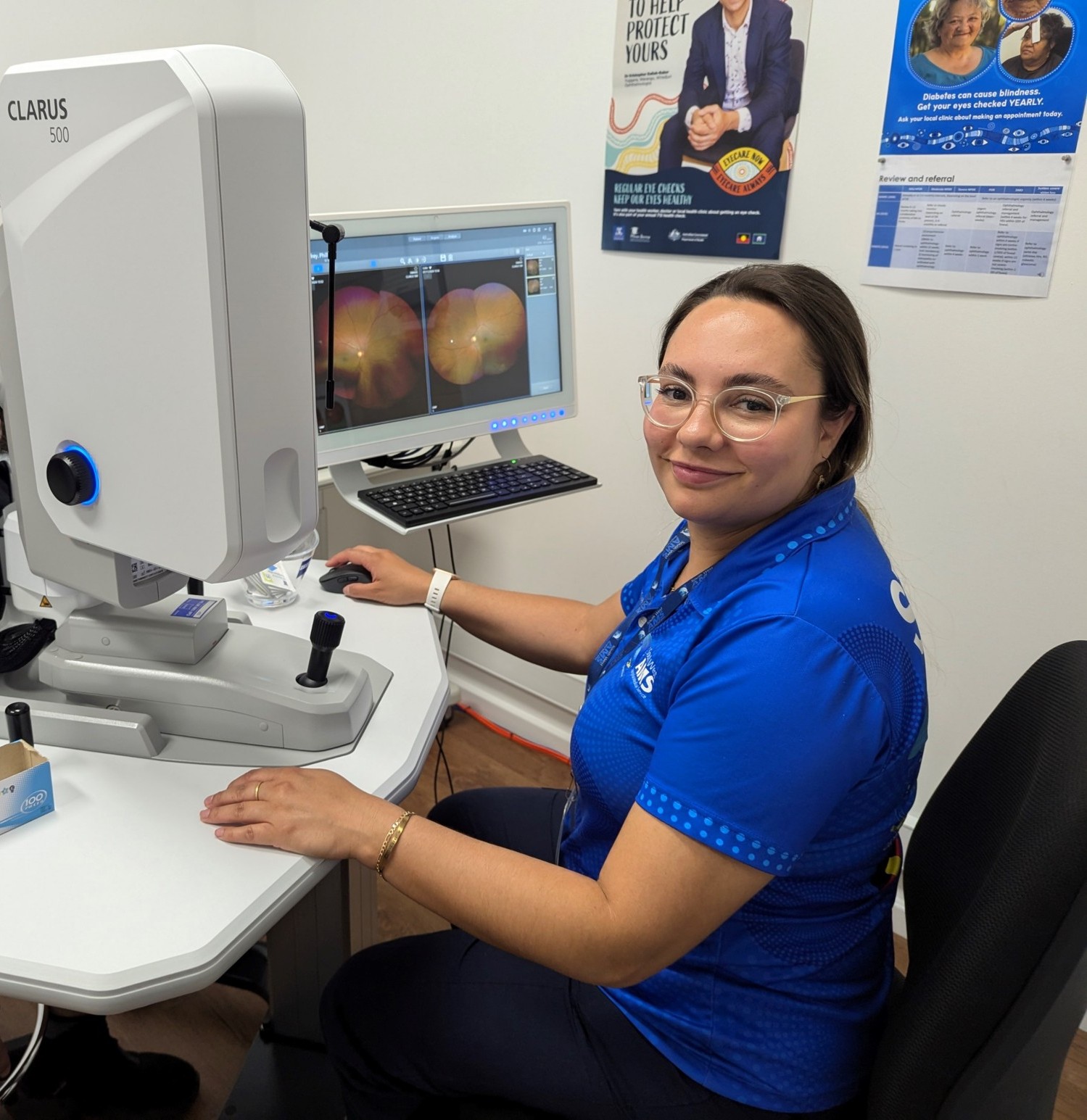
As a Noongar/Njamal woman with deep family roots in Western Australia's Great Southern and Pilbara regions, I have spent the last decade working as a registered nurse, inspired by the resilience of my mother – a proud Stolen Generations survivor and fellow nurse. My journey into healthcare has been shaped by her strength, and it's through my experiences and the teachings of my family that I find myself working towards a brighter future for Aboriginal eye health.
I work as a Registered Nurse at the South West Aboriginal Medical Service (SWAMS) in Bunbury, where I've had the privilege of working in our newly established eye clinic for the past six months. The clinic, which opened its doors in May 2024, has already seen a profound impact on our community, treating over 300 clients and offering essential services, including dilated diabetic retinopathy examinations, red-eye treatments, and spectacle prescriptions. These interventions have prevented blindness and improved overall health outcomes for individuals with complex conditions like diabetic macular oedema or advanced cataracts. The clinic provides timely referrals to tertiary care, ensuring a seamless healthcare experience for our clients.
The need for comprehensive eye care in Aboriginal communities is critical, as research shows that over 90 per cent of vision loss in these populations is preventable or treatable with timely intervention. However, many Indigenous communities continue to face barriers such as a lack of local eye care services, limited access to specialised treatment, and socio-economic challenges that prevent individuals from seeking necessary care. As we continue to address these issues, the work at SWAMS is paving the way toward closing the gap in Aboriginal eye health.
A key aspect of our clinic's success is its culturally safe care model. From day one, we have strived to build relationships with our clients, ensuring they feel respected and understood in a healthcare setting. This approach is integral to providing effective care for Aboriginal people, who have often felt marginalised within the broader healthcare system. Our eye clinic is not just about treating vision problems; it is about empowering our people to take charge of their health, knowing they will receive care tailored to their needs.
The clinic is supported by The Fred Hollows Foundation , The University of Western Australia, Edith Cowan University, University Department of Rural Health South West and Zeiss. This partnership ensures that our clinic is not only a space for patient care but also a training ground for the next generation of healthcare professionals.
Over 20 final-year optometry students have already gained invaluable experience in our culturally responsive setting. By fostering the growth of the workforce in regional and rural communities, we are investing in sustainable, long-term improvements in Aboriginal health.
The work being done in our eye clinic is a testament to the transformative power of healthcare access and education. However, the journey is far from over. Gender equity is an essential factor in achieving a fully inclusive workforce, where women in healthcare can play a central role in shaping the future of Aboriginal health. As a proud Noongar/Njamal woman working in healthcare, I am passionate about inspiring others, particularly young Aboriginal women, to pursue careers in medicine and nursing, just as my mother inspired me.
Despite the hurdles my family and I have faced – including the trauma of the Stolen Generations – I draw strength from her perseverance. My mother raised five children, completed a Bachelor of Nursing, and has worked at SWAMS for 23 years, demonstrating that even in the face of adversity, we can break through barriers and contribute meaningfully to our communities.
While much work remains to be done in closing the gap in Aboriginal eye health, the success of our eye clinic is a promising step forward. I am deeply proud of the difference we are making, and I look forward to seeing this model grow and expand across the country.
I am committed to furthering my own training in optometry, with the hope of one day becoming an optometrist myself, to continue to serve my community and further advance Aboriginal health outcomes. By working together, we can ensure that Aboriginal people receive the care they deserve, and that our health systems become more inclusive, equitable, and culturally competent.
The path forward is clear, and with each small victory, we are moving closer to closing the gap in Aboriginal eye health. It's not just about vision; it's about empowerment, education, and ensuring that our communities have the resources they need to thrive.
Sarah Haynes is a Registered Nurse and a proud Noongar/Njamal Woman.