




Aboriginal and Torres Strait Islander people are advised the following article contains the names of people who have died.
In 1963, before the Wave Hill walk off, before the Tent Embassy, before the 1967 referendum, and a generation before the Mabo High Court decision, the Yolŋu hatched a plan.
Told they did not own the land they had occupied for close to 60,000 years, and therefore would have to make way for bauxite mining leases that had been granted to a private company.
The white pegs in the ground, staking a claim for Yolŋu land - without permission - prompted one local to ask: "Yol nha djal? - Who wants this?"
They turned to the non-Indigenous superintendent of the mission at Yirrkala in North-East Arnhem Land, Methodist minister Edgar Wells, to help petition the Commonwealth government.
The Yolŋu, in kind, unassuming language, asked for a seat at the decision table.
Mr Wells' wife, Ann E. Wells typed the petition on her Remington typewriter, which featured the signatures of 12 Yirrkala residents - nine men and three women - and 12 copies were made with four of them pasted on the bark of local trees.
Painted with Ochre pictures of turtles, fish and goannas by Elders, the Bark Petitions explained the land that had been set out for bauxite mining had been Yirrkala tribes' hunting and gathering land for thousands of years.
"The Yolŋu people weren't protesting against mining, per se," Clare Wright, Professor of History at La Trobe University, says.
"They weren't protesting the digging up, because people had come and taken resources from their land for centuries already.
"What they were protesting against was not having been consulted in that process, and seemingly getting anything in return, because those two things alone broke Yolŋu law."
In the introduction to her new book, Professor Wright says the battle between the federal government, the miners, the missionaries and the Yolŋu over the right to define and control a tiny tip of North-East Arnhem Land is more complex and compelling than a traditional winners-and-losers paradigm suggests.
Nonetheless, she notes, there is no doubt who came out on top.
The mining town of Nhulunbuy is testament to that.
However, the story of the petitions is one that historians have seldom told - none in any detail.
This, despite Arnhem Land being some of the most traversed and most documented Country in the nation.
"It astounded me how little there was on this," Professor Wright said.
"It astounded me that a story that was universally acknowledged as being the beginning of the land rights movement would occupy two or three paragraphs in a book about the land rights movement."
View this post on Instagram
It took until 2010, when in a "sliding doors moment," Professor Wright's then husband Damien, a craftsman, was contacted by the late Yolŋu leader and land rights champion Dr Yunupingu to see if he would be interested in assisting him with the idea of sustainable enterprise for his community.
The family, three young children included, made the long journey to Yirrkala and her connection with the Country began.
After about a month, Professor Wright was adopted - a "loose" term in the kinship system which allows a non-Indigenous person to be brought into the community and have a relationship with everyone - by Dr Yunupingu's fourth tribal wife, Valerie Ganambarr.
"'Manymak', she said. 'I am adopting you. You call me yapa—sister. My djamarrkuḻi, children, are your djamarrkuḻi. Your djamarrkuḻi are my djamarrkuḻi. We call them waku.'"
Then, months into her time on Country, Dr Yunupingu turned to Professor Wright and spoke to her for the first time.
"What do you do?" he asked.
"I'm an historian dhuway [kinship name for 'husband']," Professor Wright replied.
After a while, Dr Yunupingu responded: "You tell stories, so do I."
From then on, Professor Wright said, that's what he did.
Over research and more conversations, Professor Wright said it dawned on her that the Bark Petitions were to the 20th century, what the Eureka flag had been to the 19th century.
"In terms of an item, a material object, that had been made by the people proclaiming: 'we are the people; we are here; we must be taken seriously. Our voice must be heard,'" she said.
In 2020, Professor Wright ventured to Gunyangara, in North-East Arnhem Land, for the funeral of Dr Yunupingu's second wife. By this stage, the land rights titan was confined to a wheelchair, having lost a leg to diabetes.
He encouraged her "very strongly" to write about the Bark Petitions. Despite being only 15-years-of-age at the time, he knew many of the signatories.
In the book, Professor Wright says she was driving Dr Yunupingu to the ceremony grounds when she asked him what he called the petitions.
After an agonising silence, like "waiting for an echo that doesn't come back," he answered.
"Ṉäku Dhäruk."
Ṉäku – Nah-koo, for the Darwin stringybark.
Dhäruk – Dah-rook, for message.
"No whitefella, it seems, had asked this question before," Professor Wright says in the book.
In 2021, when Professor Wright went back for more field work, he was unequivocal.
"Keep going and keep going and keep going and don't stop until it is finished," Dr Yunupingu said.
Furthermore, he was clear in how the process would go.
"We sit down together with a pen and a paper and a tape recorder and a computer and we tell 'em, we tell 'em the dhäwu [story], the stories. Tell the story about the bauxite, how the bauxite happened, and how it was implemented, how it was a bauxite of lies by the whitefellas, and the big bosses."
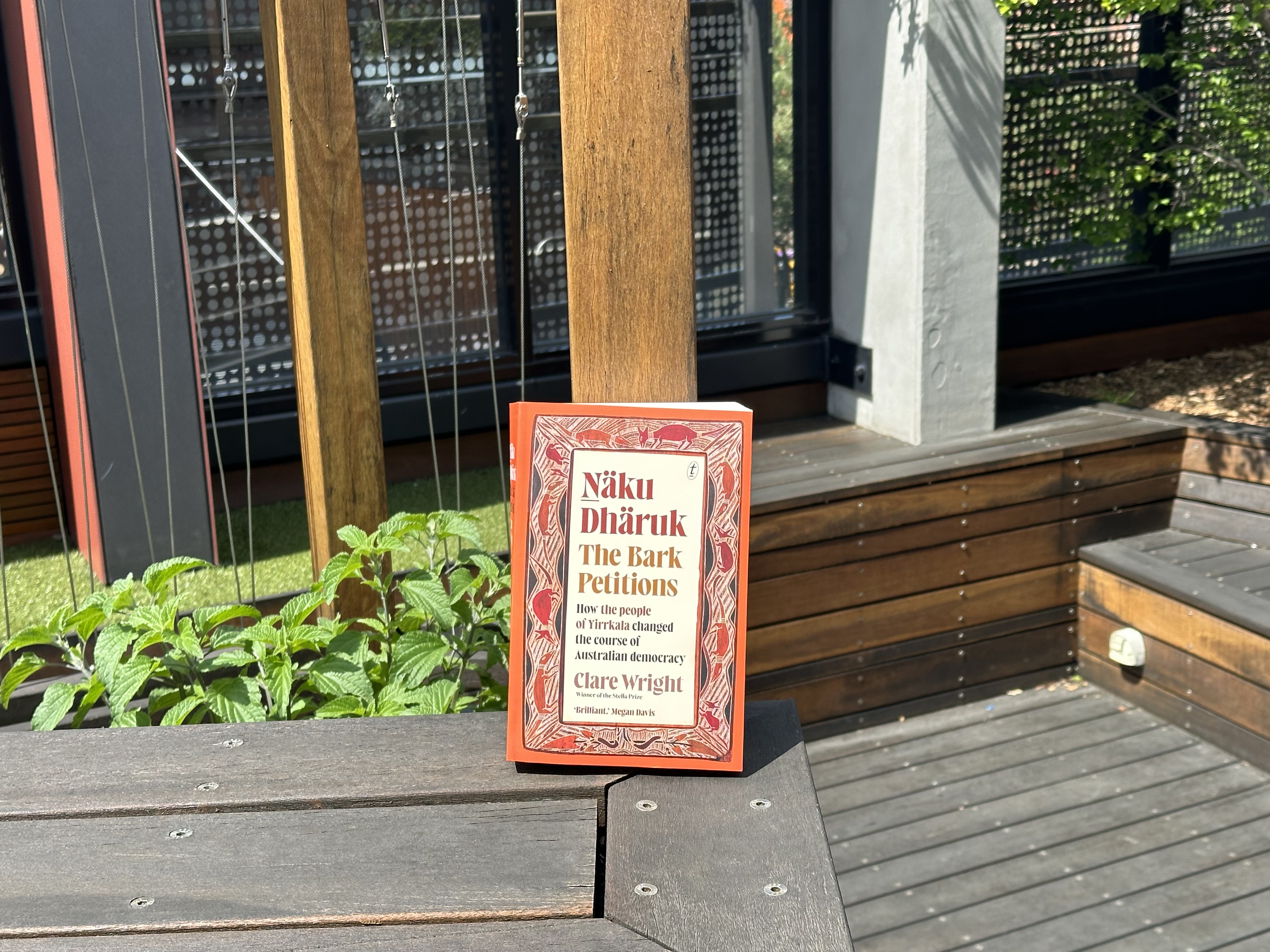
Ṉäku Dhäruk: How the People of Yirrkala Changed the Course of Australian Democracy is a compelling text. Professor Wright championed hard to have Ṉäku Dhäruk as the title, noting Elders from other Yolŋu clans confirmed it was allowed; Dr Yunupingu had that authority.
It isn't a colonial history told as a story from a library. It is one of Australia's most revered historians, spending more than a decade on Country, immersed in the way of the Yolŋu, given permission to tell a story seldom told.
Endorsed by Indigenous academics including Megan Davis, Larissa Behrendt, and activist Thomas Mayo, the book is an extraordinary story.
It is about how Terra Nullius, that legal fiction, isn't just about the removal of land, but the removal of governance. The Yolŋu, trading overseas for thousands of years, have a complex system of laws that were discarded by a colonial government.
It also shows how some missionaries came on Country, and instead of pushing their ways, immersed themselves in the culture, learned the language, and helped the Yolŋu thrive.
It's a story of colonial governments, and big business. A story that cannot be forgotten, and Professor Wright has done her very best to make that so.
Most of all, it is the story of the Yolŋu.
Ṉäku Dhäruk The Bark Petitions: How the People of Yirrkala Changed the Course of Australian Democracy (640pp, $45), is published on October 1 by Text.



