



A powerful new bilingual publication is ensuring an important Wurlaki story will continue to be carried by future generations, preserving language, culture and truth through the voices of those who have protected it for decades.
Bunyan yarraman-girninge (Man with a Horse Body), released by the Bininj Kunwok Regional Language and Culture Centre (BKRLCC) and Maningrida Arts and Culture, brings together Wurlaki language, English translation, artwork, oral history and historical research to tell a story which has lived within families on Country for generations.
More than a children's storybook, the publication is an act of cultural preservation and truth-telling. It honours the knowledge held by Wurlaki people from the Gartji area in western Arnhem Land while ensuring younger generations can continue to learn from the stories their ancestors entrusted to them.
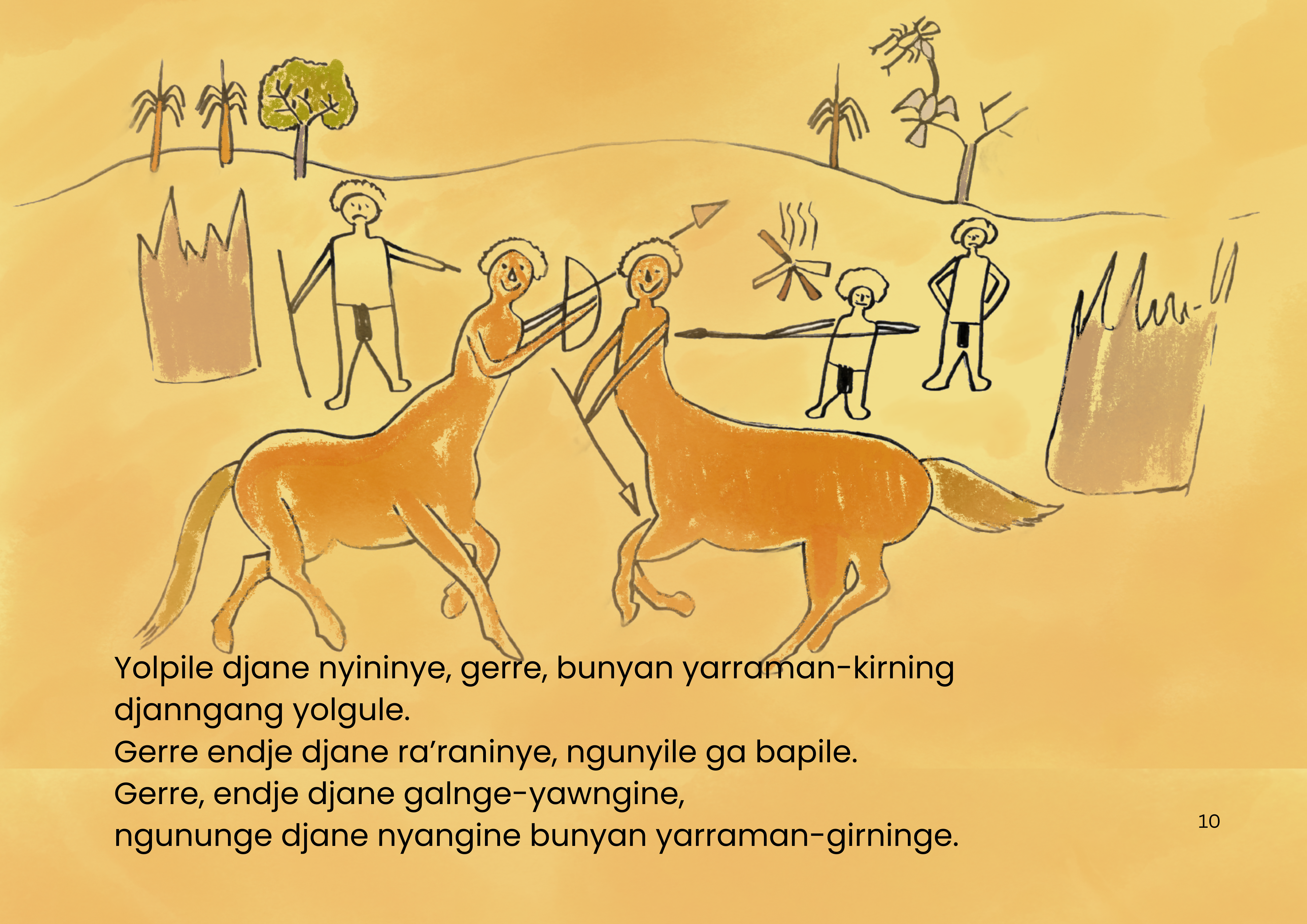
At the heart of the book is an oral history describing violent encounters between Aboriginal people and invading horse-human figures during the frontier period. For Wurlaki people, these beings represent cultural memories of a terrifying time when unfamiliar people arrived on Country with horses, weapons and violence which their ancestors had never before experienced.
While readers outside the community may draw comparisons with mythical centaurs, Wurlaki people understand the figures very differently. They are part of an enduring oral tradition which carries the lived experiences of ancestors navigating the devastating impacts of colonisation and frontier conflict.
Senior Wurlaki knowledge holder, Dale Pascoe, said the story has remained alive because each generation accepted the responsibility of carrying it forward.
"This is a true story. The old people told us this story," Mr Pascoe said.
"What the old people told us, it's locked down in our heart and in our mind."
Those words capture the significance of the publication. Across Aboriginal Australia, stories have always been more than entertainment. They are archives of knowledge, carrying history, identity, law and survival long before written records existed.
By publishing the story in both Wurlaki and English, the book strengthens language maintenance while making an important part of Arnhem Land's history accessible to broader audiences without compromising its cultural authority.
The publication combines original artwork created by Wurlaki artists alongside linguistic documentation and historical context, allowing readers to engage with the story through both visual and written forms.
An accompanying essay by linguist and researcher Margaret Carew explores how oral traditions align with documented frontier history across Arnhem Land during the late nineteenth and early twentieth centuries.
Drawing on the knowledge of Dale Pascoe, Gary Madjibarrili Smith and Stanley Djalarra Rankin, alongside historical research by Craig Elliott, the essay reinforces what Aboriginal communities have always known. Oral histories are not folklore. They are evidence, memory and lived experience.
The publication also contributes to the broader movement of truth-telling occurring across the Northern Territory.
Supported through the Northern Territory Truth, Healing and Reconciliation Program and the Australian Government's Indigenous Languages and Arts program, the project demonstrates the importance of placing First Nations voices at the centre of documenting Australia's shared history.
Its launch at the new independent Homeland School at Gamardi in May this year further highlighted the community-led nature of the project, with young people able to witness firsthand the importance of language, storytelling and intergenerational knowledge sharing.
The book also embraces contemporary ways of protecting culture. Readers can access an audio version through a QR code, ensuring correct pronunciation of Wurlaki language while creating another pathway for young people to connect with their language wherever they are.
Importantly, every copy sold contributes directly back to community. All proceeds will support the ongoing work of BKRLCC, helping fund future language documentation and revitalisation projects at a time when many Aboriginal languages remain critically endangered.
The publication showcases artwork by Dale Pascoe, Eric Pascoe, Shania Brown, Geralyn Pascoe, Pauline James and Paul Moscow, with digital artwork by Shania Brown and design by Ingrid Johanson.
For Aboriginal communities, books such as Bunyan yarraman-girninge are about far more than preserving stories. They are about protecting identity, affirming the authority of Indigenous knowledge systems and ensuring that future generations inherit language alongside the histories that shaped their people.
As conversations around Australia's frontier past continue to evolve, the publication stands as a reminder that First Nations peoples have always held their own historical record.
It has been carried in language, remembered through story and protected by those who understood that survival depends not only on keeping culture alive, but on ensuring the truth continues to be told in Aboriginal voices.



