


Microsoft's new report - 'Break Down the Barriers' - outlines how alternative employment pathways into the tech industry could help unlock a more diverse talent pipeline, whilst addressing industry skills shortages.
The recommendations of the report offer more opportunity for First Nations people interested in breaking into tech industries, an industry that is experiencing rapid growth.
'Break Down the Barriers' was developed by Accenture, a leading strategic and consulting firm, and calls for tech organisations in Australia to hire 20 per cent of early-career tech workers through alternative pathways by 2030. The report also urges tech firms to focus on skills rather than formal qualifications for people at the start of their career in the industry.
Jason Darney, a proud Wiradjuri man and Executive Director of Education and Skills, TAFE NSW welcomed the report.
"It highlights the opportunity to expand the diversity of the IT workforce through alternative pathways to enter the industry," he said.
"For Aboriginal and Torres Strait Islander students, a key enabler for this is the wrap-around support services we provide. For example, culturally safe learning spaces, and foundation skills development through language, numeracy, digital and literacy support."
Microsoft said that providing alternative pathways into industry for early-career tech workers could address growing workforce demands whilst simultaneously creating equal opportunity for diverse groups.
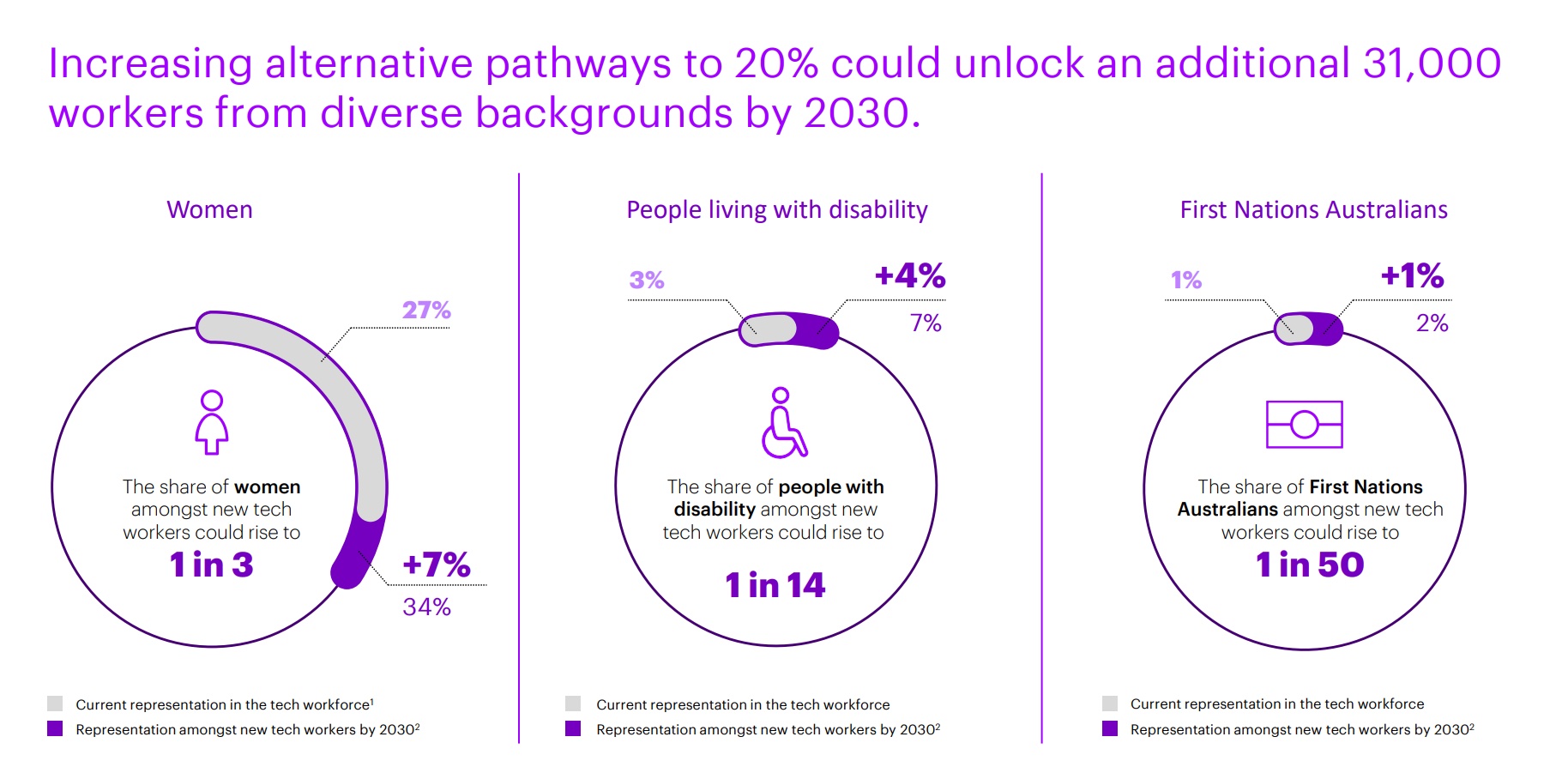 Image: supplied
The report highlights the strengths of a diverse workforce and the value that is brought to an organisation by traditionally underrepresented groups, it also found that 90 per cent of job advertisements in STEM areas require a Bachelor's Degree or a higher qualification and that this is deterring potentially high performing candidates from applying for these roles.
Accenture Australia Director of Talent and Organisation Tenielle Colussi said: "We have a real opportunity to make a difference. Gone are the days when candidates need a degree to be considered for a role."
"By removing barriers and ensuring job opportunities are open to those who have alternate pathway experience, or offering programs that include alternative pathways, we're not only solving for a talent gap, but creating exciting and fulfilling opportunities for amazing individuals who would have remained hidden in the workforce," she said.
The report acknowledges that achieving the 20 per cent target will require collective action from organisations, Australia's tech industry, Government, education providers and not‑for‑profit organisations.
Accenture outlined what alternate pathways could look like, proposing coursed-based learning (vocational education and training courses, micro-credentials and vendor courses), intensive pre-work courses (bootcamps) and work-integrated learning (apprenticeships, cadetships and traineeships).
By removing university qualifications as a requirement, Accenture have estimated that this would open the doors to 31,000 workers from diverse backgrounds and improve business outcomes in the process.
The benefits would include: $550 million in additional remuneration for new tech workers; 2,000 previously unemployed workers moving into tech roles; $250 million in additional tax revenue for government as Australians shift to more productive segments of the economy; five times more applicants for each advertised tech role, greatly expanding the talent pool; and $35 million in savings on social services returned to government through a reduction in the unemployment rate.
Microsoft Australia and New Zealand managing director Steven Worrall said the report highlights "the incredible opportunity that remains untapped in our diverse workforce, and how Australia and our economy can benefit from making the tech industry more accessible and inclusive".
"This isn't just about corporate responsibility – it's a strategy proven to yield significant economic and social returns," he said.
"An exciting initiative I'd encourage Aboriginal and Torres Strait Islander students in our community to engage with is the courses offered by our Institute of Applied Technology (IAT) in Digital Tech. The IAT Digital Tech is a partnership with TAFE NSW, Microsoft, the University of Technology Sydney, and Macquarie University.
"Students can study Microskills and Micro-Credentials in areas such as Cloud Security, Data Engineering, Artificial Intelligence, and Cyber Security. These short programs enable learners to access flexible and stackable training and provide industry with a pipeline of high-quality future workers for the growing sector."
As Australian universities continue to pursue various methods of increasing First Nations uptake of STEM courses, it is evident that more needs to be done, as it has recently been reported that only one in one hundred STEM university students identify as First Nations.
A federal Department of Education spokesperson told National Indigenous Times: "We need more young First Nations people studying and graduating from STEM disciplines. The Australian Universities Accord is working to deliver a long term plan for Australia's higher education system, which has a strong focus on First Nations students."
"This Accord process will continue to consider all contributions, including independently commissioned reports such as the 'Break down the barriers' report, which constructively add to and inform the process."
In response to the recommendations made in the 'Break Down the Barriers' report Dr Rosetta Romano, Assistant Professor Information Technology and Systems and Early Career Researcher from the University of Canberra, expressed concern over businesses that are already exploiting the skills of staff that don't have qualifications.
"They are using skilled staff and aren't paying for them. What these businesses should be doing is spending time engaging with primary schools throughout Australia, and if they are really interested in making a difference to Indigenous communities, they need to be going out the communities and inspiring the younger generations."
Minister for Industry and Science, Ed Husic announced in September 2022 a commitment to widening the pipeline of talent available to the science and technology sectors. Subsequent to this announcement, on the 15th August, Minister Husic released the Diversity in STEM Review Panel's draft recommendations which can be found here.
Until 8 September, there is an opportunity for members of the public or organisations to provide feedback on the draft recommendations to ensure they meet the needs of Australia's STEM sector. Visit the Department of Industry's consultation page for more information.



