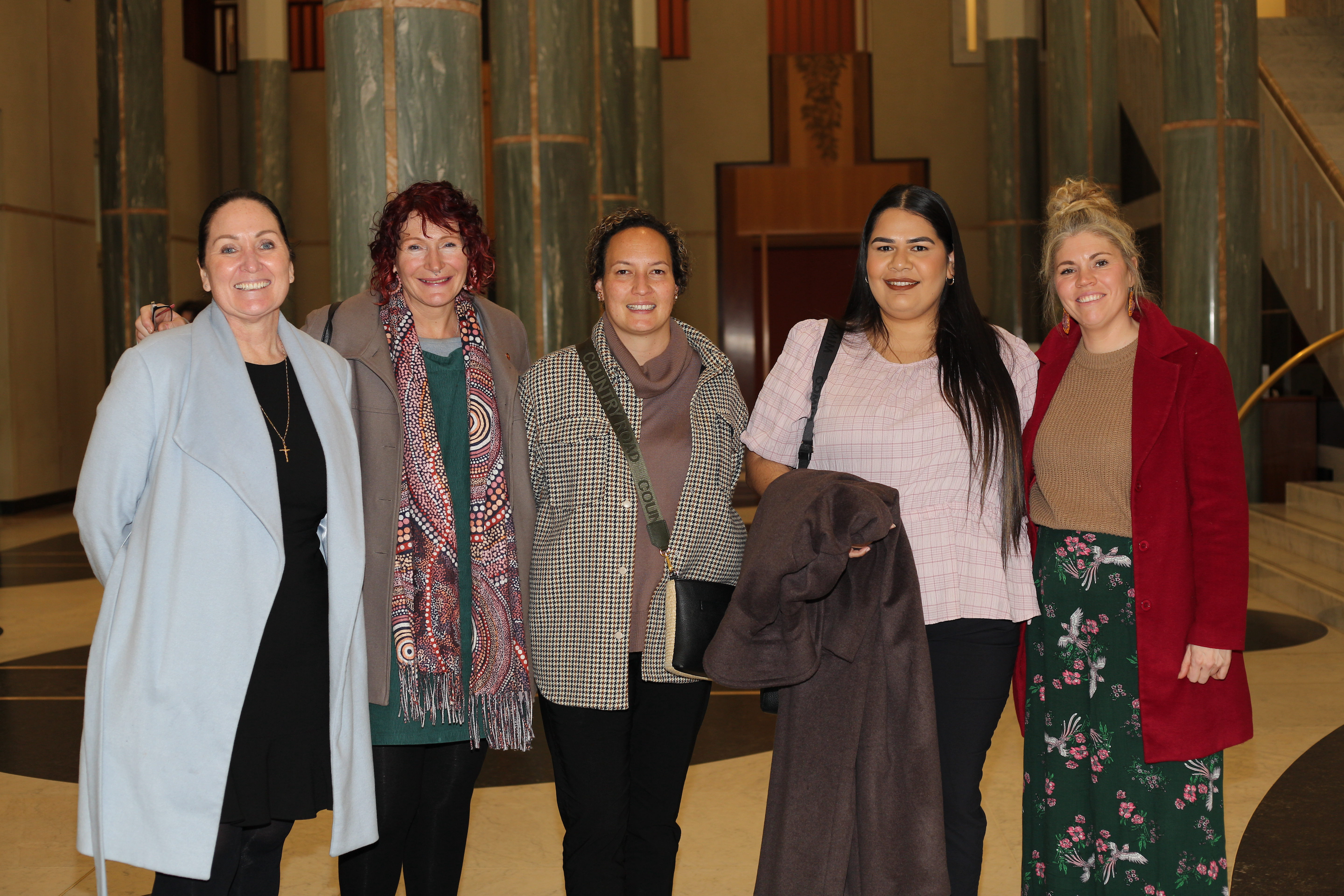
Powerful words of truth-telling permeated the walls of Parliament House last week as members of Western Australia's Stolen Generations gathered for a significant screening of their film Genocide in the Wildflower State whilst calling for justice and reparation.
Genocide in the Wildflower State is a heartbreaking and at times confronting documentary coproduced by Bringing Them Home WA and Yokai: Healing our Spirit, an advocate group for Western Australia's Stolen Generation.
Representatives of Western Australia's Stolen Generations were invited to show the film in the Parliamentary Theatre by Senate President and Senator for WA, Sue Lines, who had previously been moved by the film.
Up to fifty guests attended the screening alongside the Yokai delegation who engaged in an intimate panel discussion with attendees following the film.
The film deep dives into Australian and more specifically Western Australian history of assimilation policies that were enforced upon Aboriginal people which included; eugenics, racial absorption, social assimilation and forced child removal.
The accomplished Noongar actor Kelton Pell sets the mood of the film with an earth-shattering statement that slams the pseudo reality of Australian history many once knew.
"The way history is told, genocide never happened in Australia, in truth Australia shows that racial supremacy powerfully shaped aboriginal policies and practices in twentieth century Western Australia," Mr Pell said.
"The most violent action of these policies was the forced removal of Aboriginal children from their parents, across the state on mass scale. With the intention of destroying our very existence as a people and securing white settler dominance.
"This was a crime against my people. This was a crime against my grandmother too."
Distressing stories of those who have been impacted either directly or via intergenerational trauma are interwoven with historical accounts of policies and practices of this dark period of Australian history and the pain these policies have caused is undeniably evident.
Senator Sue Lines told National Indigenous Times she was very proud to be able to facilitate the screening of Genocide in the Wildflower State at Parliament House.
"We need truth telling as a country and in Western Australia. There is so much of our history and the actions of past Western Australian governments that I wasn't aware of before viewing this powerful film," Ms Lines said.
Chair the West Australian Stolen Generations Aboriginal Corporation, Jim Morrison said "We have produced this documentary as part of a campaign to educate Parliamentarians and the broader community about past genocidal policies in Western Australia and around Australia, in which Aboriginal children were arbitrarily removed from their families and their culture as part of a plan to create a White Australia".
One attendee said "I feel extremely emotional obviously from the movie, but at the same time I am so proud of what you have been able to share in your story but also actually physically sharing with the group because it is quite intimate".
When asked how we can make the biggest impact if it is helping our youth or our elders or both, a panel member said "it has to come through from young to old and the elders I think they need to speak a bit more about the pain they went through for them to heal".
It was then that Stolen Generation survivor, Gail Yorkshire opened up to the audience.
"I was an eighteen-day old baby when I was taken and never permitted to see my mother," Ms Yorkshire said.
Mr Yorkshire detailed being moved from various missions and the abuse that she experienced in these institutions, including knowing when they just had to leave the mission at fifteen years of age "because that's when you would disappear".
She then described her heartbreaking loss and a life without a maternal bond, her longing for precious moments with her mother, ones that can never be replaced.
Ms Yorkshire now heals through her own family and with her work in prisons, where she is referred to as Nanna, and cares for those that need a maternal connection.
Stolen generation descendant Loraine Pryor emphasised there is a long journey to go with regard to healing and a many layers of trauma.
She called for more education on trauma and what has happened in the past.
"We need to acknowledge it because we need to heal from it and it we can't do that if we don't know about it, how can we address the issues that we have no awareness of," Ms Pryor said.
Ms Pryor called for more healing services in Western Australia and cultural rehabs for both men and women.
"The majority of our aboriginal people that are incarcerated are stolen generation people or descendants. A lot of them have no understanding of what's happening to them. You know so they're medicating themselves," she said.
Ms Pryor said that along with education, acknowledgement of this true history is what is needed.
"It is real, it is real what's happening and a lot of our people are struggling, she said.
"We are the highest incarcerated, the highest suicide the highest poverty, why is that? We are the First Nations people of this country and we are the third richest country in the world.
"Let's start making the conversations more louder. Because Im definitely not going to let this rest."
Co-Chair of Bringing Them Home WA and a Stolen Generations survivor, Tony Hansen, who was removed from his family in 1970 said the 1997 Bringing Them Home Report confirmed policies were genocidal and reparations should be made to those Aboriginal People like him, who suffered under these policies.
"It is time that all Parliamentarians in Australia understood the widespread impact of these policies and the ongoing trauma and put in place proper reparations for the Stolen Generations Survivors," Mr Hansen said.
"Compensation schemes have been put in place in all States except WA and Queensland – it is time for action!"
Senator Lines was grateful to the Elders who made the journey to Canberra to share their experiences as they continue to advocate for Stolen Generation survivors.
The film features a number of prominent figures and advocates in this space, including Dr Hannah McGlade.