




A proud dad of three steeped in traditional teachings of culture has been on the lookout to revive Indigenous sports that were nearly lost during colonisation.
Yorta Yorta, Gunai Kurnai and Muthi Muthi man Leslie Briggs runs an Aboriginal enterprise that builds strong relationships in communities and focuses on the cultural education sector, while delivering opportunities for new learnings through Indigenous sports and activities.
WKY Events has pitched the traditional games of Marngrook and Buroinjin to Victorian Indigenous communities and a number of Gippsland schools to engage their level of interest.
"With the programs that I have created for Indigenous sports games, I run through all of the history of those games in separate sessions as well," Briggs said.
"So there is so much for the kids to learn about the history of Marngrook, plus of Buroinjin.
"The ideas came about to me to run these programs and these sessions in the area I grew up in Shepparton."
Marngrook's past, first in Victoria and later with the tribes through most of south-eastern Australia, is intrinsically linked to Australian rules football by colonial Tom Wills.
Buroinjin is a ball-passing game that originated from the Gubba Gubba lands of South-East Queensland, described as a cross of netball and rugby without the physicality of tackling.
Briggs attended the Academy of Sport, Health and Education, colloquially referred as ASHE in Shepparton, which uses sport participation for Indigenous students to help undertake education and training in a trusted, culturally-appropriate environment.
"That's where I gained most of my (Indigenous) knowledge, but I did receive a lot of my own knowledge off my Elders in regard to cultural aspects – I am very well-cultured, that is I have a lot of knowledge around culture," Briggs said.
Part of the ASHE education was tracking aspects of the traditional Indigenous games that once existed on the continent prior to British settlement.
"That's where they run these games and these challenges, and hold an ASHE festival where they (specifically) have a Buroinjin challenge," Briggs said.
"So that kind of an idea came up to me about creating what I have got here and to expand the idea to reach kids and the Community around my area and region."
Except the primeval ball made of possum hide wrapped in its skin is replaced by a modern 21st century replica.
Briggs also moved to Phillip Island for opportunities to collaborate with prominent Yorta Yorta and Torres Strait Islander surfer Steve Parker's cultural enterprise named after the island.
Millowl Dreaming connects to the island's Boonwurrung Country, emboldening connections with all Indigenous mobs and also non-Indigenous locals through sharing untold knowledge.
They collectively run traditional cultural activities with Welcome to Country and smoking ceremonies while always engaging with local Elders about the sessions.
But the roadblock of spreading Indigenous games further in the state is not one over cultural advice, but funding that is holding back their plans.
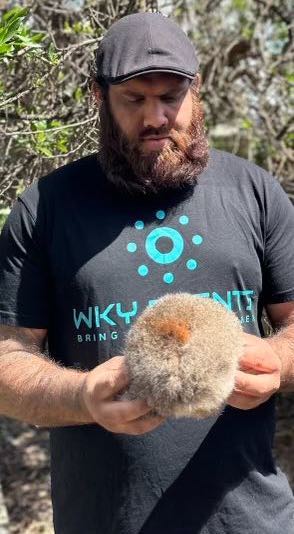
"I already know there is a lot of interest around these games and other (Indigenous) activities that I have got," Briggs said.
"I am talking to the right people, but it kind of stops where the funding lies.
"If there were opportunities to grow these ideas, I believe they would be very successful.
"In terms of having 50 people from a few different mobs from the (Phillip Island) area that I am representing for say holding a festival, the catering side of the funding is a challenge."
Briggs added local community football clubs in Gippsland have begun to take an interest in supporting the Marngrook initiative to learn of the First Nations' impact on the modern-day sport in Australia.
"I need sponsors just to get behind and grow these ideas – I am reaching out for more support that would be keen to promote, make these games well known and be included into the schools," he said.
"Even for football clubs, they can use the games as a part of training sessions, as a team-building strategy, to support this."
Once the games get off ground, Briggs is hopeful of mobs playing the game on their Country, perhaps including the possibility of mobs playing mobs in regular carnivals.
"I am always open to new engagements and opportunities," Briggs said.
"That's definitely something I am looking at as well.
"I want to get the Traditional Owners of those areas involved to support and deliver these activities for sure."
Buroinjin has more appeal to educators and it forms a connection with all types of primary school pupils, and not just the non-Indigenous institutions.
Biggs is hopeful a meeting with Gippsport, the area's regional sports assembly, could ensure Buroinjin becomes the new staple of health activity that will spread throughout most Victorian schools.
"A lot of schools have been reaching out – Koori educators in different schools too," Briggs said.
"This is where we would get a lot of benefit, but the kids would get a lot of benefit from the learning of the games' history, plus learning culture and to engage in a physical sport.
"It ticks off a lot of boxes for them to engage in these sessions in their schools.
"I think our main focus will be around the kids and their schools, and outreaching for other opportunities with the major companies to engage in holding festivals."



