




A recent excavation of a site dubbed the 'rings of mystery' close to homes in a suburb on the outskirts of Melbourne has revealed its rich Aboriginal history.
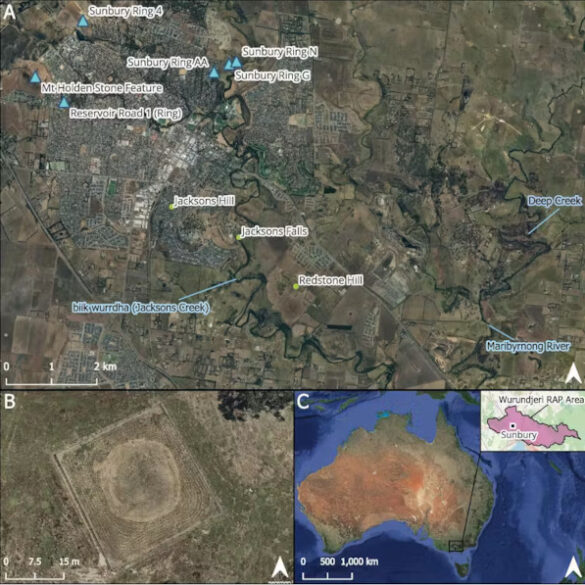
The series of large earth rings, located on the edge of Sunbury on Wurundjeri Woi Wurrung Country, rising "mysteriously out of hills", according to the authors of a study, may also only pre-date colonial settlement by as little as 350 years.
The latest scientific evidence of the man-made pursuits of a Naarm Aboriginal society was revealed in January's recent edition of the Australian Archaeology publication.
Earth rings have been said not to be a natural phenomenon, and archaeologists have revealed the land markings represent "large scale feats of human endeavour" in their report.
In this specific case the rings are said to articulate ongoing connections which Aboriginal people had with Country.
The study presents results of the only known archaeological excavation of this particular type of ring, combined in conjunction with the knowledge and understanding of what Wurundjeri Woi Wurrung Elders call parts of Sunbury "enigmatic places".
Archaeologists had documented five rings late last year in close proximity to each other, considered a particular uncommon occurrence in Victoria.
Three of the rings are located within a couple of hundreds of metres of each other.
The secret and sacred locations are a significant part of a traditional initiation and ceremony for local mobs, with earth rings also found in other parts of the world including within the Indigenous tribes of Amazonia in the sovereign state of Colombia and during medieval English times.
But Australian sites, including the rings 40 kilometres north of Melbourne's CBD, may very well be among the oldest in the world.
Archaeologists measured the time length of the rings by excavating and heaping earth together amid a large set of circles, measuring up to hundreds of metres in diameter to reach the most accurate of findings.
The study revealed Woi Wurrung-speaking people from the Kulin nation had constructed rings sometime between 590 and 1,400 years ago.
The inhabitants spent time in the area clearing the land and its plants, scraping back the soil and rock to "create a ring mound and layering the rocks to create stone arrangements".
They also lit campfires, made stone tools that they used on a variety of plants and animals, and moved items around the ring's interior, participants in the study said.
Wearing patterns and residues on some of the stone artefacts suggest Woi Wurrung speaking people may have used some of these stone tools to create feather adornments and to scar human skin for ceremonial use, a practice that has been documented in other parts of Victoria.
The study is the first to combine cultural and archaeological insights on the rings in Australia.
"It expands our understanding of the richness and the diversity of Australia's archaeological record, created over more than 65,000 years of continuous occupation by Aboriginal and Torres Strait Islander peoples," La Trobe University Adjunct Senior Research Fellow of the Department of Archaeology and History, Dr Caroline Spry stated in the report.
Accompanying Ms Spry, who co-authored the study, were Indigenous Elders of the Wurundjeri Woi Wurrung Cultural Heritage Aboriginal Corporation, Allan Wandin, Ron Jones and Bobby Mullins.
The Traditional Owners of the land were present to give the archaeologists a cultural understanding of reading and interpreting the local landscape.
Many earth rings were 'destroyed' following European colonisation and land development, and similar examples of sites of cultural experiences are not as common as they once were.
Estimates suggest several hundreds of earth rings once existed across New South Wales and Queensland alone.
Nationwide only around 100 ancient rings remain today, including very few in Victoria.
"We believe this study is important as it's an opportunity to educate people about Wurundjeri Woi-wurrung people, and our history and culture," Wurundjeri Woi Wurrung Elder Aunty Di Kerr, Mr Mullins and Mr Jones said in a statement.
"For us, it's important to braid together our traditional cultural knowledge with what archaeology can tell us to build a holistic understanding of the Sunbury Rings and their place on our Country.
"Sunbury was an important place for our Ancestors - it's a food bowl and travelling route.
"The Sunbury Rings are still used and cared for today, and we continue to tell these stories to our children."
The Wurundjeri Woi Wurrung people first led a historic first culture values study across 2021 and 2022 on the broader landscape that encompasses the same five Sunbury rings on a landscape which holds immense cultural significance.
It reflects a deep history of occupation, colonisation, resistance, adaptation, self-determination and resilience.
It is where the 'Liwik' (ancestors) have lived, travelled, gathered and raised successive generations of their people.
Wurundjeri Woi Wurrung people, who continue to hold traditional responsibility to care for the mob's Country, have in accordance with the traditional lore and customs relating to creation ancestors Bunjil and Waa actively managed the landscape for thousands of years.
"It demonstrates the importance of further investigating and preserving these earth rings, as well as others known to occur across eastern Australia," Dr Spry reported.
"This is especially important in the face of continued threats by land development and climate change, which threaten the survival of earth rings."
The Wurundjeri Woi Wurrung people had led an archaeological excavation of one of the rings, known as Sunbury Ring G, previously in 2022.
That ring represents a place where the Liwik travelled, came together but also for "probable" ceremonies.
It is also a highly significant location between the traditional lands of the Marin bulluk and Wurundjeri wilam clans of Woi Wurrung-speaking people, separated by biik wurrdha in the location known today as Jacksons Creek.
Archaeologist David Frankel had first excavated the Sunbury Ring G in 1979, some 45 years ahead of the Spry-led collaboration with the local Indigenous Elders.
To date, no other excavation of an earth ring is known to have happened in Australia.
Wurundjeri Woi Wurrung people led the dating and reanalysis of 166 stone separate artefacts found during the 1979 excavation.
This involved dating the ring deposits to estimate when rings were initially made.
It also involved piecing the artefacts back together akin to a jigsaw, and studying the residues and the wear patterns on their surfaces and edges.
This provides clues on how Woi Wurrung-speaking people made and used the stone tools at Sunbury Ring G.



