


There's a twist to the story of 2020 Indigenous Marathon Foundation graduate Peter Miller-Koncz, who is returning to the sport to test the state of his physical and mental strength.
It dates back to when the COVID-19 pandemic ruined the plans for many Australians, including First Nations runners.
Runners were supposed to come together once a month for a training camp in a new location, but instead had to share their progress via zoom calls on their hometown roads.
Their hard work culminated with the men and women who survived the trials and tribulations of that year to complete in a first-ever marathon in the heart of Central Australia.
When international marathons were cancelled, coach Adrian Dodson-Shaw came up with the idea of organising an outback 42.195-kilometre distance course on the outskirts of Alice Springs, his hometown.
After four hours, 14 minutes and two seconds on Arrernte Country, Miller-Koncz was first in his class to cross the line amid the darkness of a "midnight marathon," as the run was billed.
Runners who join the Indigenous Marathon Foundation are told the marathon finish line is just the beginning of their journey.
Miller-Koncz would find out the journey ahead was a bumpy road.
In terms of conditions which require runners to complete prerequisites of the foundation, the 2020 Alice Springs marathoners were still entitled to run an international race at the financial expense of Robert de Castella's decade-long organisation following their near six months of training.
No runner from that year has waited longer to race their overseas marathon than the dedicated father of four.
Just as overseas travel bans were lifted, Miller-Koncz broke his leg in March of 2022, an injury serious enough to change his running trajectory for the next three years.
The incident occurred during an early-season Adelaide suburban football game, snapping both of his tibia and fibula bones.
The complications would prove horrific after the initial injury.
"That was quite a significant break," Miller-Koncz told the National Indigenous Times.
"I went through three surgeries, fought through an infection, a serious infection...and the orthopedics, the surgeons said that running would probably not be an option again.
"Through all that adversity kind of stuff, I just put it all aside and said I am going to go running again."
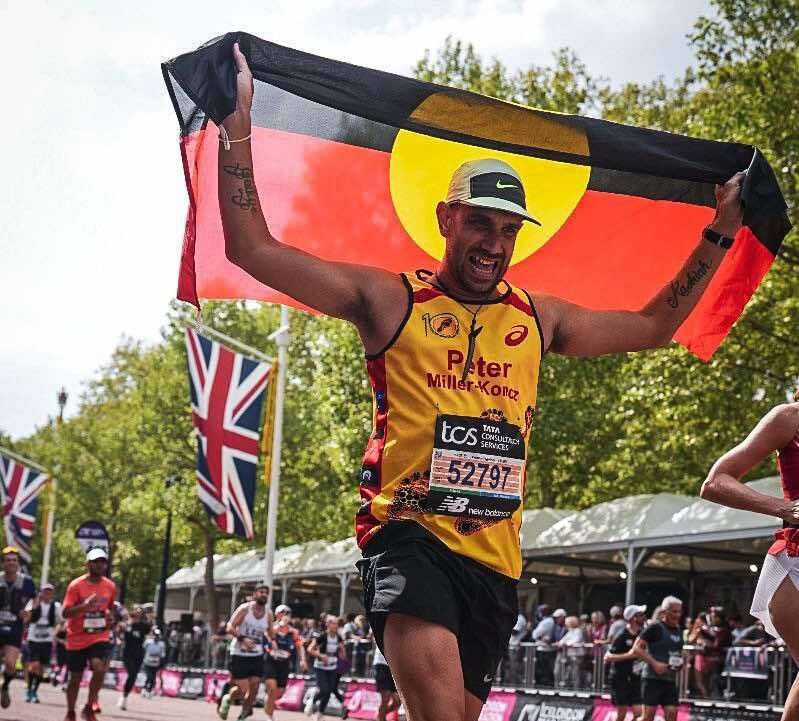
And on April 27, 2025, Miller-Koncz was back behind the starting line of the London Marathon.
It was a world away from the moon floodlighting the dry escarpment surrounding Alice Springs.
In the final metres before the finish line, Miller-Koncz heard the calling of his name, ran to the barriers which bordered the course and grabbed the Aboriginal flag on offer before completing the inspirational run.
Holding up his phone for a video selfie not long after, he wiped away tears to simply say, "I did it".
"It was definitely different because for starters there's 50,000 to 60,000 people running it," he said.
"I think that's four or five (thousand) people shy of New York."
While many fellow 2020 graduates first ran internationally in New York, Athens and Tokyo amid the far-flung locations within a year or so, Miller-Koncz had to wait four and a half years to complete his second attempt at a marathon.
The 35-year-old never gave up hope of getting back on track.
"I still did my regular running and all that, but only in the last year and a half after I had that bad break on my tib and fib have I looked at a marathon," he said.
After finishing in the UK capital in 3:57.30 – bettering his time by more than 16 and a half minutes from Alice Springs – Miller-Koncz spoke emotionally about a number of setbacks.
It started before the broken leg, when in 2021, his wife Kahlia had a miscarriage.
He also supported his wife through losing her brother in a car accident.
The environmental technician also lost two "brothers", including a cousin, to suicide while another cousin and an aunty passed away from pancreatic cancer.
"I guess it was all a setback, but I never really wanted to take it as one," he said.
"It was just another lesson in life because we take our health for granted.
"Coming back from that (broken leg) physically and mentally was tough.
"Not just for myself but for my family.
"They always see me out and active because I was a bit down as well."
At one stage on the London course, there was a moment frozen in time which tested Miller-Koncz's character.
But the spirits of his Wirangu, Kolkatha, Mirning and Ngarrindjeri ancestors pulled the Koonibba-born man on the path to the end.
"In between about the 38 and 40k marks, this guy kind of cut me off on a corner and I came to a bit of a sudden stop," he said.
"All of my muscles then kind of seized up and I cramped during that moment."
Not that he needed any more motivation, but thinking of his grandmother back in Australia with sundown dementia came to light shortly after the stumble.
Two British runners coincidentally dashed past, one fighting pancreatic cancer and the other battling a case of a similar neurodegenerative disease of his grandmother, Miller-Koncz recalls, who were inspired to run for their causes.
"It was literally in that moment, the pain all went away," he said.
"They have suffered more – and this pain is nothing compared to what they've been through.
"I literally got up and ran with (the cramp)."
Miller-Koncz ran the London Marathon with surgical metal remaining embedded in his leg.
The final of his operations were postponed for good reason.
He returned to football with it, desperate to play his comeback game in the same side with his 18-year-old son Jaikye, who four years earlier ran the final eight kilometres of the Mpartnewe marathon to support his dad.
"I was supposed to take that metal out of his leg before, but when I was given an opportunity to take a spot in London, I postponed it," he said.
Its removal will be the last step to complete his recovery, but it's certainly not the last step of Miller-Koncz's ongoing journey.



