


Historian and Warraimaay woman Dr Grieves-Williams has devoted a lifetime to working with First Nations communities and documenting Australian history.
Adding to an vast body of work and accomplishments, Dr Grieves-Williams was recently on the advisory committee for the research project that has led to Reconciliation Australia and Alfred Deakin Institute's report Recognising Community Truth-Telling: an exploration of local truth-telling in Australia .
Throughout her extensive career as a historian, Dr Grieves Williams' contributions have held a strong focus on sovereignty, decolonisation and truth telling.
"We can never truly know the past and truth is relative. When anyone writes history you learn as much about them as you do about the past. History making is a process that can be healing," she told National Indigenous Times.
Her mother grew up in various places in their grandmothers' country of Foster-Tuncurry.
"My grandfather had jobs in the timber industry, so they moved a great deal around my grandmothers' clan country - places like Coolongolook, Nabiac, Failford and Krambach," she said.
"We had some relatives who ended up on the reserve in Forster for various reasons. My grandmother had cousins there.
"The reserve never had a manager, so it was a different life for the Aboriginal people there than for those under the manager's daily rule. And my grandfather had close friendships, for example with Barney Simon.
"They worked together on making the prows for the ships in a shipbuilding business that was in Tuncurry back then. They were said to be the last of the great bushmen and axemen".
Dr Grieves-Williams was a young child when her mother worked as cook and housemaid at sheep stations at Brewarrina and West Wyalong, before the two of them moved to a station near Cootamundra, the location of the New South Wales Aboriginal Girls home.
"I used to hear on the radio, when having breakfast, 'Aboriginal girl has escaped and is last seen on the road to Stockinbingal' or something like that. And I think Oh, who is it? You know, I'd be so worried about their safety. And also wondering where they are trying to escape to, that they must have a family somewhere," she said.
Dr Grieves-Williams later forged strong friendships with some of the girls that were maintained over the years, and has seen the struggle and impact of the Stolen Generations first-hand.
"You know that experience of being in close proximity to the girl's home, as they called it was very traumatic for me. And it was terrible for them," she said.
Visibly upset recounting her experience, Dr Grieves-Williams was reluctant to speak more on the subject.
"It is their story, not mine," she said.
Following her school years, Dr Grieves-Wiliams was determined to understand why the history of Australia brought us to discrimination against and disregard for all things Aboriginal.
She began her quest by researching her mother's family history and has since published their story 'Warraimay family, The McClymonts of Nabiac'.
"I was the first Aboriginal honours graduate and had a double degree in history" she said.
.jpeg)
A young Victoria Grieves-Williams. (Image: supplied)
On her experience of higher education as an Aboriginal woman in the 1980s, she said: "Many Aboriginal women were entering university at the time that I did because of the Labor government abolition of university fees."
"Helen Corbett, Lorraine Liddle, Pat O'Shane for example were undergraduates at the University of NSW when I was.
"I had very little help with the work I did as an undergraduate. I really went through the struggle, blood, sweat and tears. I'm serious. I did a lot of crying in my undergraduate degree and I thought I would never be able to do it.
"I grew up thinking I was never good enough, but I always did a lot of reading as a child because reading was an escape from the situation I was in. I was deeply affected by racial slurs and microaggressions."
Fresh out of university she was appointed as Head Teacher at Tranby College in Glebe.
"Many of our students were wards of the state and had grown up with white people, fostered or adopted," she said.
"Often when they got to be teenagers and they wanted to know who they were, people would say to them, 'don't worry about that. You don't want to know your family. They're not good people. And worse, things like that.
"Many felt abandoned by their families and were told things about their mothers and the circumstances that just were not true. Tranby teachers worked with Link-Up to overcome this and allow them to forge a positive Aboriginal identity."
Her next move was being appointed as the first Aboriginal lecturer at what was then the Cumberland College of Health Sciences, working on the Associate Diploma of Aboriginal Health and Community Development.
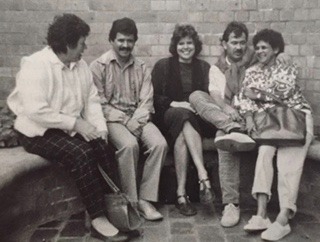
Dr Victoria Grieves-Williams in the 1980s with students Margaret Morgan from Deniliquin, Graeme from Lismore, Carl McGrady from Tenterfield, and Edna (Hedlow) Criagie from Moree. (Image: supplied)
Thriving in an academic environment Dr Grieves-Williams eventually undertook postdoctoral studies.
"My PhD thesis argues for a new approach to Aboriginal history, based on the history of the Aboriginal family. This would tell us about the lives of ordinary people living, working and intermarrying with newcomers," she said.
"I have an immense cache of research data from the published biographies and autobiographies of Aboriginal people since the 1970s. I was prevented from writing up the research data through a lack of support from the academic establishment."
In recent years, Dr Grieves-Williams continues to write and has been working with the Children Born of War in Australia during the War in the Pacific, from 1941 – 1945, with talk of documentary series.
Although her entire body of work provides an understanding of why she is in opposition to the referendum and 'The Voice', a few key reads are as followed.
In 2018 Dr Grives-Williams wrote an essay for the Griffith Review - 'A new sovereign republic – living history in the present' - which outlines Australian Aboriginal history, the imperative to decolonise, and the concept of a shared republic.
In closing it states "Australia is now poised for a deep change with the Uluru Statement from the Heart as a blueprint for ways forward".
"The time is ripe for a shift in activism to the achievement of a new Republic of Australia based on the sovereignty of Aboriginal people, the values and ethics embedded in their philosophy and the inherent value of their ways of living on this continent," it reads.
Dr Grieves-Williams now says that at the time she wrote this the call was for "Truth, Treaty and Voice" and she was expecting that the truth-telling process would lay the groundwork for the ways forward, toward a shared sovereignty. This was the reason why the Centre for Post-Colonial Studies at Deakin University held a symposium on truth telling, Decolonising Truth, she said.
In 2021, Dr Grieves-Williams wrote an article for The Conversation titled 'Truth telling and giving back: how settler colonials are coming to terms with painful family histories' where she draws attention to the families of settler colonials in Australia and in the USA who are now facing the truth of their ancestors' role in the dispossession and slavery of Indigenous people, by giving back to the communities that have been impacted.
Dr Grieves Williams, told National Indigenous Times of a process of peacemaking between people and communities called "deep canvassing".
"Its a model of communication that removes the emotion, that allows listening without judgement, sharing experiences and processing conflicts. In this way it can create huge shifts in attitudes and allow people to come together in positive and meaningful ways," she said.
After many years of teaching non-Indigenous people Aboriginal studies, she said that this method was the most effective and aligned with her preferred teaching style.
Dr Grieves-Williams said she would like to see such a process in truth telling, making it more of a truth talking exercise in Australia, "and now, at this moment Australian society is so divided, I cannot bear the hate and vitriol being demonstrated, even at the highest levels of leadership.
"It is a crisis. Emotions are at such a fever pitch we will all have to calm down before any real reconciliation work can be done," she said.
Sharing her observations from New York City where she now resides, Dr Grieves-Williams said the initial groundwork has all been superseded by racial and political conflicts through what she regrets as a mishandling of the process.
Comparing the Australian process to what eventuated in Canada, she said: "The Voice to Parliament has emerged prematurely, without the information gathering phase such as what we saw in Canada in the 1990s."
"The Canadian government mounted a Royal Commission that had a mandate to allow every native person to speak on the record," she said.
"From there they developed a strategy to assist each native community to achieve its goals for development - industry, employment, employment and training.
"This push to a referendum on the Voice did not truly emerge from a consultation with the whole Aboriginal population.
"More than this, there was no constitutional convention that would have allowed people to catch up with the thinking on the Voice. And there was no real detail divulged to the Australian people by the government.
"It has become a vote for or against Aboriginal people, a vote that proves you are or are not racist. This is a result of a lack of strategic planning, it is clumsy and dangerous".
In the newsletter of the Australian Women in New York (AWNY), she wrote: "I know many of you will think it is counterintuitive for an Aboriginal person to be opposed to the Voice proposal. I don't want to be only remembered for my opposition to this, because of the tenor of the debate, and because I work in other ways to help to create a united Australia. However, the Voice has become an issue that overwhelms everything else for us as Aboriginal people."
On Senator Jacinta Nanpijinpa Price's claim there are no ongoing negative effects from colonisation, Dr Grieves-Williams says: "Understanding colonisation and its impacts, how it morphs and presents new challenges has been my life's work."
"My response is that Jacinta speaks out of her own knowledge and experience. She is clearly very bright and capable. As Senator for the Northern Territory she has a constituency that has elected her and if they disagree with her she will not be elected again so she must be standing on solid ground when she makes statements such as this," she said.
"She is an articulate and persuasive voice out of Central Australia with a view of what happens in Australia that is unique to that territory. They have a different and unique history with the first white men not arriving until the 1890s, and then just a handful who were working on the overland telegraphic line from Adelaide to Darwin. Compare this with the history of my people briefly outlined above - the differences are stark.
"Quite apart from her remark in response to a question, I think her speech to the National Press Club was brilliant. She is a breath of fresh air. She seeks to make people accountable and is a powerful counter-force to virtue-signalling lack of substance.
"While some of her opinions need to be debated, they should not be met with racism, hatred and vitriol. I'm looking forward to a new era in Aboriginal affairs."
To view the launch of Reconciliation Australia's new report and catch Dr Victoria Grieves-Williams' speech, see the video below.



