




Despite the heavy rain in Garrthalala, in remote East Arnhem Land, a number of students from the Laynhapuy Homelands School celebrated the superb achievement of graduation last week.
For any student, graduation is a wonderful effort. Combining hard work and discipline, with all the challenges faced as they enter adulthood, is an effort worth celebrating.
For students in some of the homelands, all these challenges are magnified with the requirements of travelling great distances and living in some of the most remote areas of the country.
Students often have to travel long distances - by road or air - as well as facing inclement weather, just to attend school.
The Makarraṯa Learning Celebration and Graduation brought these students together, along with staff and families from across the homelands, to honour their accomplishments.
The Laynhapuy Homelands School comprises nine homeland sites in the Laynhapuy region, serving 150 students. The largest site hosts 20 students, with the smallest hosting just five.
This 2024 graduation saw six Year 12 students receive their Northern Territory Certificate of Education and Training (NTCET) qualifications, four achieved their Certificate II in Conservation and Ecosystem Management, and seven earned their Certificate III in the same field.
The Makarraṯa Program is a senior secondary initiative, enabling students to complete their education on Country.
Rather than attending urban boarding schools, this means students are able to stay close to community and family.
Combined with the Learning on Country Program, it's been pivotal in achieving outstanding results for the students.
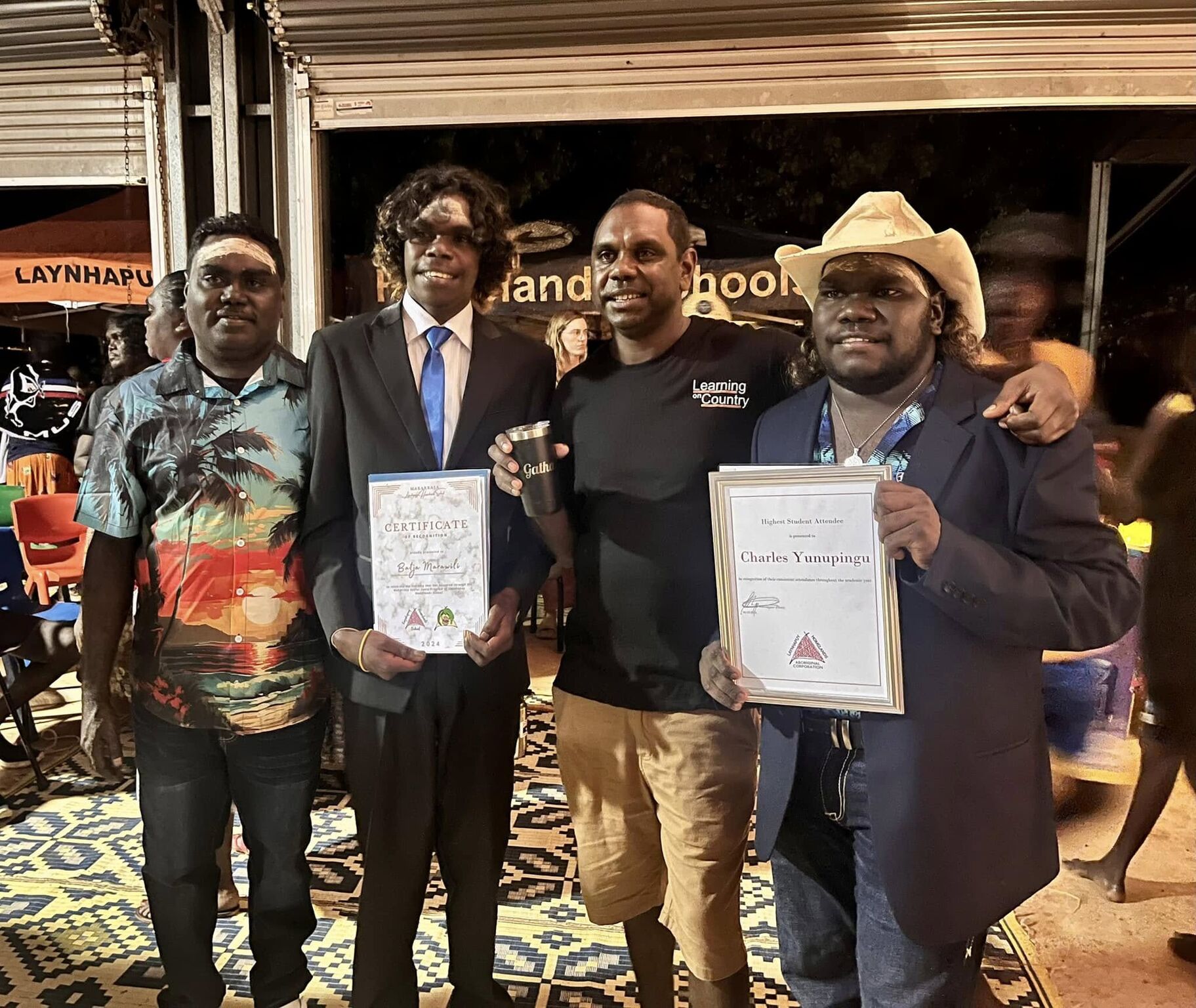
"The Learning on Country program is a really strong part of what we do," principal Abi White said.
"All of the graduates this year have had Conservation Ecosystem Management in their patterns, and many will have studied Maritime, and they will have all had a heavy involvement in the Learning on Country program to get them through their NTCET."
The Learning on Country program operates across 14 remote communities in the Top End. It has shown excellent outcomes in attendance, NTCET completions, and Vocational Education and Training (VET) qualification.
Integrating traditional knowledge with mainstream education, it helps to enrich the learning experience whilst simultaneously keeping students connected to their culture.
It recently received a National Indigenous Governance Award for its ground-up approach to two-way learning, along with the Cultural Authority directing it.
The graduation ceremony, even in the pouring rain, highlighted the importance of these programs, which are designed and tailored to give students in remote Indigenous communities the best chance of success.
Further graduation ceremonies across the Learning on country program include the Maningrida School with eight graduates, including one Certificate II in Conservation and Ecosystem Management recipient and four NTCET graduates; and the Ramingining School, which celebrated six graduates with three achieving NTCET qualifications and three earning Certificate II in Conservation and Ecosystem Management, with many others also receiving VET certification.
"Most of the students graduating will have an identified pathway – some are going into ranger traineeships, or into other work or further study," Ms White said.
"Families just feel really proud. They understand what a big achievement getting your NTCET is, and that it's a big commitment and a lot of work.
"There is a real sense of pride in the students and in the communities, when this can happen without kids having to go away from home."



