


Traditional Owner groups from the Kimberley region and one of Australia's leading climate change companies are joining forces to build a $3 billion clean energy export hub near Kununurra.
The Miriuwung and Gajerrong (MG) Corporation, Balanggarra Aboriginal Corporation, the Kimberley Land Council and climate change investment and advisory firm Pollination have formed the Aboriginal Clean Energy (ACE) Partnership which is expected to deliver one of the nation's largest-ever clean energy projects.
The world-first partnership will not only be Australia's first ever 100 per cent renewable energy hydrogen and ammonia production hub, but it will also have huge economic benefits for First Nations communities and support hundreds of Indigenous jobs.
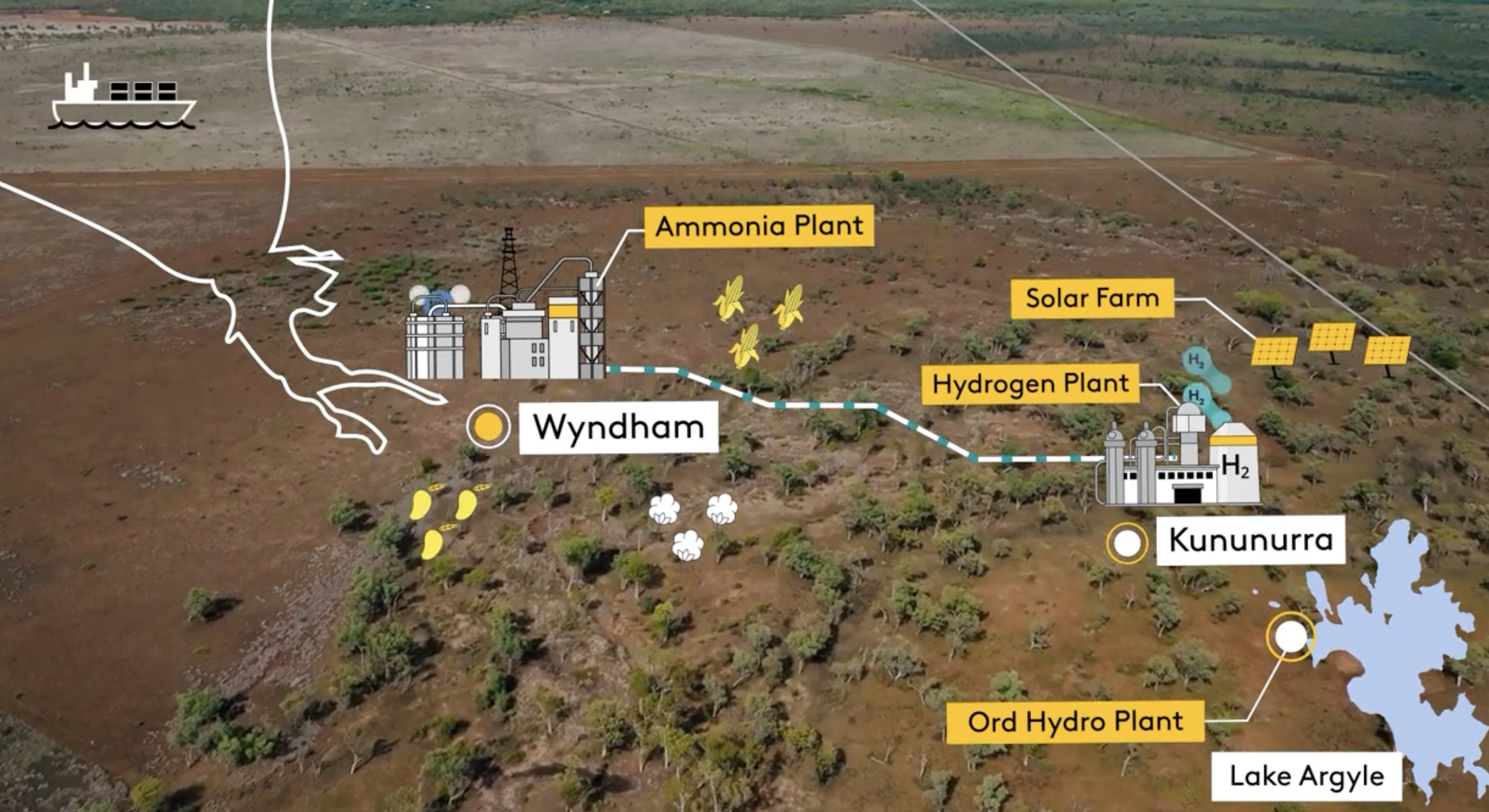
Stage one of the project, which could commence in late 2025, would see a 900MW solar farm - the largest in Australia - and a 50,000 tonne per annum hydrogen production facility - on land owned by the MG Corporation.
An existing hydroelectric facility at Lake Argyle will convert fresh water into green hydrogen in a process called electrolysis and transport the product on a new 120km pipeline to the port of Wyndham.
The hydro facility will supply base-load renewable energy to an ammonia production facility in Wyndham which will produce around 250,000 tonnes per annum of green ammonia.
The green ammonia produced will be used for local agriculture and exported to key trading partners in Asia and Europe.
Stage one is designed to leverage the region's existing assets including:
- The Port of Wyndham, which has an ideal location and is well suited for exports to Asia.
- The existing Ord Hydro facility and electricity transmission network.
- Road networks and airport facilities that link key sites to be used for production and distribution.
Pollination Head of Projects Rob Grant said the partnership model was a much "fairer" approach compared to how resource projects have traditionally been developed.
"It's the first of a kind model where we have the Traditional Owners as the majority shareholders of a clean energy development company to develop the project through a feasibility phase in a co-design and co-decision-making model," he told National Indigenous Times.
"In the traditional model of project development whether it be infrastructure or resources, the developer comes to the Traditional Owner groups later on in the process and seeks approval to build predetermined infrastructure on their land and for that, there is some form of royalties.
"The purpose of this model is not only to have Traditional Owners in the design stage of the project to decide which country they're comfortable to have the project on but from an investor point of view you have taken out all that risk having a distributive negotiations later on the process which means you can get the project to the market more quickly.
"The benefits of this model are the traditional owner groups are landlords of the freehold land, they are recipients of lease payments during the life of the project and they are shareholders of the overall project."
While the project has a few more boxes to tick before construction gets underway, Mr Grant said making Traditional Owners equal shareholders reduces project development risk and shortens the project's development schedule.
The unique shared partnerships will also have far-reaching economic benefits for the local First Nations communities.
"There is expected to be a construction workforce of around 1000 of which a large number will be from local communities and traditional owner groups."
Balanggarra Aboriginal Corporation chief executive Cissy Gore-Birch said the partnership brought crucial individual lived experience and knowledge to this project.
"From cultural heritage, social engagement and remote land management to renewable energy and green hydrogen project and industry experience, the suite of skills required to effectively deliver this ambitious project on traditional lands in the East Kimberley exists only within this consortium," she said.
MG Corporation Executive Chair Lawford Benning said the partnership represented an important way forward for traditional owners.
"A focus on First Nations economic empowerment has led groups like ours to reject the historic passive engagement model of receiving royalties for agreeing to give up control of our lands," he said.
"This project gives us a chance to be active shareholders, understanding the risks and rewards, and making informed decisions about long-term strategic projects on our Country. Anything we do must be sustainable, intergenerational and connect culture and heritage."
KLC CEO Tyronne Gartsone said First Nations' involvement in large infrastructure projects and the clean energy sector could be replicated across Australia to help deliver on the nation's climate change commitments.
"The recent Melbourne and Queensland University Net Zero Australia report shows that at least 45% of the renewable energy we need to decarbonise our domestic and export energy supply will be located on land that is subject to native title," he said.
"We cannot have a just transition to net zero without First Nations ownership of the solution and projects that ensure we can get there."



