




The following article contains the name of a person who has died
2022-23 was the deadliest year on record for First Nations people in prison, with a new report leading to increased calls by human rights campaigners to reduce incarceration numbers Australia wide.
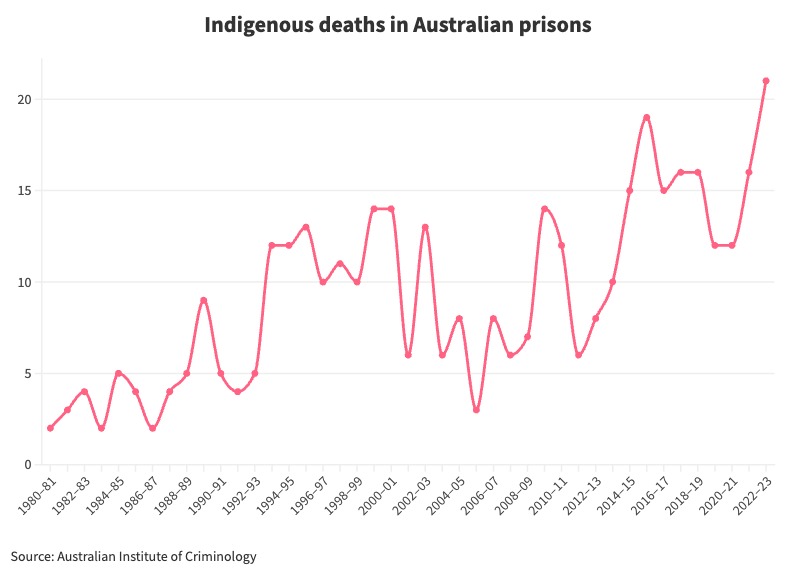
21 First Nations prisoners died whilst incarcerated between July 1, 2022, and June 30, 2023, the highest number since 1979-80. Of these tragic deaths, 11 people were unsentenced at the time of their death, they hadn't been found guilty of a crime.
Co-chair of Change the Record, Narungga Woman Cheryl Axleby, says "discriminatory" policies see Indigenous people arrested at "extraordinary" rates.
This has resulted in First Nations people dying in prisons and jails in numbers that have failed to rescind.
In the 32 years since the 1991 Royal Commission into Aboriginal Deaths in Custody (RCIADIC), there have been at least 556 Indigenous deaths in custody.
"Racist, law-and-order politics and policies cost lives," Ms Axleby said.
"Our communities have endured too much loss."
"Every death in custody is an unspeakable tragedy for that person's family, friends and community."
This year alone has seen 19 Indigenous deaths in custody – with a further 32 in 2022. They include Cleveland Dodd, 16, who died after being found in his cell at Unit 18 in the adult Casuarina prison; and Jeffrey Winmar, 28, who died in the aftermath of his arrest in suburban Melbourne.
The statistics form part of the latest numbers from the Australian Institute of Criminology and are designed to reveal full transparency around Indigenous deaths in custody.
The latest data is divided into two categories: deaths in prison custody and deaths in police custody. Overall, the 2022-23 period saw a total of 31 Indigenous, and 79 non-Indigenous, people die whilst in custody.
The numbers also reveal ten Indigenous deaths in police custody: an 18-year high, encompassing a quarter of all deaths in police custody.
Experts have consistently showed that Aboriginal people are treated disproportionately in every aspect of the justice system, starting from arrest, bail applications, sentencing and then parole.
A report from the Queensland Family and Child Commission found children were being denied bail due to family circumstances and being kept in prison on remand due to factors beyond their control.
Whilst in Victoria, the Victorian Aboriginal Legal Service CEO, Nerita Waight, said: "Aboriginal people in Victoria are more likely to be arrested, incarcerated and to die in custody compared to non-Aboriginal people."
All these factors exacerbate Indigenous incarceration. Latest data from the Australian Bureau of Statistics highlights the reality: First Nations people are dramatically over-represented in incarceration numbers.
Despite only encompassing 3.8 per cent of the population, Aboriginal and Torres Strait Islander people account for 32 per cent of all detainees.
Guardian Australia reported this year that in 2021, 36.2 percent of Indigenous prisoners were unsentenced, serving time without having been found guilty of a crime.
One of the RCIADIC recommendations was the consideration of all other options before incarceration for Indigenous people. However, 2023 has seen Queensland suspend their human rights act to criminalise bail for youths which has resulted in Indigenous incarceration sky rocket – confirming predictions made by experts.
"The Royal Commission's recommendations were very clear, particularly that arrest and imprisonment of First Nations peoples should be sanctions of last resort," Ms Axleby says.
"The report has been largely ignored by Australian governments.
"Now, we are facing an even deeper crisis than the tragedies that sparked the Royal Commission."
Numerous states have also seen children housed in adult facilities, which has only exacerbated trauma - both whilst the child is incarcerated, as well as when they leave. Recidivism accounts for 78 per cent of all Indigenous prisoners.
The death of Cleveland Dodd occurred in an adult prison and there have been sustained calls for the Western Australian government to close it, whilst in Victoria, an indigenous child felt "abused" after he was placed in a spit hood whilst being housed in an adult facility.
"A key recommendation of the Royal Commission was for substantial and sustained investment in non-custodial alternatives to prison," Ms Axleby said.
"Instead, we see state and territory governments pile more and more money into expanding police forces and building new prisons."
Amongst the recommendations urged by Change the Record, there are calls for the ending of mass incarceration for Indigenous people by "repealing punitive bail laws; mandatory sentencing laws; and custodial sentences for minor offences".
Ms Axleby says the government is ultimately responsible for the horrific statistics around deaths in custody, which have only continued to rise.
"The systemic failures of governments to prevent hundreds of Aboriginal and Torres Strait Islander deaths in custody over the last decades is a tragedy, and a disgrace, for the entire nation," she said.
13YARN 13 92 76
Aboriginal Counselling Services 0410 539 905



