Since an invasive seaweed called caulerpa was discovered in Aotearoa New Zealand in 2021, forming meadows that blanketed parts of the seabed, it's taken on an almost mythical status among people who spend time in coastal waters.
"It's so wily and so resilient," Michele Rogalin-Henderson, a doctoral candidate at the University of Auckland's Institute of Marine Science, told Mongabay.
"Yes, I did say wily," she added. "I anthropomorphize it. I spend a lot of time in the lab and in the field with this beast."
Stephen Te Tai, a commercial diver who removes the caulerpa, mainly in the Bay of Islands area in New Zealand's tropical far north, also spoke about the invasive seaweed in such terms.
"I know it's airy fairy but sometimes I feel its energy," Te Tai told Mongabay. In winter, he said, "it's real low, it's almost cowering, but in the summertime, it feels like its chest is puffed out, and it's real vibrant and strong."
Te Tai is Ngāti Hine, a Māori tribal grouping, and his surname means "coast" or "tide" in Māori. He spoke to Mongabay on the shoreline after he'd worked in the waters off Urupukapuka Island one day in July.
"The moana [ocean] is vital to our people," he later added in a text message. "It is not just something that nourishes us, it is a part of us, it was a part of our ancestors and it will be part of our mokopuna [descendants]. We love it like a part of our family."
For Māori communities and much of New Zealand's coastal population, the arrival of the caulerpa was alarming. The country has a unique marine environment, with a high level of endemism — more than half of marine species live nowhere else. Observers feared dense meadows of the invasive seaweed would smother marine life, compete with native species for space and displace habitats.
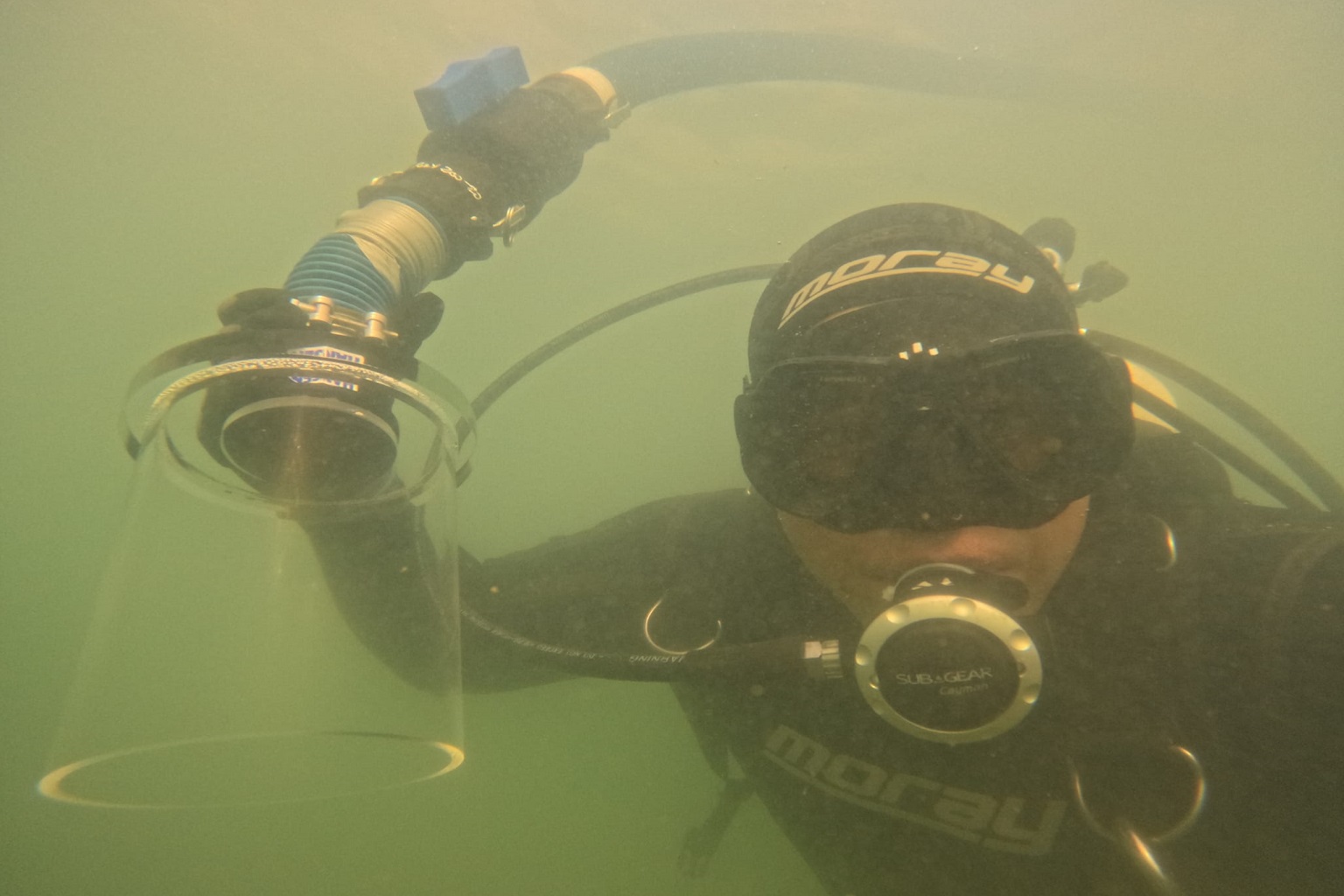
People like Te Tai got to work. His diving company, contracting for a locally-based charitable trust called Conquer Caulerpa, uses handheld suction devices to remove caulerpa from the seabed. Just on that day in July, they'd removed two metric tons, he said.
Te Tai's vacuum-like device is one of many innovative caulerpa-removal methods being developed across New Zealand, some with government funding. And yet they're emerging into an uncertain situation: Nationwide eradication is no longer seen as achievable, but a major natural dieback has tempered some of the worst fears about ecological devastation.

Methodology
The invasive caulerpa is in fact two different species: Caulerpa brachypus and C. parvifolia. Each grows a stem that creeps along the seabed, attached to which are paddle-shaped fronds up to a few inches long. Nine species of caulerpa are native to New Zealand, but the genus drew little attention before 2021, when the two invasive species were discovered around Aotea (aka Great Barrier Island), which is offshore of the North Island.
It's not clear how the two species arrived. Many experts believe they traveled on the anchor, chain or other equipment of recreational vessels — possibly first arriving in the Bay of Islands, a popular destination for superyachts. Others suspect they traveled with the current. The C. parvifolia, the more widespread of the two in New Zealand waters, has a genetic link to New South Wales in Australia; the origin of the C. brachypus remains unknown.
There were some early signs of possible damage, including health effects on kina (sea urchins; Evechinus chloroticus) and reduced quantities of scallops (Pecten novaezelandiae) in affected areas.
News of the invasion came as a shock in affected Māori communities.
"It was such emotions — just in the pit of our stomachs," Herearoha Skipper (Ngāti Tamaterā, Ngāti Pāoa), co-lead of Pou Rāhui, a research project involving five iwi, or Māori tribal groups, told Mongabay. "Going ... 'Does that mean our grandchildren and future generations will never be able to go and gather seafood from the shoreline?'"

By October 2023, the invasive caulerpa's collective footprint exceeded 15 square kilometers (5.8 square miles), some of it dense meadows, according to a government report that suggested the figure could be an underestimate.
Then in late 2024 the dieback began, and continued into 2025, dramatically reducing caulerpa in some of the most heavily infested areas. The vast, dense meadows on sandy or silty seabed largely disappeared. The caulerpa remained widespread, however, persisting in smaller patches and across a range of habitats. The cause of the seaweed's dieback is as mysterious as its arrival, but major storms, caulerpa reproductive cycles and seasonal ebb-and-flow could be part of it, experts say.
The Bay of Islands is home to perhaps the highest-profile technological response to the caulerpa: a 16-metric ton, 13-meter-long (43-foot-long) submersible dredge planer. The remotely operated vehicle (ROV) is designed to remove about a hectare (about 2.5 acres) of caulerpa per day, according to Andrew Johnson of Johnson Bros, the company that built it. It shaves away the caulerpa and a thin layer of seabed sediment, then vacuums the material to a barge, where a rotating screen device called a trommel separates out the non-caulerpa material, such as sand and water, and returns it to the sea.
Johnson and his team were conducting field trials of the machine in Ōmakiwi Cove in the Bay of Islands when Mongabay visited in July. These were operational tests not focused on removing caulerpa: the cove is one of the places where the seaweed has died back. But before the dieback, Johnson Bros removed caulerpa there using prototype dredges.
"When we first started working here, this was just completely covered with caulerpa," Johnson told Mongabay, gesturing out to the cove. "You could dive down anywhere in this bay and just be completely covered."
"We kept the bags of caulerpa on board, and we actually buried it all ashore here," he added.
Johnson said the new and improved dredge planer was the result of a "No. 8 wire" mentality — a term that implies ingenuity and resourcefulness. (It comes from the type of wire often found lying around on New Zealand farms, ripe for alternative uses.) Instead of wheels, the heavy machine crawls across the seabed on screw-like cylinders that prevent it from bogging down in sand.
The government awarded NZ$6.2 million ($3.5 million) to Johnson Bros, via the local council, to develop the dredge planer in early 2025, after making the allocation in 2024. But with the disappearance of most meadows, the machine has little immediate work to do.
"Due to the dieback occurring at all known caulerpa meadow locations over the past 12-24 months, we currently don't have any areas where we need to use the tool, but this may change," John Walsh, director of pest management at the government agency Biosecurity New Zealand (BNZ), told Mongabay in an emailed response to questions.
The dredge planer's environmental impacts are still being assessed, according to a recent BNZ announcement.


BNZ also put significant funding toward other caulerpa-removal methods in 2024, including one using short-wavelength ultraviolet light (UV-C) to irradiate caulerpa — a method that hadn't been used much in marine environments.
The UV-C system, which drew praise from experts Mongabay spoke to, has evolved along with the threat, according to Craig Thorburn, director and co-owner of Advanced Aquarium Technologies New Zealand, the company developing the technology. The company initially built a 500-kilogram (1,100-pound) ROV that works well on sandy bottoms. Yet the caulerpa isn't always found in such habitats.
"None of this equipment was suited to use around complex rocky reef habitat," Thorburn said in an emailed statement to Mongabay.
So his team, which works closely with academic and iwi partners, developed a more compact, mobile ROV that carries the UV-C system, while continuing to refine the technology for rocky reefs and study how to minimize damage to non-target species.

Community groups and researchers have used salt or biodegradable seafloor mats to smother the invasive caulerpa. In other trials, they've placed granules of chlorine under tarps — a technique that was used to successfully eradicate a form of caulerpa from the U.S. state of California in the 2000s. In a more advanced chlorine method, an inflatable unit suctions itself to the seabed to keep the chlorine confined as it's applied; it covers 75 square meters (807 square feet). Another experimental approach involves trying to kill caulerpa ultrasonically, though one set of trials showed it wasn't effective.
Rachel Woodfield, senior biologist at Merkel & Associates, a San Diego-based environmental consultancy, identified the invasive caulerpa in California in 2000 and helped manage the response. She went to New Zealand to advise on its response a few years ago and said subsequent reports indicate the methods bring net benefits.
"I'm glad to see the government investing in these trials," she told Mongabay in an email, referring to the New Zealand government. "Each has some short-term impacts on the treated marine community, particularly the disturbance from dredging and the effects of chlorine and UV-C on non-target organisms. However, those impacts need to be weighed against the potentially permanent loss of native biota and habitat structure that could result if non-native Caulerpa were allowed to establish."

The bigger picture
The tools are standing by, ready for a caulerpa resurgence. The people developing them are quick to point out that they could also have applications beyond caulerpa, particularly to removing other marine invasives.
"The whole idea of the machine is it's a multi-purpose tool that could be redeployed in any other situation that's needed as well," Johnson said of the dredge planer.
Rogalin-Henderson, the doctoral candidate, said the broader technology development would help prepare New Zealand for future threats.
"We're now developing tools which will help with the next invasion," she said.
Several experts told Mongabay that a holistic approach to biosecurity is needed because invasive species are more likely to take root in degraded marine environments with low biodiversity — for example, those that have been subject to bottom trawling.
"When you get depletion, and where you get bottom trawling, and you get bare, depleted substrates, that's just a hotbed for an invasive to take over," Barry Scott, professor emeritus in molecular genetics at Massey University and deputy chair of the Aotea Great Barrier Environmental Trust, told Mongabay.


Whatever invasive species may come next, it will test New Zealand's marine biosecurity system. Alongside Australia, the country has long been known for its strict biosecurity policies, and New Zealand communities often eagerly take up efforts to eliminate introduced species. But historically the focus has been terrestrial threats, particularly those that could affect the agricultural industry, according to Scott.
"As far as ocean biosecurity goes, New Zealand's been very, very weak in this space," he said, saying it's been only a "minuscule" part of the BNZ's budget.
But the arrival of caulerpa spurred the government into action, Scott suggested. "Since the arrival of this, they have really upped their game enormously, and they do have currently some very good people working in this space," he said.
Walsh of BNZ said that "[m]arine biosecurity is continually being improved and expanded."
"New Zealand already has some of the strongest marine biosecurity border controls in the world, with a Craft Risk Management Standard (CRMS) requiring vessels to arrive here with a clean hull, free of biofouling," Walsh added. "There are also rules to control discharge of ballast water in New Zealand waters to prevent the transfer of invasive species. The arrival of exotic caulerpa has added impetus to work in domestic marine biosecurity. There has been an extensive awareness campaign around preventing caulerpa spread and a wider public behaviour change programme called Protect our Paradise to educate marine users about good marine biosecurity."
Walsh didn't directly reply to a question about what percentage of BNZ's budget goes toward marine biosecurity but he did say the percentage has increased over the past five years. Asked about continued funding for the caulerpa response, he said the budget for the current financial year is still being confirmed.
Some Maori groups have criticized the government's handling of the caulerpa invasion. One iwi body, Ngāti Rehua-Ngātiwai ki Aotea, filed a Waitangi Tribunal claim in 2023 arguing that the government had failed to adequately respond to the incursion and engage them, in breach of historical treaty obligations; Mongabay couldn't locate a published tribunal decision. Skipper, the Pou Rāhui co-lead, helped lead development of a 302-page report drafted in 2024 calling for a stronger, more comprehensive government response to the caulerpa invasion. She told Mongabay that marine management and biosecurity should be iwi led.
Walsh said the "entire caulerpa response has been managed in partnership" with Māori customary authorities.
Just as the government's approach has shifted, so has the caulerpa's behavior, and Rogalin-Henderson said it was important to try to keep up with the changes. The first time she dove with it, there was so much caulerpa she thought controlling it would never be possible.
"We're just in a different place now than we were five years ago, and we know a lot more, but we still don't know enough, and it keeps changing, so you know it's really just a moving target — that's why I called it wily."
This article was originally published by Mongabay and has been republished here with permission.