




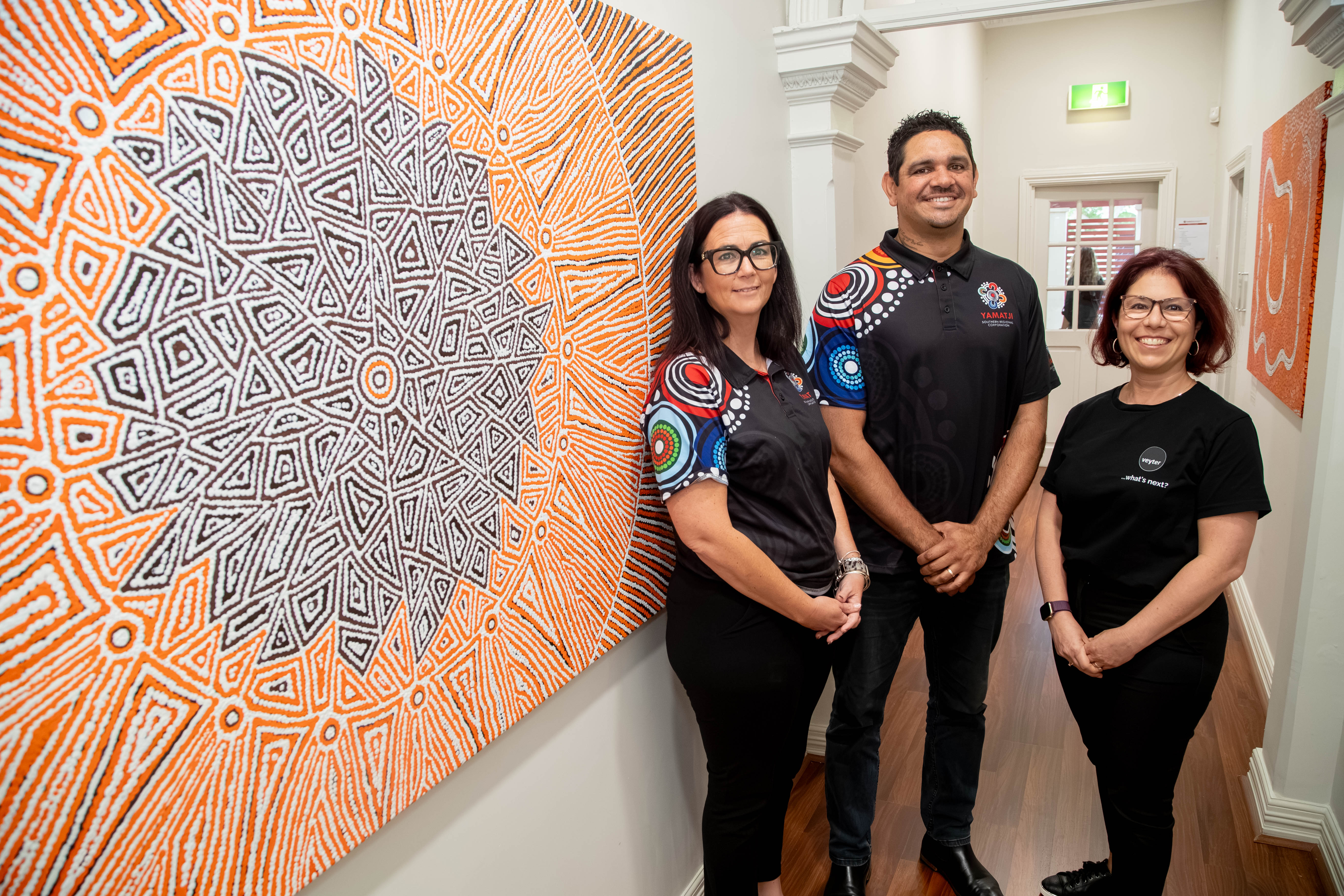
The Yamatji Southern Regional Corporation, Australian strategy and design firm Veyter and its Canadian parent Agilitas Advisory Corp have signed a Memorandum of Understanding to explore the development of a renewable Agri-Diesel refinery near Geraldton in Western Australia's Mid-West.
The MOU was endorsed by the Yamatji Southern Regional Corporation (YSRC) Board, and concept-stage work has now started as the parties progress the project through feasibility.
The plant would produce about 1.1 billion litres of Agri-Diesel a year, equivalent to 20,000 barrels a day or approximately four per cent of Australian diesel demand, from Western Australian canola and tallow.
Agri-Diesel is a drop-in substitute for conventional diesel, requiring no blending or engine modification, and cutting lifecycle emissions by approximately 85 per cent. Output would be sold domestically into mining, agriculture, transport, aviation and defence markets.
The project is being progressed on the basis of 51 per cent First Nations majority ownership, giving Yamatji Traditional Owners a controlling interest in the project. The remaining 49 per cent interest would be held by Veyter. The model is designed to ensure Yamatji people participate not simply as stakeholders or beneficiaries, but as majority owners of a major industrial project on Yamatji Country.
YSRC chief executive Luka Gray said "for Yamatji people, this is about moving beyond participation to genuine ownership of major industry on our Country".
"A project of this scale has the potential to create lasting economic opportunities for Yamatji people, Mid West growers and the broader region, while contributing to Australia's domestic fuel security," Ms Gray said.
In a joint statement, YSRC, Veyter and Agilitas Advisory Corp said a facility of this scale would carry indicative capital expenditure of approximately $2.5 billion, including the refinery, an integrated oilseed crushing facility, and associated infrastructure.
"Confirming and refining that estimate will form part of the feasibility studies. Any decision to build would follow front-end engineering design and a final investment decision," the joint statement said.
The statement noted that diesel demand is growing at roughly four per cent a year in sectors with limited alternatives, including mining, freight, rail, ports, construction and defence, and Australia remains "heavily dependent" on imported refined fuels, with approximately 80 per cent of refined petroleum product consumption met by imports.
"At the same time Australia exports feedstocks used to make renewable diesel. Western Australia is Australia's largest canola-producing state and accounts for around half of national production, worth about $1.2 billion a year, and Australia is the world's largest exporter of tallow," the parties said.
"Refining that feedstock domestically would keep more of the value onshore and reduce exposure to imported product, which the parties estimate carries a two to eight per cent premium at the wholesale level. The Pilbara alone consumes around 4 billion litres of diesel a year."
Oakajee Strategic Industrial Estate is being assessed as a potential location, alongside other sites within the Yamatji Nation ILUA (Indigenous Land Use Agreement) area.
YSRC, Veyter and Agilitas Advisory Corp said on Tuesday that early estimates indicate approximately 4,000 construction jobs and approximately 400 direct operating positions, alongside additional demand for Mid West grain growers.
"Projects like this get financed when the feedstock, the land, the power and the offtake market are already in place. In the Mid West they are," said Ron Loborec, Managing Partner, Agilitas Advisory Corp.
"We have taken renewable fuel projects to FEED stage in Canada with First Nations partners holding the majority, and that experience is what we bring here."
While Australia currently has no commercial-scale renewable diesel production, and the project's viability depends on federal policy now under development, in particular the demand-side mechanism for low carbon liquid fuels.
The parties said they consider that substantive demand-side certainty, alongside the Cleaner Fuels Program and the Future Made in Australia Innovation Fund for Low Carbon Liquid Fuels, is a precondition for a final investment decision".
"Engagement will continue with the Commonwealth and the Western Australian Government," they said.
Veyter Strategy Designer said Andi Csontos said "projects of this scale are rarely undone by the engineering".
"They are successful as a result of the relationships, and by decisions taken with the right people in the room," he said.
"Our work is designing how this partnership makes its decisions, so that Traditional Owners, the State, growers and future offtakers each have a genuine say from the start."
The parties have commenced a staged 12-month program of work to complete a full pre-FEED study by the third quarter of 2027.
YSRC and Veyter said that subject to those results and a final investment decision, front-end engineering design would be underway in 2027 with first production targeted for 2032.



