




The Victorian Liberals have pledged to repeal the state's historic Treaty legislation within 100 days if they win government in 2026.
Introduced last month, the bill has been described as a proud and historic step forward for First Peoples. It formally recognises the First Peoples' Assembly — under its new name Gellung Warl, meaning "tip of the spear" or "pointed spear" in Gunaikurnai — as the permanent representative and deliberative body for Traditional Owners and First Peoples in Victoria.
The legislation will be debated in Parliament this week, with the Opposition having already withdrawn from the previously bipartisan Treaty process last year.
On Tuesday, the Liberals and Nationals announced their own plan, despite broad support for Treaty among Traditional Owners across Victoria. There are currently no Indigenous MPs in either party.
The Opposition said it would introduce legislation in its first 100 days to repeal the Treaty Act, arguing it is not the "best way to close the gap and deliver better outcomes for Indigenous communities".
Instead, they have proposed creating a new department — First Nations Victoria — and an unelected Aboriginal advisory body.
The current First Peoples' Assembly is made up of 33 elected First Nations representatives, who have led negotiations with the state government on behalf of Indigenous Victorians.
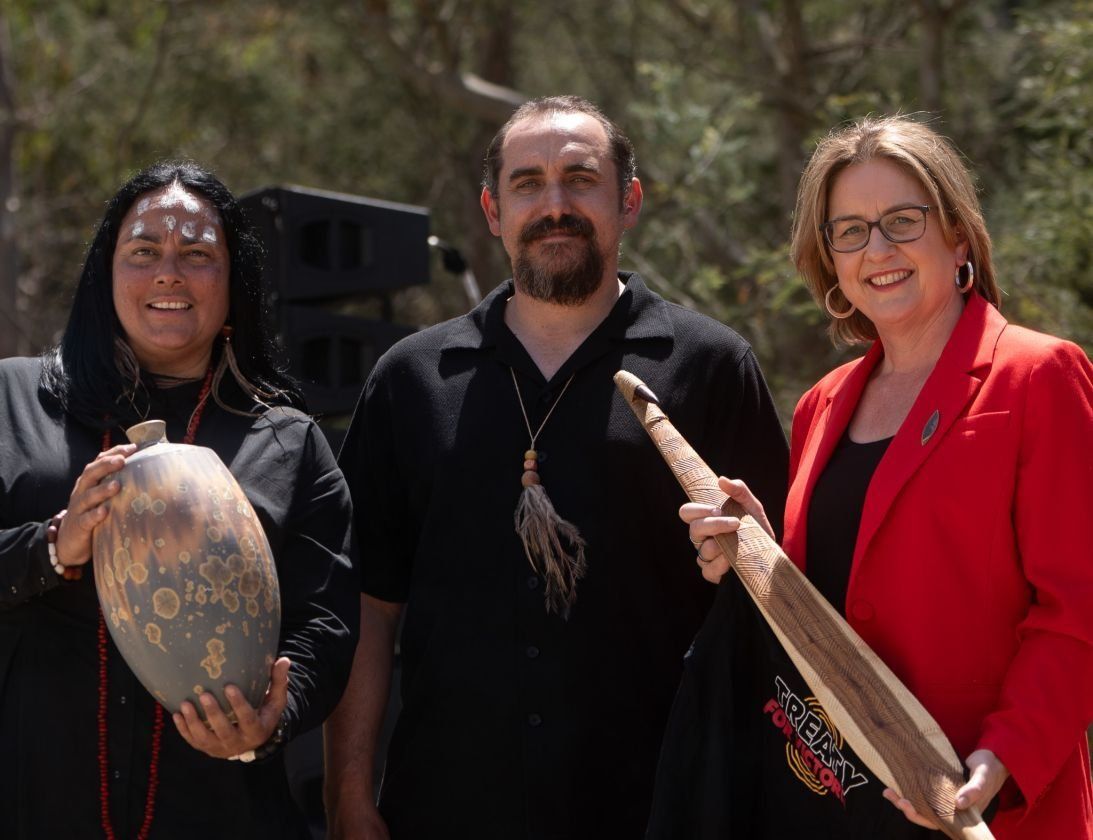
Addressing Parliament on Tuesday, Assembly Co-Chair Ngarra Murray said Treaty marked an end to governments treating Aboriginal people as political pawns.
"The time for paternalistic Governments making decisions on behalf of our people ends with this Treaty", the Wamba Wamba, Yorta Yorta, Dja Dja Wurrung and Dhudhuroa woman said.
"No longer will policies be made about us, without us. Our people will no longer tolerate being the political football that politicians kick around looking to further their own selfish interests."
Her fellow Co-Chair, Rueben Berg, added that good intentions have too often outlived good outcomes, arguing Gellung Warl would focus on accountability and transparency.
"We will accept scrutiny from our people, from this Parliament, from independent bodies. And we will measure success where it counts."
The Opposition said its proposed new department would deliver transparency and measurable progress by working "alongside Indigenous Victorians to implement a community-led, co-ordinated and transparent approach to policy, funding and service delivery".
They said First Nations Victoria would publish quarterly updates and table annual reports in Parliament to track outcomes across health, education, justice, and child and family well-being.
They also said one minister would be "ultimately responsible for First Nations Victoria, providing true accountability to ensure funding and services reach the people who need it".
Currently, Natalie Hutchins serves as Victoria's Minister for First Peoples and Treaty, and has been widely praised by First Nations Victorians for her active support of the Treaty process.
Liberal Leader Brad Battin said Labor had "dropped the ball" on Closing the Gap and claimed First Nations Victoria would help turn that around. He said the Opposition was focused on "real change in the lives of Indigenous Victorians," achieved through "genuine collaboration and respect for community-led leadership".
"First Nations Victoria will work in genuine partnership with Aboriginal community-controlled organisations, traditional owners, elders and local communities to co-design and deliver services that reflect their priorities," he said.
"Our commitment is to work alongside Aboriginal organisations, elders and communities to ensure that every initiative is grounded in cultural safety, trust and local knowledge."
He added on Tuesday: "There's a big difference from running an advisory group, to having an elected group come into the Parliament and operate effectively as another level of government."
Opposition spokeswoman for Aboriginal Affairs, Nationals MP Melina Bath, said the policy was aimed at improving outcomes in key areas such as suicide prevention, out-of-home care, and youth engagement.
"We have listened to Indigenous communities who want practical solutions," she said.
Premier Jacinta Allan slammed the announcement, arguing the Opposition has told the community "that their first priority if they should have the privilege of holding government is not to build the future, it's to tear it down".
"Tear down something that has been worked on not just for the last ten years that we have been working on this, but for decades," she said.
Under the proposed Treaty legislation, the Assembly — which has held two democratic elections since being established — would have the power to make representations to Cabinet, ministers, and both houses of Parliament. It would also be able to meet with the police commissioner, address Parliament annually, and report on matters impacting Indigenous people.
Furthermore, Assembly representatives would attend Cabinet meetings at least twice a year, with all discussions held in strict confidence. The legislation also makes clear that nothing in Treaty limits Parliament's power to make laws or conduct its business; a point the government and Assembly have repeatedly stressed.
Aboriginal communities across Victoria have been vocal in their broad support for Treaty — some of whom did not support the Voice to Parliament — with the democratically elected Assembly championing the process for several years.



