


WARNING: Aboriginal and Torres Strait Islander readers are advised the following article contains the name of an Indigenous person who has died.
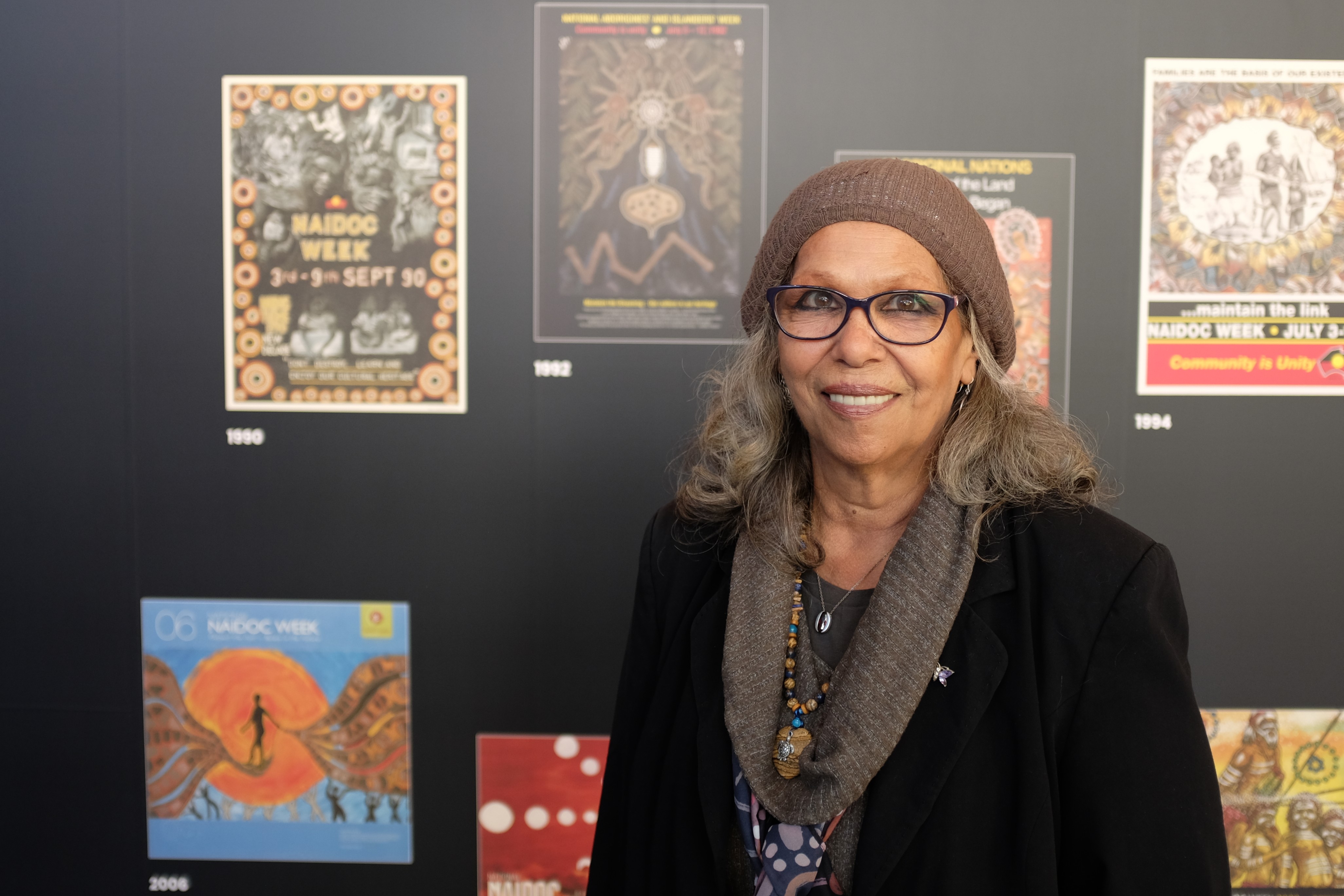
Even after 35 years, Heather Kamarre Shearer still believes her upside-down artwork changed her life.
The painting, Maintain the Dreaming - Our culture is our heritage, spectacularly won her $5000 when it was named the winning poster for NAIDOC Week way back in 1992.
The poster, which was mistakenly printed upside down when released, features in the South Australian Museum's 50 Years Deadly; Moments and Movements exhibition, which opened during NAIDOC Week (5-12 July).
The exhibition includes a beautiful 12m wall art in the Museum's foyer, showcasing the NAIDOC Week posters dating back to the mid-1970s.
"I'm so happy I'm being remembered," Heather said of her inclusion in the exhibition.
"It's been so long. That was a whole lifetime away."
Ms Shearer is a member of the Stolen Generations - she was taken from her mother in 1959 and grew up with her adoptive parents in Blackwood, attending Mitcham Girls High School.
Her adoptive parents were told she had been given up for a better life, and all she knew growing up was that she was from Alice Springs. She was in her 20s when she learned her birth name was Tanya and she had a brother Ralph.
The connection process began when Ms Shearer joined the then Aboriginal Childcare Agency, where her effort to find her family was championed by her boss, the late Brian Butler, who was a champion of the Stolen Generation movement.
Then in 1986, South Australia led the nation to change adoption laws and Ms Shearer obtained the final piece of the puzzle - who her parents actually were.
She was finally able to connect firstly with her mother's family who are Western Arrernte, and later her father at Atitjere in Harts Range, who are Eastern Arrernte.
It was there where she learned to paint and tell her story through art.
"We found out Brian used to go to school with my mum,' Ms Shearer said. "So close, but so far away."
"Everyone (at Atitjere) knew I was back but didn't know my story. So, I thought why not do a painting of my two families. I started to paint my family tree and that's how I started to learn about myself."
While at Atitjere, Ms Shearer decided to enter the NAIDOC Week poster prize, encouraged by people she knew on the NAIDOC Week committee.
"I drove to Alice Springs with the painting still drying on the back seat to catch the airplane," she said. "A few weeks later I was told I won, but they printed it upside down.
"Winning that competition changed my life though."
.png)
Ms Shearer went on to work in the arts, and travelled and exhibited extensively, including the Rainbow Dreaming exhibition in Belfast in the 90s. She also worked in a number of Aboriginal support agencies and chaired the Indigenous Arts Advisory Committee with ArtsSA.
Nowadays, Ms Shearer lives in Port Augusta but plans to return to live on Country at Hermannsburg near Alice Springs.
"It wasn't until I went home, took my shoes off and stuck my feet in the dirt that I got my connection," she said.
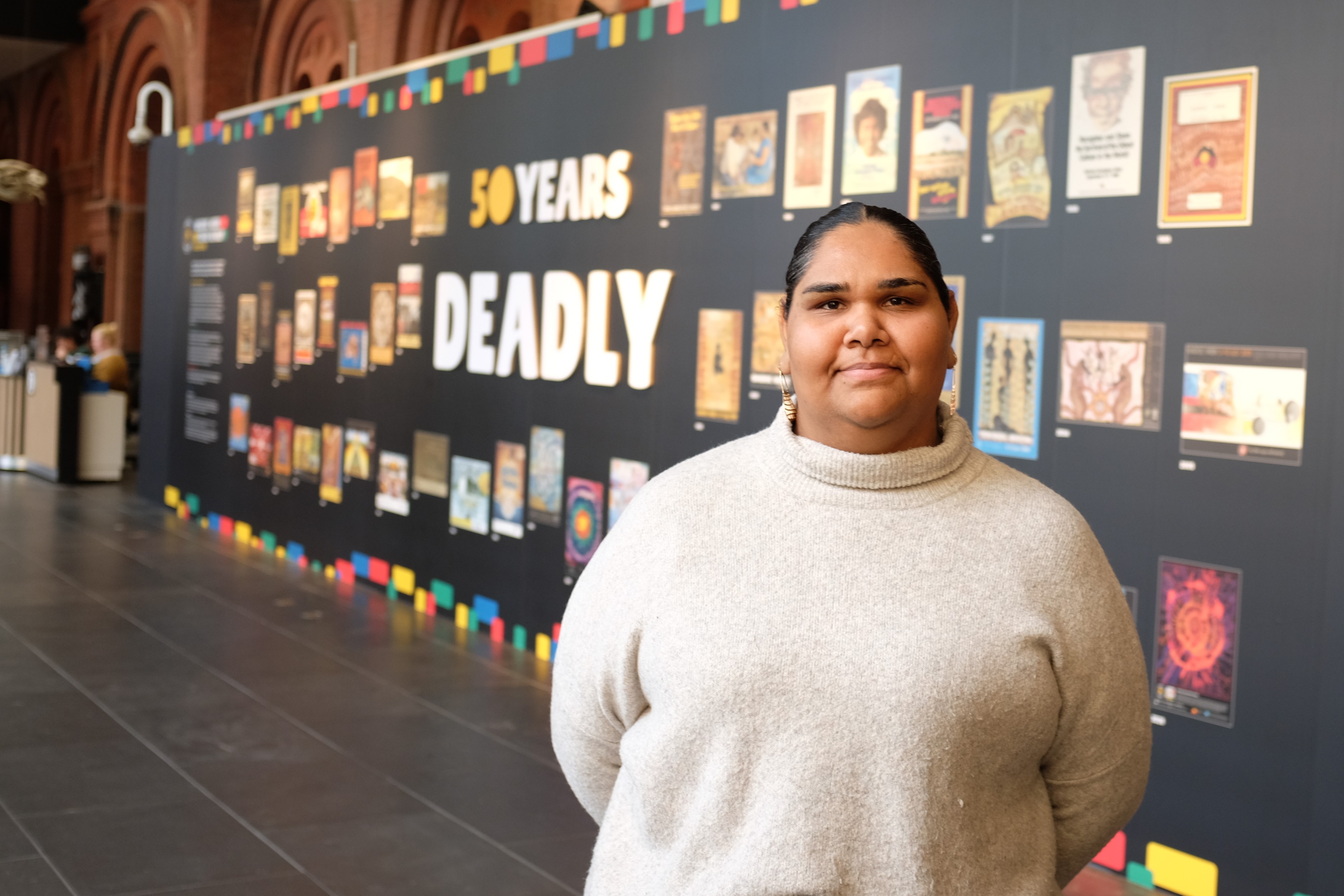
Coincidentally, it was Port Augusta where Ms Shearer met the curator of the 50 years Deadly exhibition - the Museum's Research Fellow for Aboriginal and Torres Strait Islander Culture and Arts, Jacinta Koolmatrie.
"I grew up around the corner from Heather," Ms Koolmatrie said. "I interviewed her for my high school research project.
"I was looking at the list of poster artists and thought I've got to know someone here, and Heather's name popped up."
Ms Koolmatrie liaised with the NAIDOC committee to access the posters but one remains unfound - 1973. Another was only recently included in the collection after being located in the National Library.
This year's poster Paralpi was created by musician Zaachariaha Fielding.
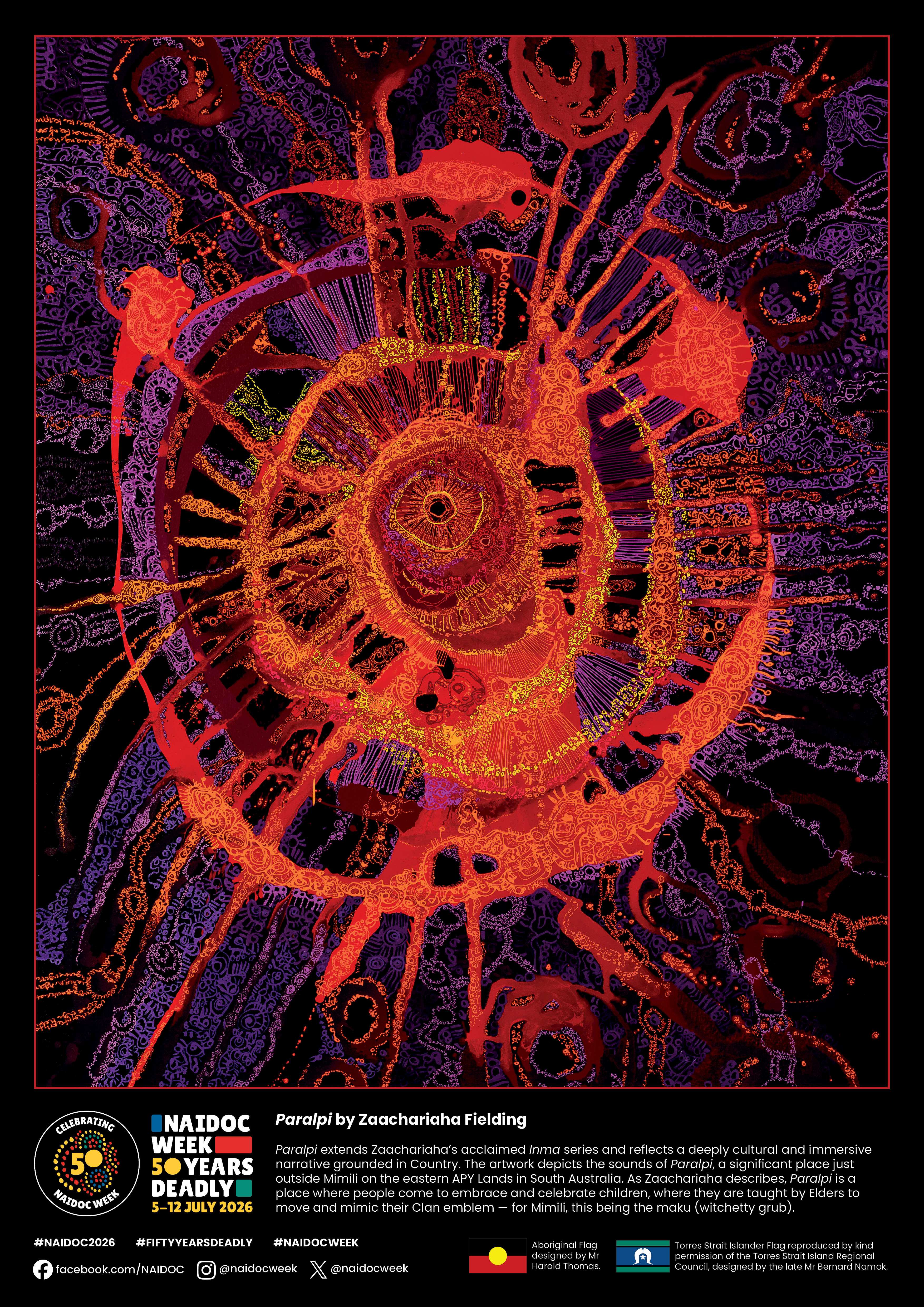
The 2026 NAIDOC Week poster 'Paralpi' by Zaachariaha Fielding. (Image: supplied)
Unfortunately, though, the identities of many of the artists have been lost in time.
"I wanted people to see the posters all in one place," Ms Koolmatrie said. "They show how people reflect over time - how things have changed and how things have stayed the same.
"I reckon the last one will be found though. A lot of people are looking."
The past few years have been a little tough for Ms Shearer as she's struggled with her health, twice beating cancer.
But she has found comfort with her art again, three and half decades after making her name as a painter.
"I've just started to paint again in the past few months," she said with a smile.
More information about the 50 Years of Deadly: Moments and Movements exhibition is available on the South Australian Museum's website.



