




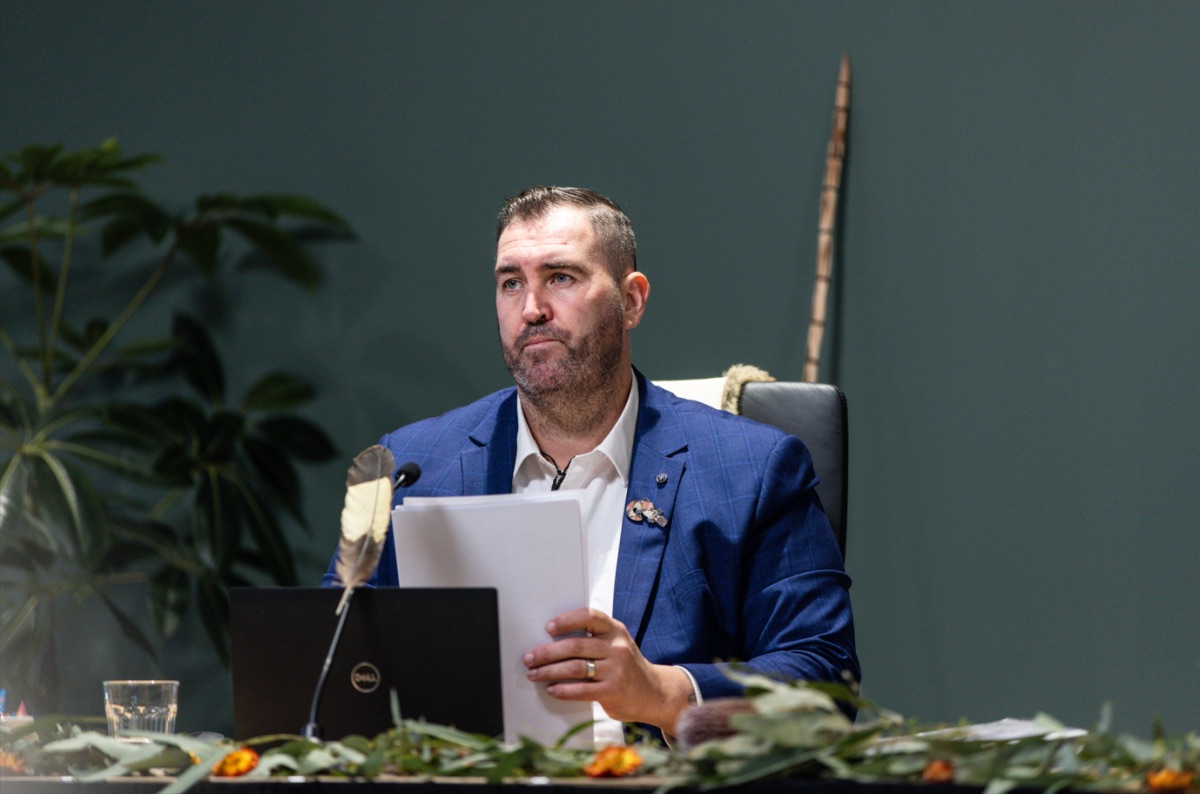
Since colonisation, schools and the education system have played a significant part in reinforcing racist perceptions and stereotypes about First Peoples, the deputy Premier and Education Minister Ben Carroll has told a truth-telling inquiry in Narrm.
Speaking before the Yoorrook Justice Commission, Mr Carroll said the system had failed - until recently - to acknowledge First Peoples' perspectives or their history prior to colonisation.
"These effects can be seen in the racism that continues to be experienced by First Peoples," he said.
"I have reflected on the evidence provided to this Commission by Elders who have shared their education experiences."
He said these experiences were not confined to history, but "continue to have implications for First Peoples lives today," including with Indigenous people's engagement with the education system.
The Yoorrook Justice Commission is examining the injustices perpetrated on the First Peoples of Victoria since colonisation to create an accurate record of the state's history.
On Friday, the Minister apologised for many of the historical state records in education that are problematic — "observations based in ignorance, paternalism and unbridled racism".
"These accounts do not do justice to the complexity and holistic nature of First Peoples education and knowledge systems," he said.
"There was a view that First Nations students should be not going to school...that is something I'm deeply ashamed about when I read about the history."
Focussing on racism in schools - highlighted in a report last year by the commissioner for Aboriginal Children and Young People, Meena Singh - a range of methods and programs have been outlined by the Education Department to help eliminate racism, which has seen reports of children suffering racial comments from teachers as well as fellow students.
Commissioner Maggie Walter said: "It does not seem that those programs are working, not with 30 per cent of children reporting that they have experienced racism last term".
The minister accepted that "in terms of soft bigotry, racism…we have got to do a lot more work".
Discussing the reporting of racism, Commissioner Travis Lovett asked why people would report racism at schools to the very people who often are the ones being racist.
"It distresses me that that is what First Nations young people, you know, the truth is that is what they've experienced, and we have got to change that," Mr Carroll replied.
The minister, who spoke of educational reform and the embracing of self-determination when interviewed by National Indigenous Times last month, reiterated this belief before the commission on Friday.
"It cannot be given or granted by governments but must be supported to be exercised by First Peoples," he said.
"However, too often the actions of government are barriers to self-determination."
Commissioner Lovett argued First Nations people "need to be involved in the decisions that affect our lives".
"That's another key way that [the] education system can play a pivotal role in ..making sure our people feel safe and get the meaningful education that is their right, their human right."
On education amongst First Peoples, Commissioner Lovett said there remained a misconception in society, "that our people don't want an education, and that our parents aren't invested in their children and that's just absolutely categorically wrong".
"Reading testimony from people like Uncle Jack Charles; his experience in education, you are 100 per cent right that that was a view, sadly and wrongfully, widely held and permeated... and a view that went for way too long," the Minister replied.
Commissioner Lovett asked the minister how his government, and the department, was embedding culture, language and "our ways of learning" into the system.
"Whilst we come from our culture and our principles and our ways of being, knowing and doing, we're trying to benefit the system for every child," Mr Lovett said.
"But I'm not seeing…our culture and our practice beyond doing some artwork or painting our hands with the Aboriginal flag colours during Reconciliation Week."
In response, Mr Carroll noted: "It does need to be systematic change and it is about the deep listening with First Nations People that we will bring about the change in the entire system."
The hearings continue.



