




A Northern Territory health alliance says men, families, and community leaders need to unite to prevent violence against women and children over the holiday period.
The Aboriginal Medical Services Alliance Northern Territory (AMSANT) issued the call as the Central Australia Aboriginal Congress' Ingkintja Men's March Against Domestic Violence takes place in Mparntwe/Alice Springs on Wednesday.
Coinciding with International Human Rights Day and the end of the United Nations' 16 Days of Activism, the march comes ahead of the busy holiday season — a period when data shows alcohol-related harm and domestic, family and sexual violence (DFSV) increase. It underscores both men's responsibility to challenge violent behaviour and government responsibility to address the causes of violence, Northern Territory Indigenous groups say.
Michael Liddle, Manager of Congress' Ingkintja Male Health Service, said family violence is not "traditional behaviour". Instead, he argued, "we have shaped it into a cultured and accepted behaviour".
"There are many Aboriginal men who provide the strength and leadership that make strong family lives, who have been raised in a strong family environment," he said. "They are good partners, good parents, who are shaping the next generation around ethics and morals and are not perpetrators of violence."
The march will commence at 11.30am at the Courthouse Lawns on Hartley Street, and will proceed through the town centre before ending at the Alice Springs Town Council Lawns.
Last year, the march attracted hundreds, with men holding signs reading "stop the swearing, bashing and killing," and "we are nothing without the women in our lives" as people chanted "End the Silence! Stop the Violence!".
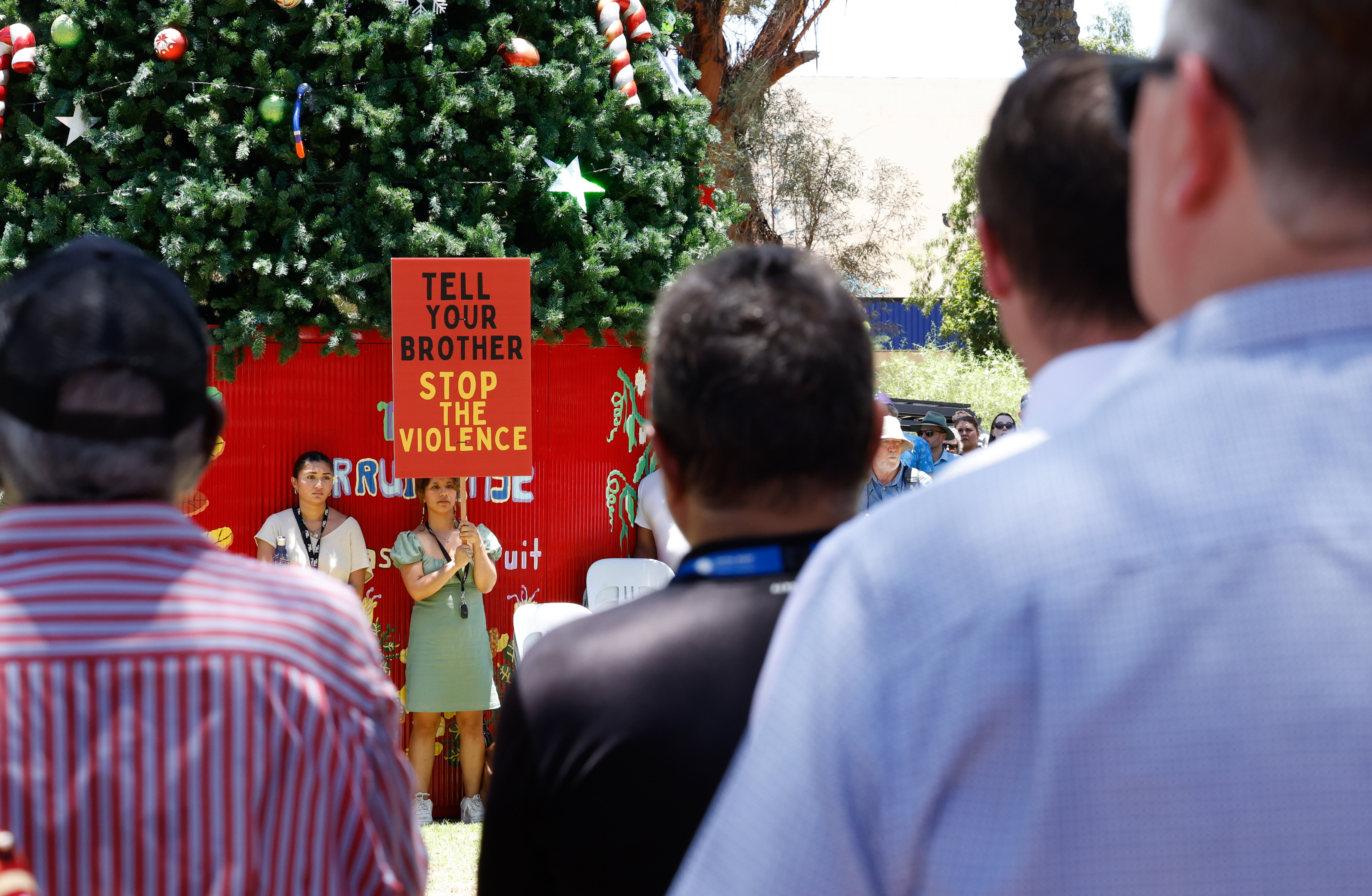
AMSANT deputy chair and Congress chair, Ebony Abbott-McCormack, said the event is a critical moment for change, demonstrating Aboriginal men leading solutions by "standing up, stepping in and reclaiming our cultural responsibilities to keep families strong".
"Every woman and child deserves to be safe," she said. "Our women carry culture, language and the well-being of our families. When harm is done to our women, it is done to our whole community.
"This march is a powerful statement—that violence is not our culture, and it will not be tolerated. We must look after each other, look out for our families, and call out violence when we see it."
AMSANT highlighted NT Police data showing alcohol reforms — including a minimum unit price and tighter supply controls — were linked to a reduction in homicide and related offences.
In Alice Springs, there was a 21 per cent decrease in alcohol-related domestic violence assaults under the 2017-19 minimum unit price. But when Stronger Futures alcohol protections lapsed in 2022, alcohol-related domestic violence almost doubled.
"These figures show what strong policy, prevention and community leadership can achieve," Mrs Abbott-McCormack said. "But policy alone won't end violence. We need men to stand up, to step in, and to choose safety for our families—especially over the holidays."
Mr Liddle said more people need to call out men's behaviour. Rather than "hiding our heads in the sand," he said people must openly acknowledge that "violence by some of our men is getting worse". He urged men to speak up, challenge violent behaviour, and support others to change.
At least 90 women have been killed by domestic violence in the Territory since 2000—more than 90 per cent being Aboriginal and Torres Strait Islander women. Domestic violence accounts for up to 80 per cent of police callouts.
"That's why Ingkintja's men are standing up to say to all men that hurting women and children won't be tolerated in our communities," Mr Liddle said.
"We are sick and tired of it, because all of us Aboriginal men are carrying around the label and it's not good at all.
"Our men need healing places with male cultural leadership, trauma-informed and healing-focused therapeutic care. We need a place that men can go to de-escalate, before violence starts, and to help men coming out of prison to be strong and loving husbands and fathers who don't use violence."



