




A new, "historic" national strategy to end violence against First Nations women and children will place community-controlled solutions and family strengthening at the centre of safety and wellbeing.
On Tuesday, the federal government announced more than $200 million in funding alongside the launch of Our Ways - Strong Ways - Our Voices: National Aboriginal and Torres Strait Islander Plan to End Family, Domestic and Sexual Violence 2026-2036.
The 10-year plan spans policing, justice, child protection and frontline services. It was developed in partnership with Aboriginal and Torres Strait Islander peoples and has been endorsed by all states and territories.
Operating alongside the National Plan to End Violence against Women and Children, released in 2022, the funding will support the establishment of up to 40 Aboriginal Community-Controlled Organisations (ACCOs) to deliver specialist, community-led services. These include crisis response mobile teams, assistance for people leaving violent situations, ongoing post-separation support, therapeutic care, and behaviour change and outreach programs for men and boys.
Community-led solutions at the forefront
Responding to the announcement, SNAICC - National Voice for our Children said the plan reflects years of advocacy for culturally safe, self-determined responses, and welcomed its development with First Nations communities.
CEO Catherine Liddle said the plan's "clear focus on community-controlled solutions and family strengthening" is critical, noting that when "families are supported to be safe and strong, children are safer too".
"We know that child removal is often a consequence of unaddressed harm so preventing violence is an important factor in reducing the number of Aboriginal and Torres Strait Islander children entering the out-of-home care (OOHC) system," Ms Liddle said.
%20(1).jpg)
"A child protection system that responds after violence has occurred is not enough. Safety starts earlier, with family support, healing and culturally grounded programs that keep children connected to family and community."
National data shows Indigenous women are seven times more likely to be victims of intimate partner homicide and 27 times more likely to be hospitalised due to family violence than non-Indigenous women, rising to 41 times more likely in regional and very remote areas.
Landmark plan
Aunty Muriel Bamblett, a Yorta Yorta, Dja Dja Wurrung, Taungurung and Boon Wurrung elder and co-chair of the plan's steering committee, told reporters on Tuesday that Our Ways - Strong Ways - Our Voices is the first of its kind.
The CEO of the Victorian Aboriginal Child and Community Agency says she is hoping it will transform systems supporting Indigenous women and children.
"This plan is the first plan that's actually written by us, for us," she said. "That will bring about real change. Systems have to change, the core processes, the policing, the way justice is implemented, the way that housing and homelessness, child protection systems, all of those things have to change."
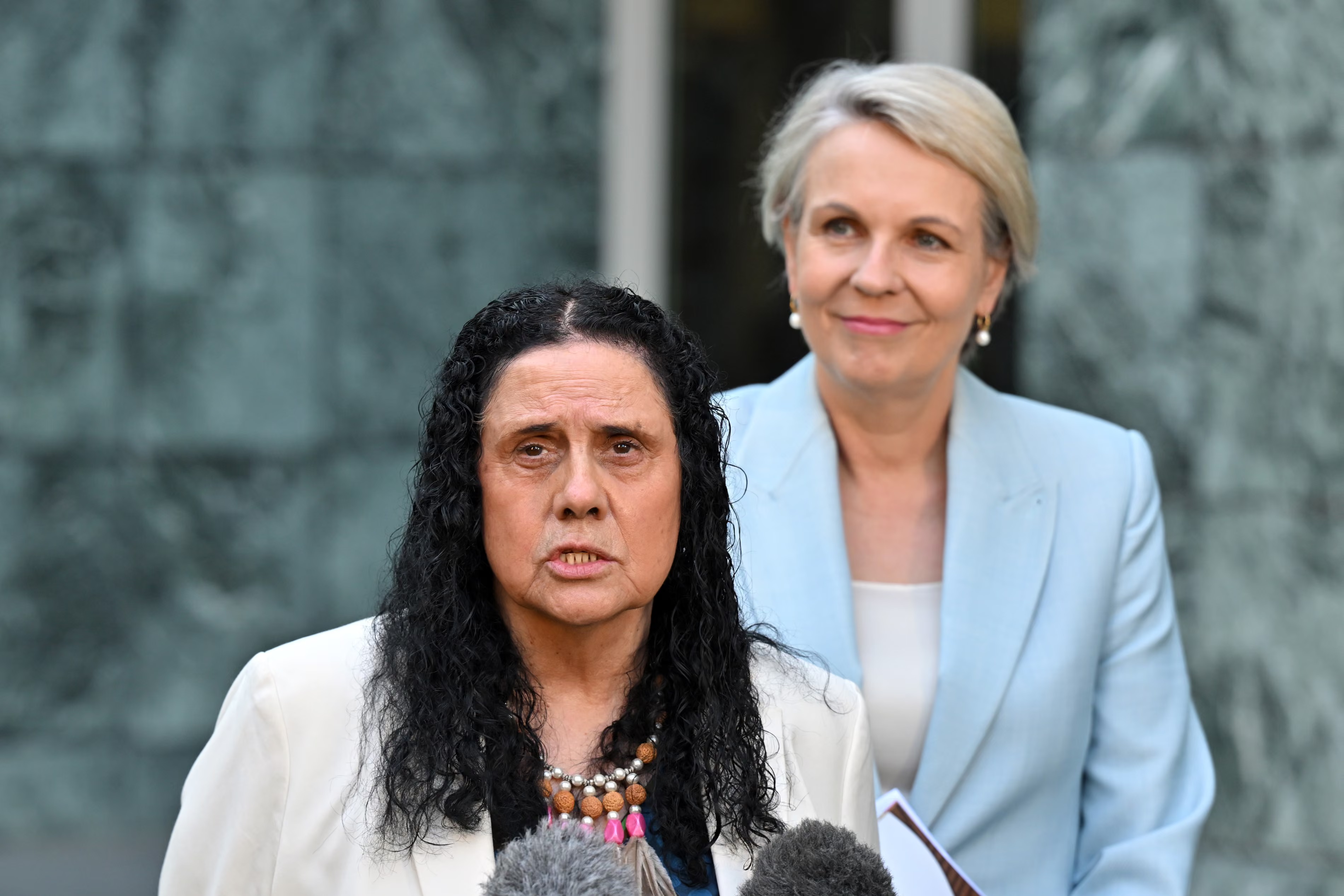
Social Services Minister Tanya Plibersek told the ABC the plan "charts out how we really reduce the unacceptably, shockingly high rates of violence against Aboriginal women and children into the future".
"It says that we need to prioritise delivery of programs that are locally designed, locally delivered, locally staffed, because Aboriginal communities themselves know what works in their communities," she said.
"But it also says our big mainstream systems like health, education, policing and justice need to reform themselves as well so they are better fit for purpose."
The plan also commits to tackling the underlying drivers of violence, including poverty, housing instability, mental health issues, alcohol and other drug use, gambling harm, and unmet disability and developmental needs. SNAICC welcomed this approach, with Ms Liddle saying it recognises that "violence does not occur in isolation".
"Safety is shaped by systems such as justice, health, housing, education and child protection, which must be reformed to be culturally safe, accessible and accountable," she said.
"This is a roadmap for lasting change, grounded in community leadership, collective wisdom and a shared responsibility to ensure Aboriginal and Torres Strait Islander women and children can live free from violence."
Speaking in Canberra on Tuesday, Minister for Indigenous Australians Malarndirri McCarthy said that while the national plan is an important step, "it's about what we do next".
Addressing the women involved in its development, she said: "I know it's not easy, and at times you probably felt like you wanted to walk away and no doubt there'll continue to be frustrations as we go.
"But one of the most important things is that we stay at the table and we keep trying, not for ourselves, but for the people that we're here to represent," the Minister said. "Not just as politicians representing Australians across the country, but each of you as leaders in your own homes, in your own families and communities."
1800 RESPECT (1800 737 732)
Lifeline 13 11 14
Men's Referral Service 1300 766 491
13YARN 13 92 76



