




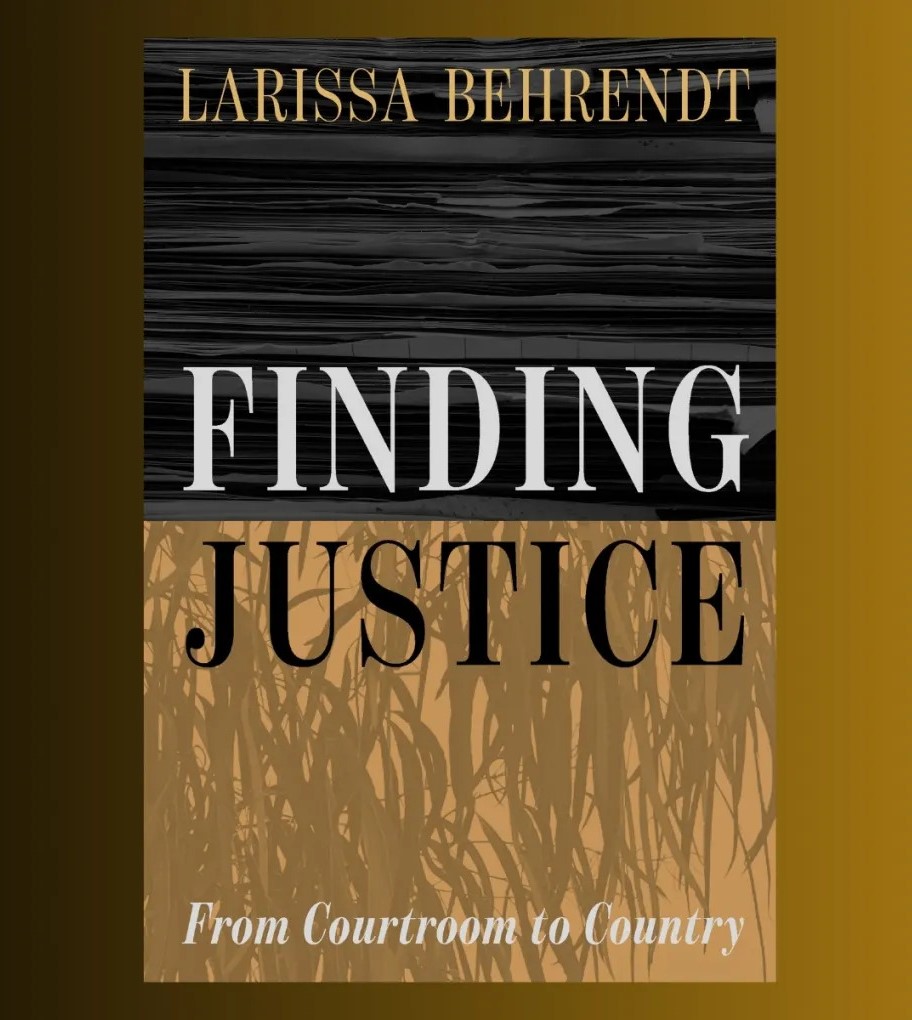
Finding Justice: From Courtroom to Country, the new book from Distinguished Professor Larissa Behrendt AO released last week, explores "what real justice means, and what it might yet become".
The ground-breaking work is part philosophical meditation and part historical reckoning, with Professor Behrendt weaving together personal reflection, Indigenous knowledge and decades of legal experience to "illuminate a deeper truth about Australia: that more than one way of understanding law, justice and responsibility has always existed".
Professor Behrendt, a Eualayai/Gamillaroi woman and Laureate Fellow at the Jumbunna Institute of Indigenous Education and Research at the University of Technology Sydney, considers how First Nations' Practices of Sovereignty - grounded in self-determination, reciprocity and collective care - have succeeded within communities.
Finding Justice is described as an "invitation to rethink power and policy, expand our understanding of justice and achieve genuine transformation".
'We've never had a moment where the legal system has acknowledged its complicity'
Professor Behrendt told National Indigenous Times there are two threads that have made the structural nature of the legal system a challenge for First Nations rights and equality.
"The first is the way the law has been used as a tool of colonisation to justify dispossession to give powers over control of bodies, removal of children. And I would argue that the way in which it was structured to commit those things has never been altered," she said.
"So, the idea that we've somehow gone from a colonial legal system to a postcolonial one is untruthful, because we've never had a moment where the legal system has acknowledged its complicity and thinks differently about its relationship, which is why we continue to see the over-representation in out of home care and in the criminal justice system."
Legislated protections are 'fragile'
Professor Behrendt said the second thread is "in the fabric of the Constitution" itself.
"When the framers drafted it in to come into effect in 1901, they made a deliberate choice to ensure that racially discriminatory legislation could be passed. And that was, of course, with an eye to the white Australia policy. The '67 Referendum when it gave powers to the federal government didn't change that assumption," she said.
"And all we've really had as a shield from that racial discrimination is the Racial Discrimination Act when it came in in 1975. It's been helpful in a couple of instances. I cite the Koowarta case, and Mabo number one, but you can look through the Howard era and see how fragile that protection is because basically because it's in the statute and not in the Constitution, because it's legislative, the parliament can pass the legislation, but it can also override it or repeal it.
"I think when you understand that that's the structure within which we're working, it helps you realise how much the machinery of the law and the legal system is, is really designed to continue with a power relationship with Aboriginal people that still sees us as colonial subjects."
Professor Behrendt noted that one important point to note with regards to legislative reforms as opposed to constitutional rights is the need for a referendum for constitutional reform.
"I think the challenge we face now, as a result of the Voice referendum, it's hard to imagine there'd be the political appetite to revisit constitutional change for quite some time," she said.
The unjust system is 'working as it is intended to'
Asked what can be done to tackle more than two centuries of systemic injustice, Professor Behrendt notes a quote from Elder and historian Uncle Gary Foley, who said: "We have never had so many First Nations lawyers, but we have never had so many people in prison."
"As soon as he said that I was like, 'you have just summed up my life'. As I say in the book, and as I say elsewhere, when you understand that that's how the system is working, that it is actually working as it is intended to, it's why it feels so hard and why you feel like you're hitting your head against a brick wall on why change is so difficult.
"And the response of the system is often to just say, 'well, we'll just get some more Blackfellas in and that will change it'. But that doesn't, that doesn't deal with the underlying power dynamics or those value systems that are entrenched in the legal system."
To begin to unpick what has been sewn into the system over the decades, Professor Behrendt notes the first step is to acknowledge that reality.
"People get trained in that system and they are completely unreflective about those power dynamics that they don't appreciate that's the system that they're working in as lawyers or judges," she said.
"So, I would say it's really important that people understand that's the system that we're working with. I don't think that there is a huge recognition of that outside of First Nations legal practitioners and services that that's actually what the dynamic is that we're dealing with. I think there needs to be a recognition, that that's what the system is."
"It's one thing to identify the problems but it leaves us with the question: What then? And I think it's, for me, we have had two systems of lore on this country, one of which has been here for tens of thousands of years and a system that actually supported cultures that are now the world's oldest continuing living cultures," Professor Behrendt said.
"One would safely assume that there are values within that legal system that give us a different way of thinking about what Justice is. I think for me fundamentally one of the differences in a western world view and a First Nations worldview is the idea of interconnectedness; the philosophy that sits within our kinship systems and within our um totemic systems is a world view that is about interconnection and one that comes with responsibility and obligation, so it's not just 'we're all connected', but when you have those connections to Kin or to Country, it comes with active obligations.
"I think rethinking the way in which we approach our relationships with each other, to see that it's not an 'us and them' or a 'win-lose' plaintiff v defendant the way that it's set up in the western legal system, but it is actually something much more holistic approach and something that really can't be achieved just through a court system. It is much more about providing space for people to tell their stories and support them through a process of healing."
Indigenous approaches to justice are the key
Professor Behrendt said western Justice "assumes you can go to court and get a verdict and somehow that repairs what you've been through".
"I don't think you can repair intergenerational trauma or the trauma of being a victim of crime, or approach the underlying issues that might lead somebody to come into contact with the criminal justice system, by just relying on the courts," she said.
"Within Indigenous ways of approaching things through that interconnection, and that sense of responsibility I think there's a different way of approaching these issues."
On how to break down the barriers that prevent the Indigenous justice system from reforming and healing the western justice system, Professor Behrendt says the first step "is to create more spaces where First Nations approaches to justice can be the leading way".
"I think that's fairly consistent with the ideas of Justice reinvestment, of having first responders rather than the police always involved. I think there are spaces now, particularly through the activism and advocacy of First Nations communities, about finding community-based solutions to these issues. So, there are spaces being carved out already," she said.
"I think the other strategy is to emphasise that the system as it is structured isn't working - and is flawed - and if we want to have a different outcome, then we need to think more strategically and go beyond just trying to tinker around the edges but think about a more systemic change to the way we approach these issues."
'We are the world's oldest continuous living culture. Why aren't people more curious about how we achieved that?'
Professor Behrendt does have some optimism about the future for justice, arising from "those sorts of philosophies like interconnection" which a "have a way of giving us a road map for not just thinking about a question, like, 'what is justice?', but also for thinking about other issues, like how we approach the climate challenge and how we approach the current fracturing of society, the polarisation of society."
"Indigenous world views around interconnection are the absolute antithesis of a polarised society; you couldn't get anything more different," she said.
"So, I would hope that non-Indigenous people could start to see that within these philosophies there are actually strategies that can help with problem solving.
"I often reflect on this in my work. We are the world's oldest continuous living culture. Why aren't people more curious about how we achieved that? It's not just because you can live on Country or you're lucky. You have to have a societal structure that is sustainable, both in the ecological sense, and also in the way you live with each other.
"So, I have some hope that if there's more respect and understanding of the philosophies that are embedded in our knowledge systems, that more people will see them as places to look at real alternatives to the really difficult issues that face our society as a whole."
Finding Justice: From Courtroom to Country is the synthesis of many years of work.
"I've been thinking about it for a long time and really, the book itself is a culmination of a lot of essays and talks that I've done over the years and are kind of bringing it together," Professor Behrendt said.
"If people say why this this book now, it's like, 'well, I'm closer to the end of my career than the beginning and it's probably time to share some things that I've learned the hard way'."



