



A leading hearing health advocate says undetected ear disease is preventing many Indigenous children from developing key skills needed to thrive.
Yorta Yorta woman and Hearing Australia Cultural Leader, Kirralee Cross, said early, frequent and long-lasting ear infections continue to have a serious impact on Aboriginal and Torres Strait Islander children.
"These type of ear infections are very common but in First Nations kids they usually occur more often, they start very early in life and it actually lasts longer," Ms Cross said.
"It can start in infancy without any obvious symptoms."
New data from Hearing Australia shows 35 per cent of young Indigenous children experience fluctuating middle ear disease, while 8 per cent have persistent trouble.
The findings come from the government-funded Hearing Assessment Program - Early Ears (HAPEE), which has supported more than 10,000 Indigenous children aged 0–6 each year since 2019.
More than 26 per cent of children assessed through the program have undiagnosed ear disease, and one in five have undiagnosed hearing loss.
Ms Cross said middle ear infections such as otitis media can interfere with a child's listening, speech and language development if left untreated.
"It affects the ability to connect and yarn with their mob, with others, with family, and when they get to school it can be a bit isolating," she said.
Ms Cross said teachers often misinterpret hearing problems as behavioural issues.
"We do hear reports of teachers saying they have kids that muck up or aren't paying attention in their class, and it's nothing to do with their attitude or behaviour, it's actually because they can't hear," she said.
A new five-minute screening tool, the PLUM (Parent-evaluated Listening and Understanding Measure), developed by the National Acoustic Laboratories with Aboriginal health services, has been found to be 91 per cent accurate in identifying long-term hearing issues.
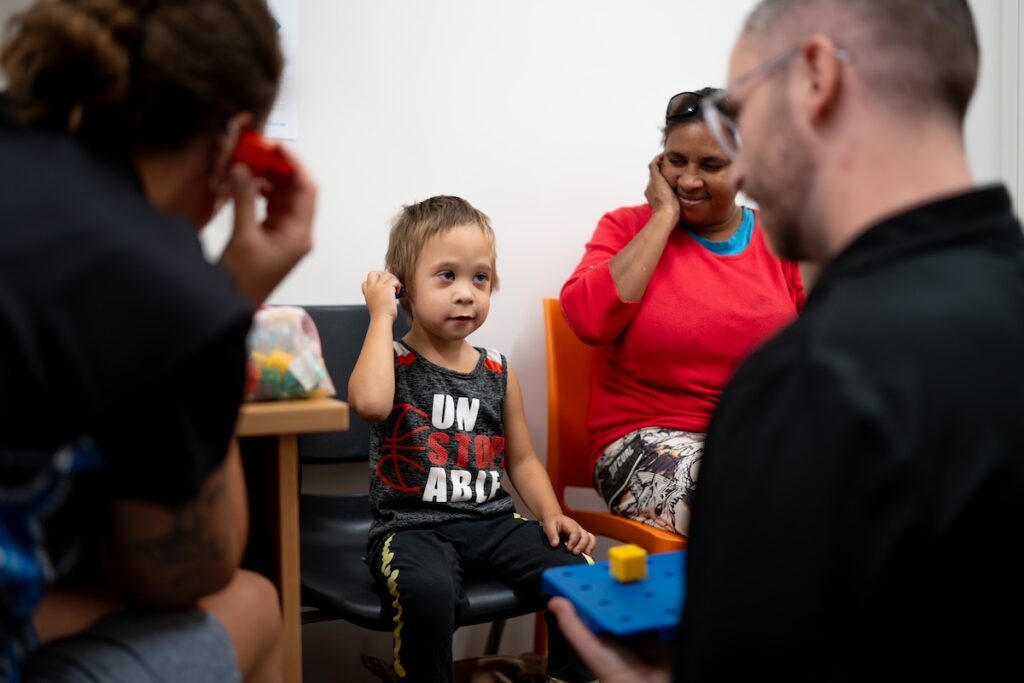
Analysis of more than 15,000 hearing appointments found children marked as 'not yet on track' using PLUM were 46 times more likely to have significant, sustained hearing loss.
"These findings from NAL are valuable as they show the PLUM tool identifies children who are both likely - and not likely - to have long term ear health and hearing trouble," Ms Cross said.
"This will help health practitioners to know when to give reassurance to families and when prompt action is needed to reduce the impact of otitis media."
Hearing Australia is working with more than 400 health organisations nationally, including nearly one-third Aboriginal Community Controlled Health Organisations, to improve access to regular ear checks and use of tools like PLUM.
"We're tailoring our support and coordinating services with Ear, Nose and Throat specialists where possible so that children can get the help they need," Ms Cross said.
"Identifying hearing problems shouldn't fall solely on families.
"Often there are no signs of ear trouble which is why it's important that ear health checks are a routine part of care."
Since the HAPEE program began, more than 1,000 health workers have been trained in hearing screening.
At Karadi Aboriginal Corporation, Outreach Worker and Care Coordinator Maree Marney said the PLUM tool has helped triage children ahead of Hearing Australia visits.
"This proactive strategy allows us to identify concerns early, ensuring better outcomes for our community," she said.
Hearing Australia managing director Kim Terrell said the agency aims to halve hearing loss rates in Aboriginal and Torres Strait Islander children by 2029.
"Our hope is that more First Nations children with ear health problems will be identified and connected with support early, so that ear trouble doesn't stop them from learning and thriving," he said.



