




In the immediate aftermath of the death of a five-year-old Aboriginal child in Mparntwe/Alice Springs, Indigenous politicians and leaders are asking for transparency on how the tragedy could occur.
On Thursday, the body of a missing five-year-old girl — now referred to as Kumanjayi Little Baby at her family's request in line with cultural practises — was found, after she had been missing since Saturday night when she was allegedly abducted from her home in the Aboriginal town camp of Old Timers, on the outskirts of Mparntwe/Alice Springs.
Police believe she was likely kidnapped by Jefferson Lewis, 47, who had been released from prison just six days earlier and who, between 2016 and 2025, had been sentenced to 64 months in prison for offences including aggravated assault, breaching domestic violence orders, bail offences and resisting police.
After a five-day manhunt, Mr Lewis was found and reportedly beaten unconscious by community members on Thursday evening after he was seen wandering outside the Charles Creek town camp. He was taken to Alice Springs Hospital by emergency services, where large-scale protests took place outside, before being flown to Darwin on Friday morning.
He remains in police custody, and charges are expected to be laid within the coming days.
Community leaders call for calm
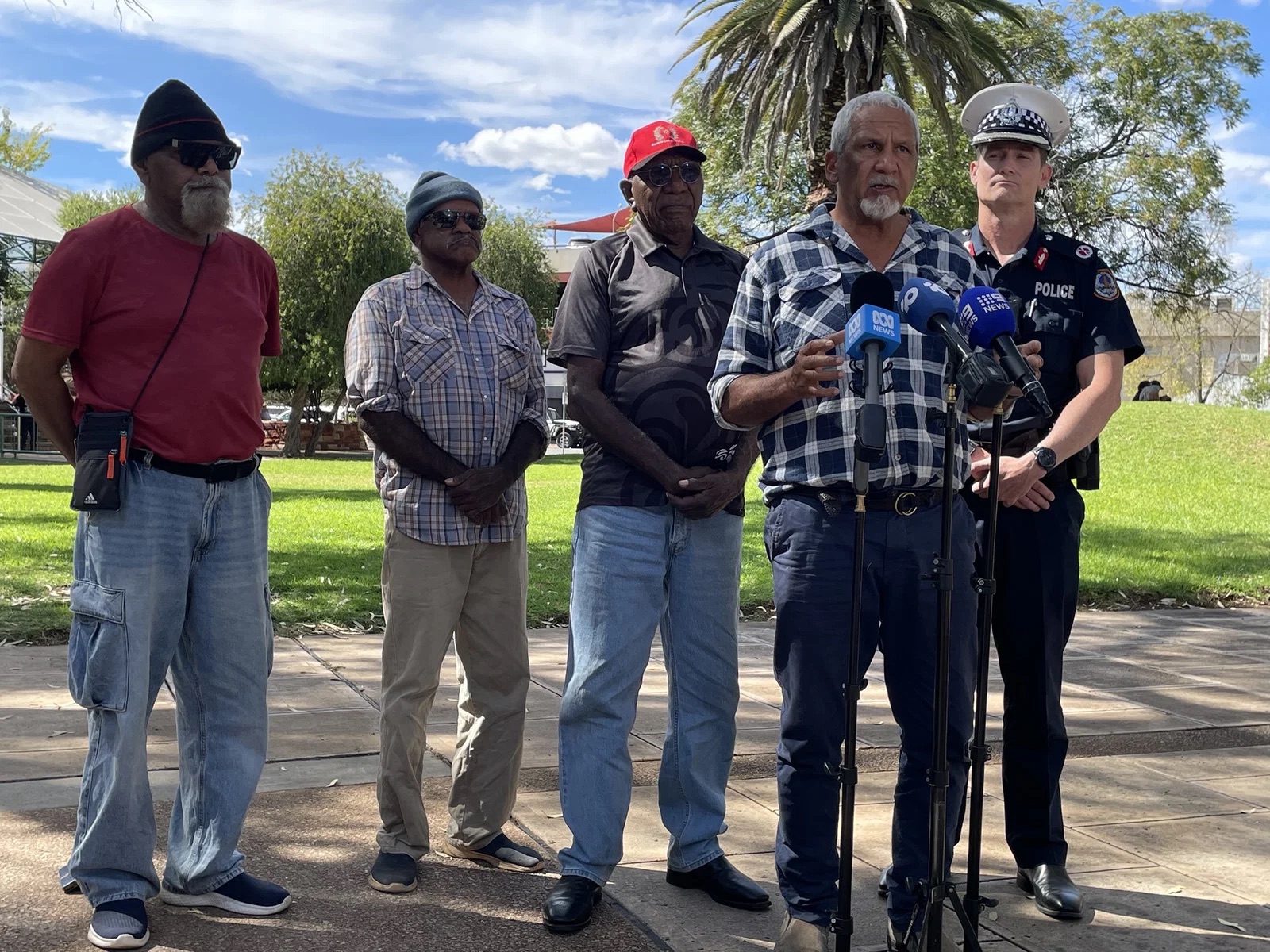
Traditional Owner and senior Alyawerre man Michael Liddle addressed the media on Friday. He said the protesting on Thursday night was an "incident of anger that turned into violence that had no thinking about the consequence".
"All week, the community of Alice Springs come together — service providers, business-owners — searching for a little baby that was taken by a monster," he said.
"That hard work was undone last night by some people who are very angry with the systems, the same systems that create safety and less harm, keeping people safe in Alice Springs."
Elder Warren Williams said the grief in the community was immense and thanked the whole town for coming out and supporting the family.
"I feel devastated by what happened all this week, and losing our grandchild was enormous, really appalling," he said.
"People are very emotional about what happened there...It's something that we've never seen before."
View this post on Instagram
Kumanjayi Little Baby's family released a statement, via SNAICC, calling for calm. Robin Granites, a senior Yapa (Warlpiri) Elder and spokesperson for the family, said the time was now for sorry business and to "show respect for our family and have space for grieving and remembering".
"Everyone is feeling very upset and emotions are very high, I understand that," he said. "What has happened this week is not our way. Our children are precious, of course we are feeling angry and hurt at what has happened."
In a statement, Independent Senator Lidia Thorpe sent her condolences to Kumanjayi Little Baby's family, before calling for a "full and transparent investigation into the circumstances of this crime," adding that the "perpetrator must be held to account".
"Our families and communities must not be demonised or blamed for the violent actions of one individual," she said. "We are already seeing racist commentary being made about Aboriginal people, and this must stop. People should refrain from sharing footage of violence online, which is only inflaming tensions."
Writing in Black Witness, journalist Amy McQuire said social media comments arguing the protests showed black communities are ungrateful to police "are as predictable as they are inaccurate, and should be condemned outright".
"This is because the focus should always be on Kumanjayi Little Baby, and on ensuring her memory and how she was in the living is presenced, and brought to the forefront, always," she wrote.
"What this tragedy has shown us is the enormous depth of care and love from Black communities towards our children. It has shown again how the loss of any one of our children hurts us all. It has demonstrated just how much Kumanjayi Little Baby was loved, and how she was loved, not only in life, but also in death."
View this post on Instagram
Long-term change
Senator Thorpe said governments must do more to tackle "extreme poverty and a lack of basic services and support" faced by Indigenous Australians across the country — especially in the Northern Territory.
However, the Victorian senator warned that "interventionist approaches" cannot be part of the solution.
"Governments must do more to ensure communities have the resources and authority to determine their own solutions," she said. "Our families hold the answers and must be trusted and empowered to lead. What we do not need is a return to the interventionist approaches of the past."
On Friday, the National Indigenous Child Commissioner Sue-Anne Hunter called for a "wider investigation into the correctional systems that led" to Jefferson Lewis' release.
Senator Thorpe backed the call, noting, "We also know there are serious failures in how authorities respond to the risks our women and children face from domestic violence. This was a known perpetrator. There are questions about how this could happen so soon after his release from custody."
View this post on Instagram
Traditional Owner Cedric Miller works with men who commit domestic violence. He told reporters recently released prisoners can access more support in their communities.
Having been released from prison, Mr Lewis was told to go to Lajamanu, where he has family. It's understood he was not welcome back in the remote community of Yuendumu — two-and-a-half hours north-west of Alice Springs — because of his offending.
He elected not to travel to Lajamanu, a dry community 560 km south-west of Katherine, instead going to Old Timers to see some extended family.
"I'd like to say, for our men who get locked up in jail, when they get released from prison, where do they go?" Mr Miller asked. "They go back to the society, back to this town.
"We'd like to see this government changing things, prison rules, [so] when you come out of prison, you've got to go straight back to your [own] community."
In an opinion piece in The Australian, Opposition small business spokeswoman Jacinta Nampijinpa Price, who previously revealed she was the girl's aunt, said the death was at least partly due to the poor management of remote communities.
"The town camp now at the centre of this case is one I know well. It is a place where I have lost family," she said.
"A niece was stabbed to death there. Another child in my extended family was killed in an accident at the front of that same camp. There have been too many lives lost in that place alone."
National Sexual Abuse and Redress Support Service 1800 211 028
Lifeline (24-hour crisis line): 131 114
Full Stop Australia: 1800 385 578
Beyond Blue: 1300 224 636
Ruby Gaea (NT): 08 8945 0155



