




Just out of Katherine, in the Indigenous community of Rockhole, 22-year-old student Edwina Murphy looks after her two younger brothers.
Often, her mother is 300km away in Darwin for treatment. Like Edwina, she is managing diabetes, having already lost sight in her left eye and four toes before beginning dialysis.
When she was 15, Edwina - like her two brothers and older sister - was diagnosed with type 2 diabetes following a Wurli-Wurlinjang Health Service school screening program.
Despite the family history of the disease, the diagnosis still shocked her.
"I was depressed and worried. I couldn't help but feel angry," Edwina said.
Diabetes is one of the leading causes of death for First Nations Australians, with type 2 diabetes accounting for almost 60 per cent of those deaths between 2015 and 2019. First Nations people were hospitalised due to diabetes at a rate nearly 4 times that of non-Indigenous Australians
In 2018–19, First Nations adults were 2.8 times as likely to report having diabetes or high sugar levels as non-Indigenous adults, according to the Australian Institute of Health and Welfare.
It also occurs earlier amongst Indigenous Australians, and Aboriginal and Torres Strait Islander children are eight times more likely to develop type 2 diabetes than their non-Indigenous peers.
The outcomes, including kidney damage, loss of vision, peripheral nerve damage and peripheral vascular diseases, as well as mortality, are devastating.
For years, Edwina used the often-painful finger-prick method to monitor her glucose levels. Having lived with the burden of the chronic disease since a young age, combined with looking after her family, she would often forget.
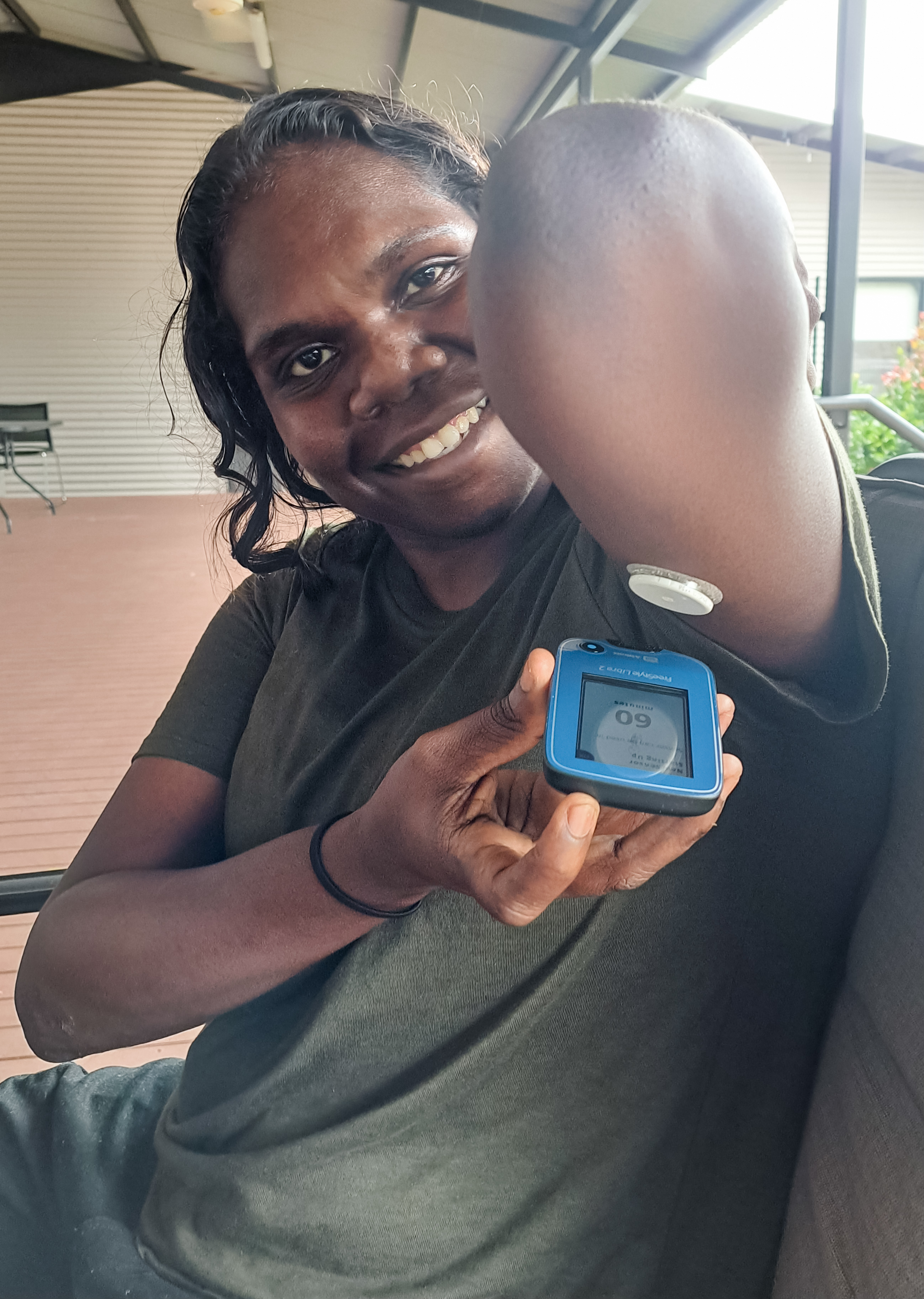
However, last year, she started using the FreeStyle Libre 2 continuous glucose monitoring (CGM)4 system, a wearable sensor that continuously measures glucose levels, displaying real-time readings on your smartphone.
With customisable alarms, as well as generated reports, it is a life changer for Edwina.
"There's nothing I miss with the CGM. It is so easy to check," she says. "I can see my sugar levels, and it tells me everything I need to know.
"It takes the worry out of my life."
While the National Diabetes Services Scheme (NDSS) subsidises CGM systems for 130,000 Australians living with type 1 diabetes, there is no such subsidy for people living with insulin-requiring type 2 diabetes who also use insulin daily in a similar manner.
Monitoring systems such as the FreeStyle Libre 2 can cost users up to $2,700 annually, a huge expense for many across the country, even more so in remote and regional areas.
Edwina and her younger brothers sporadically access CGMs from Wurli-Wurlinjang Health Service, where she now works as a Youth Diabetes Peer Support Facilitator - but she can't afford the expense independently.
She is terrified of how her brothers will access this technology in the future.
Along with thousands of others, she has been calling on the government to provide NDSS subsidies to cover CGMs for people living with insulin-requiring type 2 diabetes, a point recommended by the Government's recent inquiry into diabetes.
Edwina participated in the inquiry, sharing the challenges of shopping at the local supermarket and purchasing nutritious produce for her sibling's diabetes management.
Over 300 days since the recommendations, there has been no action.
"There is a significant positive impact of using CGMs when living with type 2 diabetes, irrespective of therapeutic intervention, and the ADS is advocating for equitable and affordable access to CGM for all people living with type 2 diabetes," Australian Diabetes Society (ADS) chief executive Dr Sof Andrikopoulos said.
"The Parliamentary Inquiry recommended subsidised CGMs for people living with insulin-requiring type 2 diabetes. This is very sensible, and I encourage the government to implement and fund this recommendation."
For Edwina, she continues to help others who experience diabetes.
Every month, she runs a group session at Wurli-Wurlinjang Health Service along with other young Indigenous Australians in Katherine who require support with diabetes management, alongside her Credentialled Diabetes Educator (CDE).
"I do it for the community," she says.
"It is important for me that young people can educate themselves about diabetes management. So many people need help."



