




Prisoners being denied parole due to a lack of access to rehabilitation programs will lead to more "entirely avoidable" deaths in custody, a leading Western Australian barrister says.
It comes as the ABC reported Corey Devree, who took his own life earlier this month, had been eligible for parole for more than four months but hadn't been able to enrol in a family and domestic violence course - a condition of his release.
His brother-in-law said he was "depressed" in the weeks before he passed.
"When I saw him last time, he was just so quiet, so slow speaking. [He] didn't even say 'see ya' at the end of the conversation," Damon Pelham told the ABC.
In a letter seen by National Indigenous Time and addressed to all members of state parliament, Steven Penglis SC highlighted the similarities of Mr Devree's situation with 30-year-old Noongar and Torres Strait Islander man, Jomen Blanket, who was found dead in Serco-run Acacia Prison in 2019.
His mother Karen Blanket alerted authorities after receiving a phone call from her son in which he said he was going to kill himself, but the call was not referred to the Prisoner Risk Assessment Group (PRAG).
"Someone at least could have attended to him, given their attention after the phone call," she said in 2022.
Mr Penglis, who is representing the family of 16-year-old Yamatji boy Cleveland Dodd, who died in custody in 2023, also wrote to all members of state parliament last year, and highlighted Coroner Urquhart's findings in Mr Blanket's inquest, which he argued had seemingly not been implemented.
"So yet again I find myself writing to you repeating what I said in my letter of 26 October 2023, albeit in a different context, namely that if the State Government and the Department of Justice do not fully implement the recommendations of Coroner Urquhart referred to above, it is inevitable that there will be more entirely avoidable deaths in custody," Mr Penglis said.
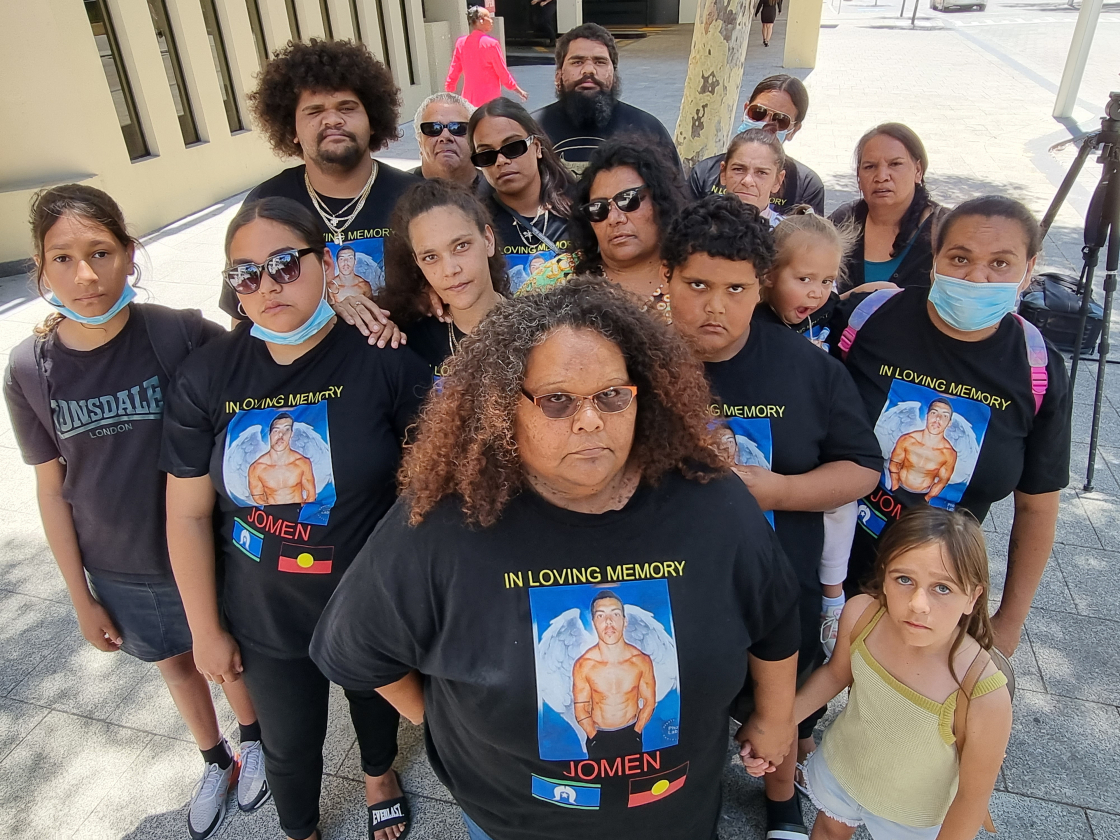
Jomen Blanket's mother, Karen, outside of the inquest in 2022 Photo credit: Giovanni Torre
In his findings, Coroner Urquhart said Mr Blanket was denied parole because the Department of Justice and Serco had failed to complete an individual management plan (IMP) and in turn, because he had "not been assessed for treatment interventions and therefore has not had the opportunity to address his offending behaviour".
"[T]he vast majority of prisoners who are sentenced to 12 months imprisonment or less are not having an initial IMP prepared for them," he said.
"I feared the outcome for these prisoners, like it was for Mr Blanket, was that they are regularly not being granted parole by the Board and that a commonly cited reason is due to 'unmet treatment needs'."
Furthermore, he argued a situation should "not arise" where a prisoner genuinely committed to rehabilitation was denied the chance of participating in said programs due to waitlist demands.
"The situation that Mr Blanket faced did not measure up to the commitment made on Department's website page under the heading, Rehabilitation and Services: Corrective Services: 'While the Department provides offenders the opportunity to take part in programs and interventions, it is ultimately up to the individual to change'," Coroner Urquhart said.
"What actually also needs to change is the length of the waitlists for many of the programs that are available for short-term prisoners."
There have been at least 576 Indigenous deaths in custody since the 1991 Royal Commission into Aboriginal deaths in custody.
18 First Nations people have died in custody this year.
Last week, a 46-year-old Indigenous man was found unresponsive in his cell in Casuarina Prison.
The inquest into Cleveland's death has revealed inadequacies, failures and a litany of lies in the Justice system, which has seen the state government and department routinely push blame onto one another.
"As I see it, the problem with governments and bureaucracies is that issues are regularly identified as being someone else's problem or the solution being for someone else to figure out and/or implement," Mr Penglis said in his letter last year.
A year on from his original correspondence, he said it appeared another suicide by a prisoner related to parole being denied had taken place inside a WA prison, with the inmate being unable to access a relevant offender program a possible contributing factor.
He said the situation existed where inmates can't return to society when they might otherwise be allowed to due to their inability to complete programs; but also, one where prisoners were released into the community at the end of their full term of imprisonment with unmet treatment needs.
"These are not new issues," Mr Penglis said.
"Lack of adequate services/programs and the backlog of IMP's have been squarely on the Department's and the State Government's radar for many years, including through numerous reports tabled in State Parliament by the Office of the Inspector of Custodial Services."
"Adequate resourcing and political will are necessary preconditions to resolving these issues."



