


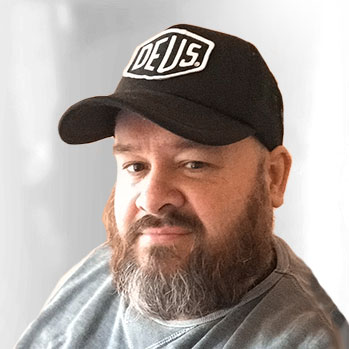
Should Melbourne be Adrian Dodson-Shaw's final marathon, there is no finer tribute to the novice runner turned coach's interrupted yet inspirational legacy than one last lap of the MCG.
The 41-year-old proud Kaytetye, Yawuru and Arrernte man capped off the impressive performance in less than four hours after running four world marathons within his first four years of completing the routine 42.195-kilometre distance.
The one-time Indigenous Marathon Foundation mentor was the 35th Aboriginal man to finish their New York City race to end the 2014 training from scratch, following in the footsteps of best mate, Charlie Maher, its first warrior to cross the line in Rob de Castella's inaugural project.
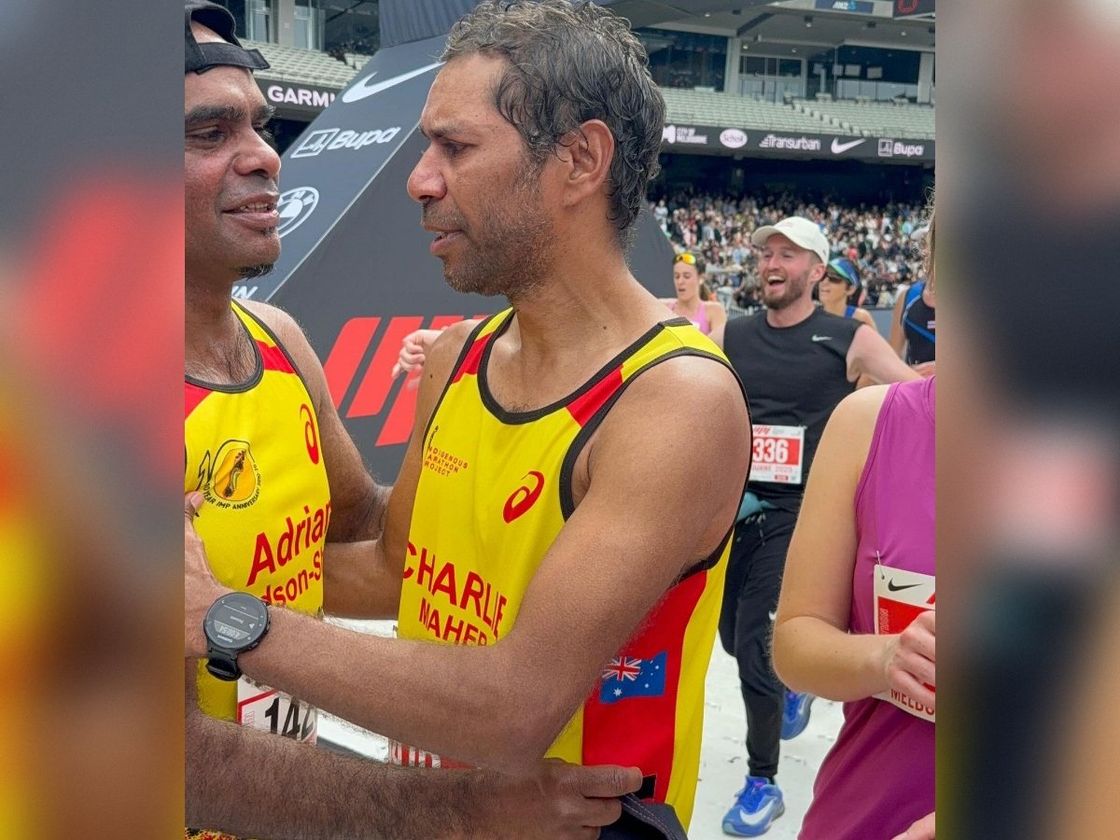
But in a turnaround of history between the Alice Springs-raised pair, it was Dodson-Shaw that finished the 2025 Melbourne Marathon in the time of 3:59.53, just one minute and 38 seconds ahead to present the race's completion medal to Maher.
"We say that the MCG is the Holy Grail, especially being a footy fanatic, but finishing your first marathon after seven years at 41, and to do a marathon again with Charlie and with other IMF runners around you on the oval was really pretty powerful," Dodson-Shaw told National Indigenous Times days after the feat.
Dodson-Shaw eyed off at least one graduate on the bitumen from every squad that he coached from 2017 until 2020 during the marathon.
Melbourne was also the first time Dodson-Shaw and Maher ran a marathon together since they ran a 2018 marathon in Chicago.
Maher watched Dodson-Shaw weave through the five boroughs of New York's famed race back in 2014.
"It's quite mad - I mean, I have only done a couple of 'halves' (marathons), but to run one of the traditional, full marathons after those seven years is just mad," Dodson-Shaw said.
"I mean I couldn't run a marathon for some time, though this is only my fifth, but to do this seven years on, and to finish with Charlie, is just special for me.
"After his eight marathons and to finish a few minutes before him, and to be able to give him his medal was just nice, being my best mate and all."
The initial plan was to run the London Marathon with Maher, who months later in Sydney completed the final leg of all seven world majors that included in the UK capital.
But the Canberra public servant, the son of retired Federal Senator Pat Dodson, was not quite in the right frame of mind, let alone the right size as the middle-aged father of two boys.
He trimmed down for Melbourne from 98 to 82 kilograms to physically and mentally demonstrate a remarkable commitment, even before even stepping up to the start line.
"When you put it into an age perspective, you are a lot different when you're 34 to when you're 41," Dodson-Shaw said.
"I've been very lucky with my body when I train: my body responds and I can get pretty fit.
"It's only from running I get fit, and I don't get fanatical around diets, and I don't get out there running routinely either."
The burden of enduring a marathon again began to lift when he headed back to Mpartnwe (Alice Springs) and met a couple of Aboriginal footy heroes.
The turning point that had Melbourne appearing on the horizon was joining the retired Lance 'Buddy' Franklin, 38, with inspirational Johnathan Thurston, 42, on the way to training to their own first marathon with several other lucky IMF participants for New York City on November 2.
"I was on the fence to do Melbourne or not at that stage, but then I did a couple of training runs first and I got out to the Alice Springs camp with the squad, Buddy and JT, and I did the 30 (kilometre trial) and I thought, 'I am a chance here'," Dodson-Shaw laughed.
"So, I completed that and basically two-and-a-bit weeks later, I knuckled down again and had a real crack at training."
Dodson-Shaw had only two "solid" runs, including a pre-race half-marathon test, to prepare for the comeback.
But the outcome of the other two of his previous four marathons would fill Dodson-Shaw with a rare confidence that his mind could cope with anything his body would throw at him.
The year after debuting in New York City, Dodson-Shaw accepted a once-in-a-lifetime invitation and lined up at the 2015 North Pole Marathon in the Arctic Circle.
He was the first Australian Aboriginal person to not only race at the North Pole, but also the first to step foot onto the icy surface at the top of the world.
It is a marathon with a difference, other than just its course of 12 laps of a near 3.5-kilometre circuit.
Not too many customary marathons require snipers dotted around the course to protect runners from the dangers of polar bears on the attack, a little more of a distraction than kangaroos on a training run across the Australian outback.
The running surface on the frozen Arctic Ocean is a cross between slippery hard ice and knee-deep snow that takes every measure of energy to finish.
To simulate conditions, Dodson-Shaw had trained on the shifting surfaces of sand dunes in the Darwin humidity, with the nearby presence of saltwater crocodiles acting as de facto polar bears minus the firearms.
The next challenge was the 2017 Volcano Marathon in the Andes Mountains of Chile.
It was his second run that was classified an 'extreme' marathon where the distances were the same as New York City, Chicago or Melbourne, but Dodson-Shaw best described them as "marathons on steroids".
"It's a traditional marathon, but the environment on those marathons are very tricky," he said.
"Both are gruelling, but it's really hard to pick one that's tougher.
"I like Volcano marathon because you're travelling more like the desert back here (in Australia), but the elevations were just nuts.
"North Pole was just so cold while doing the 12 loops is bananas and I did it over eight hours.
"That's more of a slow grind because I really had stop and go on chains, grind to push it out. You're literally running on iced water and it just so thin but hard."
But it's the Melbourne Marathon that will hold Dodson-Shaw's heart forever. It was the race that really pushed his self-belief again.
"You never forget your first and those other two you never forget the impact you have with other people internationally to share your story, being an Aboriginal fella.
"I think that story was more about my own journey.
"Melbourne, seven years down the track, was about my comeback."



